


Impact of COVID19 on education
Sadaket A Malik
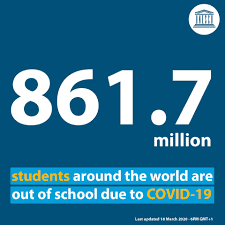
The ongoing COVID 19 has by and large created a flatter among the strong academic community around the globe making a paradigm shift from Conventional classroom to the e classroom, m learning, digital learning, tele-based education and video conferencing or we can say the Google classroom. The international organisations like UNICEF has come up with almost a Dozon of guidelines for the schools, staff, administrators and the students/Children in order to keep the students safe which include following of basic principles, safe operations, know the basic facts about this deadly virus, including symptoms and implications, Update or develop school emergency and contingency plans. Work with officials to guarantee schools are not used as shelters, treatment units, etc. Reinforce frequent handwashing and sanitation and procure needed supplies, social distancing which include cancelling of assembalies, establishment of procedures if the students and staff are unwell, promote information sharing with national and local health and educational authorities, adopt school policies if appropriate, Implement school absenteeism monitoring systems to track student and staff absence and compare against usual absenteeism patterns at the school, plan for continuing of learning and access to quality education, this includes use of online learning, Assigning reading and exercises for home study, Radio, podcast or television broadcasts of academic content,Assigning teachers to conduct remote daily or weekly follow up with students and Review/develop accelerated education strategies, implement of targeted health education, address mental health/psychological support needs and support to vulnerable populations by working with social service system.
In the country like ours, the government and other autonomous bodies at national and state/local level are veering to have a similar guidelines and schemes viz a viz procedures for school teachers and other stakeholders. The union Ministry of HRD has come up with a vital agenda to teach the students online or through e classes to cope up with the learning that they recieve in conventional school system in such a situation perpetuated due to the COVID 19 pendemic. The students can use such 10 online resources by the Ministry of Human resource Development Government of India to grasp the content of their study through different modes.
There are many online education websites initiated their content for free now and students who are sitting at home can make full use of this learning material.
UGC has advised the students to use their online education websites to study for free during the Coronavirus lockdown. The HRD Ministry initiatives that can teach you for free are –
1. SWAYAM Online Courses: SWAYAM Online Courses provide complete access learning online resources. These resources were earlier delivered on the SWAYAM platform. Students or learners who registered on SWAYAM (swayam.gov.in) in the January 2020 semester can continue their learning as usual.
2. UG/PG MOOCs:UG/PG MOOCs provides learning material of the SWAYAM graduate and Masters courses.
3. e-PG Pathshala:e-PG Pathshalahosts high quality, curriculum-based, interactive e-content containing 23,000 modules (e-text and video) in 70 Post Graduate disciplines of social sciences, arts, fine arts and humanities, natural & mathematical sciences are also provided online.
4. e-Content courseware in graduade subjects: e-Content courseware in 87 Undergraduate courses with about 24,110 e-content modules is available on the CEC website at http://cec.nic.in/.
5.SWAYAMPRABHA:Swayamprabha is a group of 32 DTH channels providing contents covering diverse subjects such as arts, science, commerce, performing arts, social sciences and humanities subjects, engineering, technology, law, medicine, agriculture, etc to all teachers, students and citizens across the country interested in lifelong learning.
6. CEC-UGC YouTube channel:CEC-UGC YouTube channel provides access to lectures absolutely free for the students.
7. National Digital Library: National Digital Library is a digital repository of a huge amount of academic content in different formats and provides interface support for leading modern Indian languages for all academic levels including researchers and life-long learners, all disciplines, all popular form of access devices and differently-abled learners.
8. Shodhganga:Shodhganga is a digital repository for research students to deposit their Ph.D. theses and make it available to the entire scholarly community in open access.
9. e-Shodh Sindhu:e-Shodh Sindhu provides current as well as archival access to more than 15,000 core journals and a number of factual databases in different disciplines from a large number of publishers and aggregators to its member institutions including centrally-funded technical institutions, universities and colleges.
10. Vidwan:Vidwan is a platform of experts which provides information about resource persons to peers, prospective collaborators, funding agencies policymakers and research scholar in the country. Faculty members are requested to register on the Vidwan portal to help expand the database of experts.
There are several other Information technology enabled initiatives of the MHRD, UGC and its Inter-University Centres (IUCs) – Information and Library Network (INFLIBNET) and Consortium for Educational Communication (CEC), in the form of online platforms. These portals can be accessed by the teachers, students, and researchers.
These ICT initiatives, which cover a broad range of subjects and courses, have been prepared by experts for providing an excellent learning experience to all. Meanwhile another initiative launched by IGNOU is egyan kosk that too can help the students. In the union territory of Jammu and Kashmir and even Ladakh, the education department has initiated a multi folded strategy to provide the students education online or in e way of learning so that students can complete the task assigned by the teachers during the lockdown days. The online and Google classroom initiated by the teachers and schools in Jammu are highly hureculean and will certainly provide access to the students community online during this pendimic. The state education departments Jammu and Kashmir Knowledge Network JKNN has a specialist expert teachers who deliver lectures online to the students.
Lo and behold, what we need is to keep in mind the hygiene at the home and other peer groups and sharing and caring can make a difference in overcoming this deadly pendimic. The directives of the UNICEF for students teachers and Community at large are praise worthy and need to be imbibed. The private agencies and private players who are providing free online coaching need a special mention here and students should get advantage of these besides the initiatives taken by the respective schools and people education sector.


The Chenab Times News Desk