


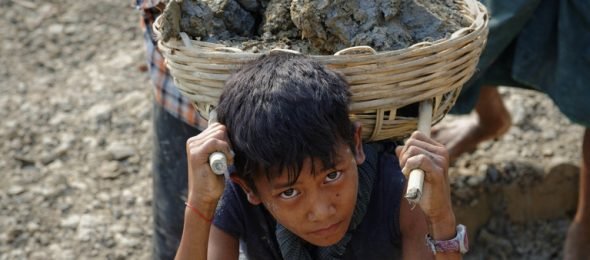
Childhood is considered to be the golden period of one’s life, but this doesn’t hold true for some children who struggle to make their ends meet during their childhood years.
Child labour means employment of children in any kind of work that hampers their physical and mental development, deprives them of their basic educational and recreational requirements. Children are employed in hazardous occupations such as bidi rolling, the cracker industry, the pencil, matchbox, and bangle manufacturing industries, and so on. The young and immature minds of children find it difficult to cope with such situations, leading to emotional and physical problems.
Employers also prefer child labourers because they can extract more work and have to pay a less amount. Based on my personal observations, as a resident of Chenab Valley, I am surprised that it has become common practice to use small children in households without regard for their age.
As an example, I once stayed with a family in Jammu.It was a chilly winter’s morning, near around 5 ‘o clock in the morning, and an 11-year-old boy was cleaning the lobby with cold water. When I discussed this issue with one of the members of that family, they reverted. These kids are meant for work, and ours are from the elite strata. Anyway, this is what we are looking around and experiencing.
In the fight against child labour, the government has a crucial role to play. Because poverty is one of the leading causes of child labour, the government must ensure that all citizens have access to basic services. It must create enough jobs to ensure that the poor can find work. The government’s initiative to provide free education to all children aged 6 to 14 years should be made known to parents and children. Children are a country’s future citizens. A country full of impoverished, illiterate children can not progress. If child labour is to be eradicated from India, particularly in our region, it is imperative that the machinery for enforcing the various laws on child labour be expanded.
The recent amendments to the Child Labour (Prohibition and Regulation) Act, 1986, show a lack of national commitment to the abolition of all forms of child labour. Rather than attempting a legislative overhaul that has proven ineffective in curbing the phenomenon, Parliament has allowed children as young as 14 to work in ‘family enterprises,’ and has created a new category of ‘adolescents’ (those aged 14 to 18) who can work in ‘non-hazardous’ occupations. The amendments tweak the law in such a way that children are available for employment in some form or another in the name of acknowledging India’s socio-economic realities. Their only educational concession is that they are only allowed to work in family businesses outside of school hours and during vacations. Surprisingly, the main amendment, which prohibits children under the age of 14 from working in any occupation, is being promoted as a progressive step forward from the previous ban, which was limited to certain occupations and processes. It should not be forgotten that, since the passage of the Right of Children to Free and Compulsory Education Act of 2009, every child has a legal obligation to complete elementary school. The exemption for family businesses effectively maintains the conditions under which children are forced to work while studying. Working outside of school hours to supplement the family’s income will almost certainly have a negative impact on the children’s health and learning ability. Regulation will be difficult to enforce because it will be difficult to tell whether a single family is running a business or if a faceless owner has hired a single family to get around the law. A higher dropout rate will be the result. They may attend school for a few years while also working with their families, and then graduate to full-time adolescent workers without having completed elementary school. The NDA government, like its predecessor who proposed the amendments, appears content with merely adhering to ILO Conventions 138 and 182. The former requires compulsory education until the age of 15, but allows countries with insufficient educational facilities to reduce it to 14, while Convention 182 prohibits children from being employed in “the worst forms of labour.” Simple adherence to international standards is insufficient. Children from poor and marginalised communities, particularly Dalits, are still at risk of losing both their childhood joys and their constitutional right to education. It’s yet another stark reminder that the country is still a long way from eliminating child labour entirely.


An Author/Writer at The Chenab Times