


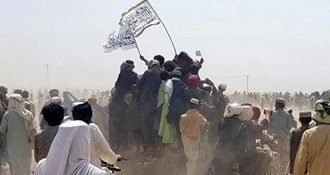
The Taliban claimed to have taken Kandahar, Afghanistan’s second-largest city, on Friday, leaving the government with only the capital and swaths of other area.
“Kandahar has been entirely taken over. The Mujahideen arrived at the city’s Martyrs’ Square “A local told AFP that government forces appeared to have withdrawn en masse to a military facility outside the city, according to a claim made by a Taliban spokesman on an officially recognised account.
A resident confirmed the report, telling AFP that government forces appeared to have withdrawn en masse to a military base outside the southern city.
Following an eight-day blitz into metropolitan centres by the Taliban, the Afghan government and its US backers have virtually lost control of the vast majority of the country.
The offensive began after the US and its allies withdrew almost all of their forces from Afghanistan, with President Joe Biden keen to bring the two-decade-long war to a close by September 11.
There are no regrets.
Biden has insisted he has no regrets with his decision, but the speed and ease of the Taliban’s urban victories in recent days has been a surprise and forced new calculations.
On Thursday night, Washington and London declared plans to immediately remove their diplomatic employees and other people from the city.
“In view of the deteriorating security circumstances,” US State Department spokesman Ned Price told reporters, “we are further decreasing our civilian footprint in Kabul.” The embassy, though, would stay operational.
“This isn’t a case of abandonment. This isn’t a mandatory evacuation. This isn’t a complete detox.”
The Pentagon announced that 3,000 US troops will be deployed to Kabul in the next 24 to 48 hours, but that they would not be used to battle the Taliban.
Ben Wallace, Britain’s defence secretary, said the country would send 600 troops to rescue its citizens and former Afghan personnel.
Price added that the US would begin sending daily planes into Afghanistan to evacuate Afghan translators and others who supported the Americans.
‘They laid down their arms,’ says the narrator.
Since May, when US-led forces began the final step of their troop departure, the fighting has increased drastically.
After months of capturing less strategically significant rural areas, the Taliban turned their attention to the metropolis.
In the last week, the militants have gained control of a dozen provincial capitals and encircled the country’s largest city in the north, Mazar-i-Sharif, which is now one of the last remaining anti-Taliban strongholds.
Pro-Taliban social media sites boasted of the massive spoils of war retrieved by their warriors in recent days.
They’ve shared photographs of armoured vehicles, heavy weapons, and even a drone taken from abandoned military outposts by insurgents.
After weeks of siege, government soldiers withdrew from Herat, an ancient silk road city near the Iranian border, and retreated to a district army barracks on Thursday.
Masoom Jan, a Herat local, told AFP that the city’s fall was sudden, and that the Taliban were to blame “In a hurry, I entered the city. Everywhere they went, they waved their flags.”
The fall of Ghazni, roughly 150 kilometres (95 miles) south of Kabul and along the main highway to Kandahar and the Taliban heartlands in the south, was also announced by the interior ministry on Thursday.
Qala-i-Naw, the capital of Badghis province in the northwest, also surrendered on Thursday, according to a security source.


The Chenab Times News Desk