


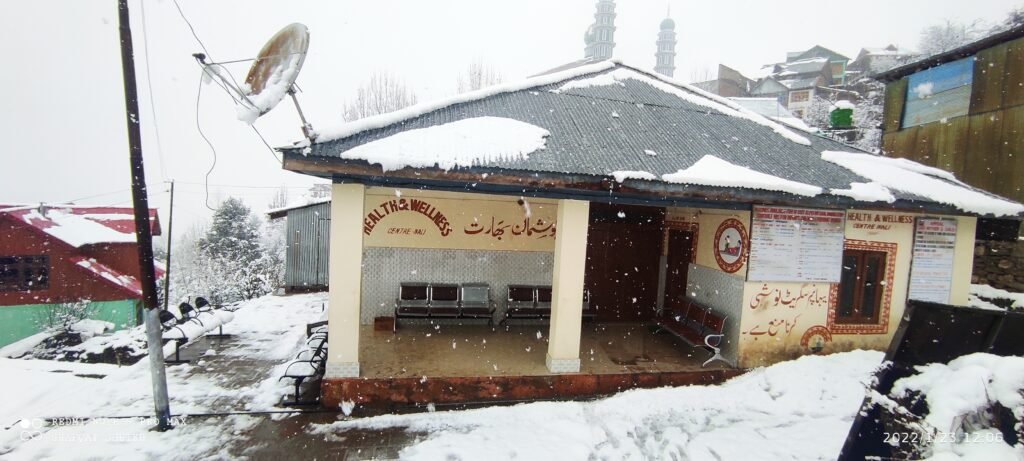
The lack of proper healthcare infrastructure – centres, doctors and paramedical staff in several remote villages in Kishtwar district of Jammu and Kashmir has made lives of residents of this hilly region difficult. Left with no option, they are forced to travel 200-250 km all the way to Jammu, even for basic treatment. The Primary Health Centre (PHC) Nali in Bunjwah region of this district is the right example. Here, patients are treated in open area as the PHC lacks basic built infrastructure, staff, and medical equipment to cater to the patients.
The PHC Nali was set up in 1980 in a small space. It took authorities to almost two decades to expand the infrastructure. Some rooms were added to the centre in 1999. It’s been over two decades since, the infrastructure remains as is – running with limited, old facilities making it almost impossible for the existing employees and doctors to handle the increasing patient rush.
At present, the PHC has five rooms- Medical Officer’s room, a labour room, a laboratory, one dental section, and an emergency room. Besides, the beds are often shared by two to three patients at one time. Even after so many years, the PHC still lacks the ability to provide proper services without compromising the dignity of the people of this distant region.
Expressing the difficulty faced while catering to the needs of the patients, Dr. Haroon Rashid Bhat, the medical officer of PHC Nali, said, “With the current strength of staff members and accommodation, it is difficult to run the PHC during night hours and in cases of sudden emergencies. Moreover, the rise of Covid-19 has further highlighted the gaps in the PHC’s operations.”
Noor Din, a local from the region, recalls how as a young child he would visit the PHC with his parents. “Today, I bring my own child to this centre but, unfortunately, nothing has changed. In 2012-13, the administration had made an announcement to provide a 20-bed hospital while also improving the existing health centres in Bunjwah on priority basis. But to our dismay, nothing has happened,” he rued.
Social Activist Ashiq Wani informed that during 2010–11, 10 kanal of land was acquired for the construction of a separate block, but, till date, no action has been taken. Moreover, according to him, the district administration has been requested to upgrade the PHC to a Community Health Centre and to add more staff, separate blocks, X-ray, ECG, blood bank, and other health facilities.
“During the Covid-19 pandemic, the shortage of space, medicine, and oxygen cylinders had completely hampered the life of a common public in rural regions, as they were only living at the mercy of God,” Ashiq further added.
Complaints are regularly made by the people, social activists, and NGOs, but the concerned administration is yet to address the issue. In times of disasters, people need immediate treatment, but without any proper medical arrangements, their lives are often at stake. Moreover, the unwillingness of health professionals to work in a remote area also affects the functioning of an adequate health centre. This requires the administration to take appropriate steps to improve the healthcare facilities of people living in far-flung areas of Bunjwah. Locals should also be consulted while strategizing the action plan to address the issue.
(The author is a freelance columnist and have written various articles for The Chenab Times already but this article is featured via Charkha Features)

