


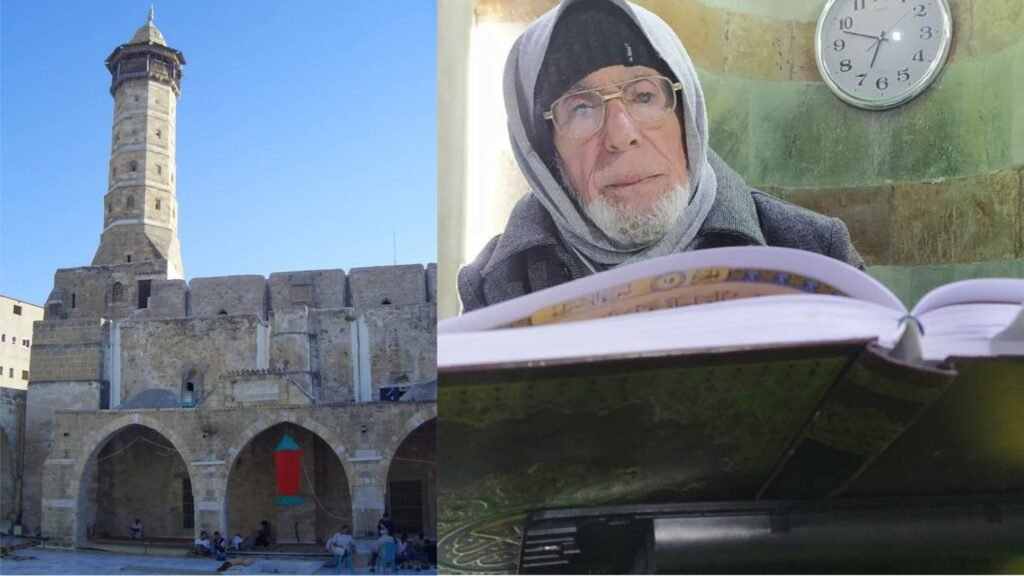
For more than half a century, the Palestinian Abu Husam Haniyeh has been linked with the muezzin of the Great Omari Mosque in Gaza City, Palestine’s second oldest masjid after Al-Aqsa Masjid in Jerusalem.

Haniyeh, 85, began his adventure as a volunteer with the call to prayer. According to data from the Ministry of Waqfs and Religious Affairs, he is now the Gaza Strip’s oldest muezzin, according to Arab News.
Haniyeh remembers the first time he took to the microphone at the Omari Masjid and shouted the call to prayer, many decades ago, after obtaining permission from the former authorised muezzin.
When I started as a muezzin, I did not expect that my life would extend for all these years and my name would become associated with this great ancient mosque.
Abu Husam Haniyeh, Oldest muezzin in the Gaza Strip
“It was a wonderful experience that I will never forget, and after the death of Abu Al-Said I succeeded him as the authorized muezzin.”
Until the foundation of the Palestinian Authority in 1994, and his reliance on muezzin records in the Ministry of Waqfs for around $155, Haniyeh remained a volunteer, raising the call to prayer for the five daily prayers.
“I do not seek the reward of this life, for the muezzin’s recompense is with God, and his reward on the Day of Resurrection is immense…” “We are the muezzins, God’s voice on earth,” he explained, “and we summon people to worship and abandon the joys of this life.”
The muezzin spends all of his time in the Omari Masjid, which is adjacent to his home in the ancient district of Al-Daraj in old Gaza, and only leaves for brief periods to spend time with his family.
He finds solace in the mosque, especially during Ramadan, where he studies the Qur’an and converses with other members of his generation, reminiscing about his youth.
Haniyeh was born into a refugee family that was forced to flee Jaffa during the 1948 Nakba.
Following the Nakba, he did not return to school, and his family took safety in Gaza City. Haniyeh later married and had three sons and three daughters while working as a carpenter.
“I wish to return to Jaffa, and to raise the call to prayer in the blessed Al-Aqsa Masjid,” he said.
“I remember everything from the days when I was in Jaffa, the house we used to live in, my father’s journey by train to Egypt and from there to Saudi Arabia to perform the Hajj, the iftar cannon, and the many friends we used to have. We had fun and played together in alleys and on the beach,” he said.
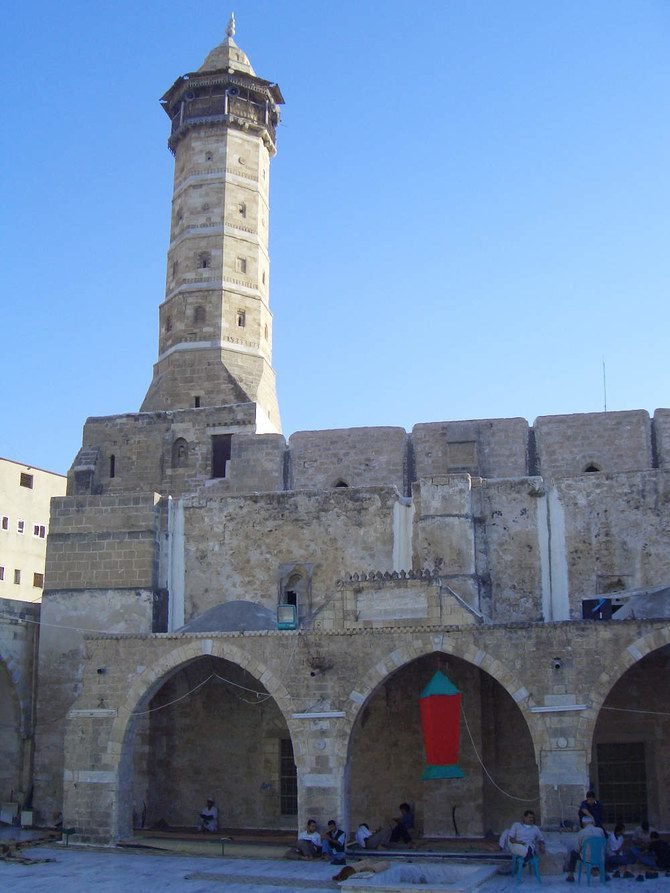
Haniyeh’s long relationship with the Omari Mosque has earned him the title of specialist on the mosque’s history. It is the second-oldest mosque in ancient Palestine, after Al-Aqsa, and the third-largest, after Al-Aqsa and Ahmed Pasha Al-Jazzar Masjid in Acre.
During Ramadan, especially during the last 10 nights of the month, the masjid can seat up to 5,000 worshipers.
The Omari Masjid is 4,100 square metres in size. The first structure on this location, a pagan temple, was built some 3,700 years ago. It stayed thus way until the Romans conquered the Levant in 407 AD and built the “Porphyrios Church” atop its remains.
The church survived until the Islamic invasion of Gaza in 634 AD, when the vast majority of Gazans converted to Islam, with only a few remaining Christians. Residents agreed to build a mosque on the greater portion of the land and a church for the Christian minority on the smaller portion, which still stands today and is known as Saint Porphyrios Orthodox Church.


The Chenab Times News Desk