


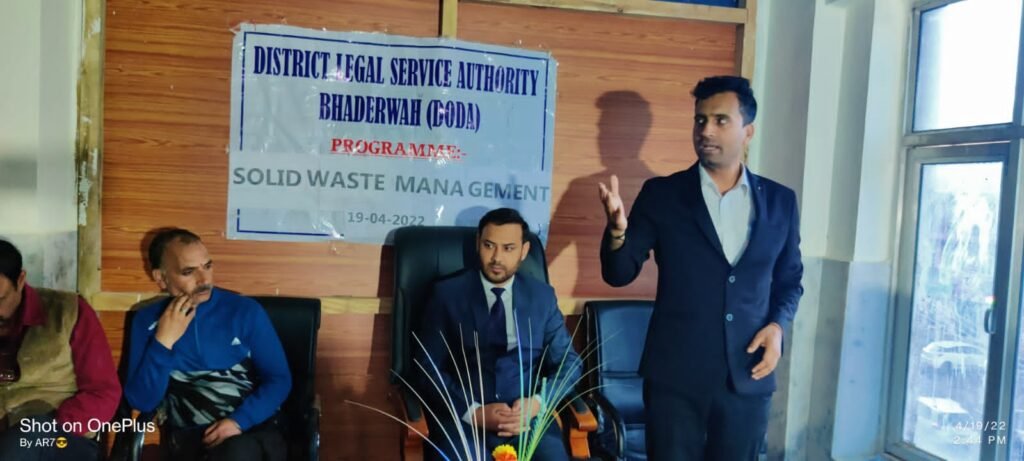
Under the chairmanship of Principal District & Sessions Judge Bhaderwah and under the supervision of Mudassir Farooq, Secretary DLSA, the District Legal Services Authority organised an awareness programme on “Solid Waste Management” and “No Plastic/Polythene usage, Conservation of the Environment” in the premises of Municipal Committee Bhaderwah today.The event was aimed at educating the people of Bhaderwah about the significance of cleanliness and hygiene in our lives for the sustainable development of society, besides ensuring the safety and protection of children in educational institutions.
Secretary DLSA Mudassir Farooq has apprised the people of cleanliness measures initiated by the Center government to make “Clean India, Green India”. He emphasised the complete enforcement of the ban on the use of polythene bags and the proper disposal of both degradable and non-biodegradable waste. He stressed the need for strict adherence to all rules and laws of solid waste management to create a healthy environment. Adv Mohd Majid Malik, who was the resource person on the occasion, also enlightened the gathering on solid waste management and said it is the process of collecting, treating, and disposing of solid waste. He also informed us that in the waste management process, the waste is collected from different sources and disposed of, and this process includes collection, transportation, treatment, analysis, and disposal.
Adv Mohd Majid Malik said there are many sources of solid waste, which include solid domestic garbage , solid waste material from various industries, solid agriculture waste, and medical waste, and he also informed us that around the world, waste generation rates are rising. In 2016, the world’s cities generated 2.01 billion tonnes of solid waste, amounting to a footprint of 0.74 kilogrammes per person per day. He also said that with rapid population growth and urbanization, annual waste generation is expected to increase by 70% from 2016 levels to 3.40 billion tonnes in 2050. Compared to those in developed nations, residents in developing countries, especially the urban poor, are more severely impacted by unsustainably managed waste. In low-income countries, over 90% of waste is often disposed of in unregulated dumps or openly burned. These practises create serious health, safety, and environmental consequences. Poorly managed waste serves as a breeding ground for disease vectors, contributes to global climate change through methane generation, and can even promote urban violence, he added.
On the occasion, Vice President MC Bhaderwah, Rishi Kotwal, President JOB Tahir Nadeem Khan, Sukesh Kumar, Brijesh Yogi and others were also present.


The Chenab Times News Desk