


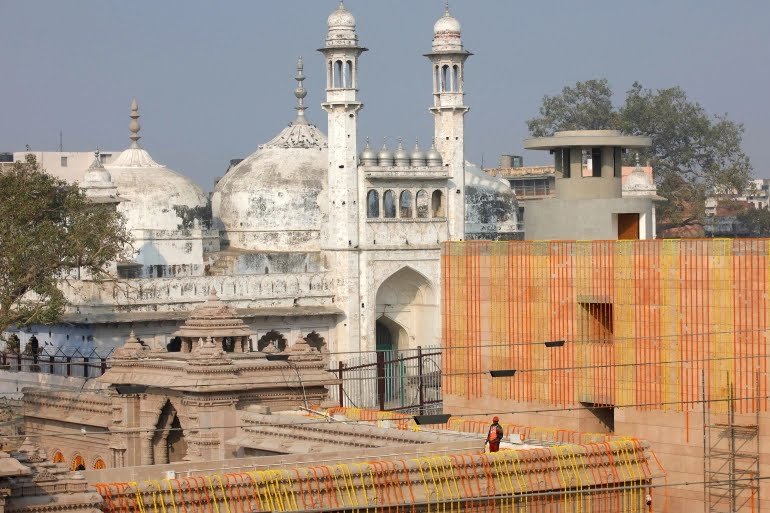
The Gyanvapi Masjid, located near the Kashi Vishwanath Temple in Varanasi, India, is currently undergoing legal proceedings. The two are not only places of worship, but also the city’s most prominent landmarks, located on the Ganges’ bank.
In the Gyanvapi masjid case, the Supreme Court on Tuesday directed the District Magistrate of Varanasi to ensure the protection of the area where a shivling was reported to be found. However, the Supreme Court made no restrictions on Muslims performing Namaz.
“We are not disturbing anything but holding everything in balance,” Justice D.Y. Chandrachud addressed the court after passing the interim order.
“This is a situation when everybody must cooperate,” said Justice P.S. Narasimha, the punsine judge, who also spoke for the judge.
After leaking the Gyanvapi masjid inspection video through a private cameraman, a Varanasi court on Tuesday removed advocate commissioner Ajay Kumar Mishra. The court took a decision when Ajay Kumar leaked the video of the inspecting site secretly through a private cameraman. The video is now viral on social media.
Also, the court has decided that the commission will now function under special commissioner advocate Vishal Singh. Also, the Assistant Advocate General, Ajay Pratap Singh, would work under Vishal Singh.
The committee of management of Anjuman Intezamia Masjid, Varanasi, has submitted a plea in the Supreme Court. The plea was challenging the videography survey—ordered by a local court of the Maas Shringar Gauri Sthal in the complex. The Muslim body contends that it is contrary to provisions of the Places of Worship (Special Provision) Act 1991. Also, the Hindu Sena President has filed an intervention in the apex court, seeking dismissal of the appeal.
The Gyanvapi Masjid is situated in Uttar Pradesh, near the Kashi Vishwanath Temple. Some believe that the structure we see today of the Gyanvapi Masjid is not the same as when it was built. It has undergone multiple reconstructions. Some historians believe that it was during the Aurangzeb era when the temple was first broken down and there was then the construction of Gyanvapi Masjid.
In her book Aurangzeb: The Man and the Myth, author Audrey Truschke wrote: ”My understanding is that Gyanvapi Masjid was indeed built during Aurangzeb’s reign.” The masjid incorporates the old Vishwanath temple structure—destroyed on Aurangzeb’s orders—as its qibla wall (a significant wall facing the Maccah). While the mosque dates back to Aurangzeb’s period, we don’t know who built it. ”
The Gyanvapi mosque dispute came to the notice of the court in 1991, when a petition sought the removal of the mosque and the land must be given back to the Hindu Community.
The petitioners belong to the Kashi Vishwanath Mandir Trust. They claim that the temple was originally built by the Maharaja Vikramaditya more than 2,000 years ago. As per the petitioners, the temple was broken down on the order of Aurangzeb-Mughal Ruler in 1669.
Meanwhile, the petitioners’ lawyers were given a copy of the report, which was provided in a sealed envelope and appears to support the petitioners’ assertions of proof of Hindu idols within the mosque. We are unable to independently verify the report’s accuracy, NDTV reported.
Here are some apparent findings of the report:
- On a pillar in the basement, carvings in the “ancient Hindi language” were discovered.
- A ‘Trishul’ symbol has been discovered on a basement wall.
- Two massive pillars and an arch protrude from the mosque’s western wall.
- The petitioners referred to them as temple ruins, which the mosque committee objected.
- A conical structure was discovered beneath the mosque’s central dome.
- There are lotus engravings on a stone beneath the mosque’s third dome.
- A 2.5-foot-high spherical construction was discovered in a pond used for ‘wuzu.’ The mosque committee said it was a fountain, but petitioners called it a “Shivling.”
All of this does not answer the main question, whether the survey violates the law, specifically the Places of Worship Act of 1991.
The Supreme Court on Thursday directed the Varanasi civil court to desist from hearing the Gyanvapi mosque survey case for a day, as it deferred the hearing to Friday in view of a request made by the lawyer for the Hindu petitioners.


Syed Khalid Niyazi Shah is an author at The Chenab Times.