


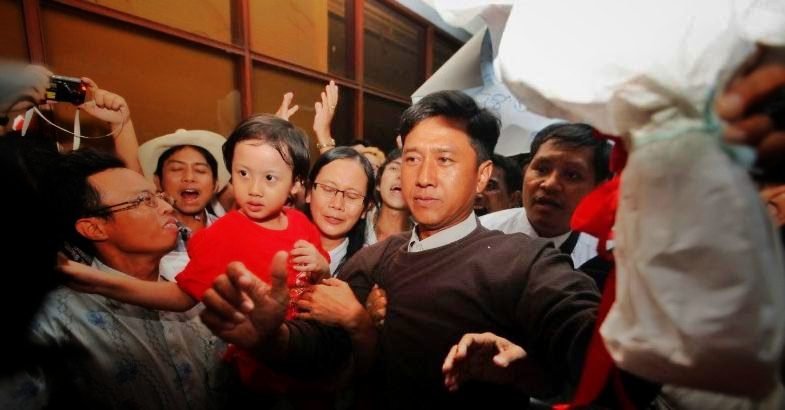
Four democracy activists were put to death by Myanmar’s military junta on Monday, July 25, after they were charged with aiding in the commission of “terror activities,” prompting international outrage of the Southeast Asian country’s first executions in decades.
The four men were found guilty of aiding insurgents in their struggle against the army, which had seized power in a coup last year and had unleashed a deadly crackdown on its opponents, and were given death sentences in secret tribunals in January and April.
The National Unity Government (NUG), a shadow government that the junta outlawed in Myanmar, denounced the deaths and urged on other countries to take action against them.
The spokesman for the NUG president’s office, Kyaw Zaw, sent a message to Reuters saying, “Extremely saddened… condemn the junta’s cruelty.” “The entire world must condemn their barbarism.”
Hip-hop musician Phyo Zeya Thaw and democracy activist Kyaw Min Yu, often known as Jimmy, were among those put to death, according to the Myanmar publication Global New Light.
In June, the 53-year-old Kyaw Min Yu and the 41-year-old Phyo Zeya Thaw, a supporter of the former leader Aung San Suu Kyi, lost their appeals against the sentences. Hla Myo Aung and Aung Thura Zaw were the two other people put to death.
Erwin Van Der Borght, regional director of the rights organisation Amnesty International, said that these executions “amount to the arbitrary deprivation of lives and are just another illustration of Myanmar’s awful human rights record.”
“The four men were found guilty by a military tribunal following incredibly secretive and unfair trials. More than 100 people are reportedly on death row after being found guilty in similar trials, so the international community needs to intervene right away, he continued.
Phyo Zeyar Thaw’s wife, Thazin Nyunt Aung, said she was not informed of her husband’s execution. It was impossible to immediately contact other relatives for comment.
A person with knowledge of the situation claimed that the families of the men had visited the colonial-era Insein prison on Friday. According to the source, just one relative was allowed to communicate with the captives online.
The sentences were later verified to the Voice of Myanmar by junta spokesman Zaw Min Tun after the executions were first reported by state media on Monday. Both failed to provide timing information.
Hanging has formerly been the method of death in Myanmar.
The Assistance Association of Political Prisoners (AAPP), an activist organisation, claimed that Myanmar last carried out a legal execution in the late 1980s.
International condemnation
Zaw Min Tun, a junta spokesperson, supported the death penalty last month by saying that it was appropriate and practised in many nations.
In a letter to junta leader Min Aung Hlaing in June, Cambodian Prime Minister Hun Sen, who serves as chair of the Association of Southeast Asian Nations (ASEAN), expressed the grave concern of Myanmar’s neighbours.
As chair of the ASEAN Parliamentarians for Human Rights, Charles Santiago of Malaysia said, “Not even the previous military regime, which ruled from 1988 and 2011, dared to execute the death penalty against political prisoners.”
This results in yet another rise in the junta’s brutality, which is primarily encouraged by the lack of any effective action taken by the international community to stop it from perpetrating additional crimes.
The executions, which contradict Japan’s repeated calls for a peaceful resolution and its requests to release detainees, according to Japanese Foreign Minister Yoshimasa Hayashi, will further isolate Myanmar.
Since the coup last year, there has been chaos in Myanmar, with violence spreading across the country as the army put down largely peaceful rallies in the cities.
According to the AAPP, security forces have killed over 2,100 people since the coup. That number, according to the junta, is exaggerated.
Since hostilities have extended to more rural areas where ethnic minority insurgent groups are now battling the military, it has been difficult to assess the real scope of the violence.
According to the Arakan Army (AA), a significant ethnic militia in Myanmar’s unrest-ridden Rakhine State, the executions have shattered hopes of any peace agreement.
The AA said in a statement that the executions “wiped out ASEAN members’ efforts toward peace and reconciliation,” adding that they would only “draw braver heroes in the future” and “help to the spring revolution.”
The World Court dismissed Myanmar’s objections to a genocide case last Friday, clearing the door for a thorough hearing on Myanmar’s treatment of the Muslim Rohingya minority.
According to International CRISIS group analyst Richard Horsey, the most recent executions exclude any possibility of putting an end to the unrest in Myanmar.
According to Horsey, who spoke to Reuters, “this is the regime showing that it will do what it wants and listen to no one.” It regards this as a sign of strength, although this could be a serious miscalculation.


The Chenab Times News Desk