


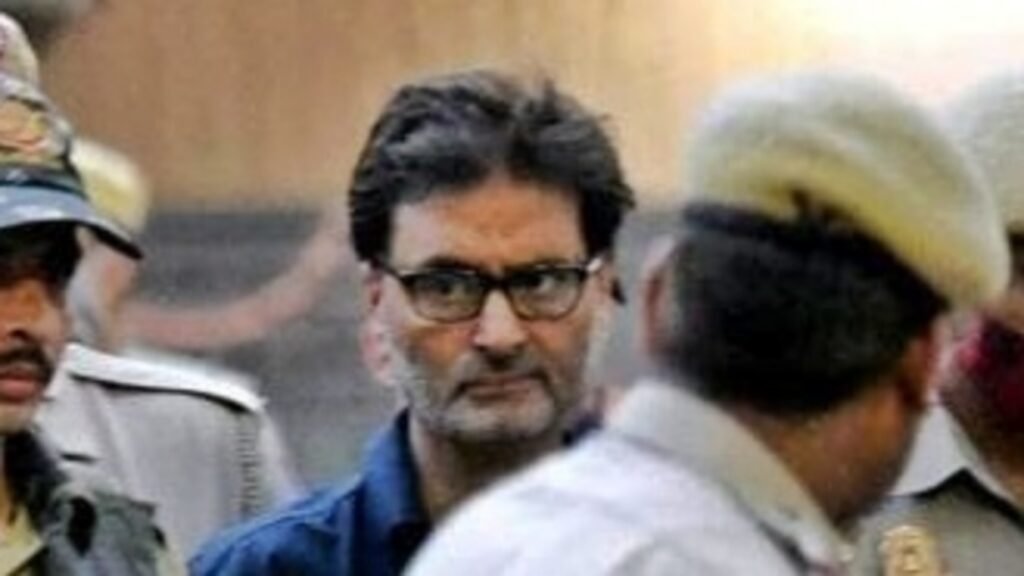
Yasin Malik, the leader of the Kashmiri separatist movement who is currently on a hunger strike since last Friday and is being held in Tihar jail for life in connection with a case involving the funding of terrorism, was admitted to the Ram Manohar Lohia hospital in central Delhi on Tuesday, according to those familiar with the situation.
Due to fluctuations in his blood pressure, Malik, the leader of the banned Jammu and Kashmir Liberation Front (JKLF), was admitted to the hospital.
The jail doctors called the hospital after noticing that his blood pressure was fluctuating. He is brought in to the RML medical centre. We often receive reports from the hospital, according to a prison official. After he refused to end his hunger strike on Sunday, the jail staff moved him to the medical investigation room and started him on intravenous fluids (IV).
Malik, who is currently serving a life sentence in a case involving the funding of terrorism, has been detained alone in a high-risk cell at Tihar’s jail number 7. A week after pleading guilty and being convicted of funding terrorism, spreading terrorism, and engaging in secessionist activities in the Kashmir Valley in 2017, a Delhi court sentenced Malik to life in jail on May 25 of this year.
On Friday morning, the 56-year-old went on a hunger strike after the union government rejected his appeal to be permitted to physically appear in a Jammu terror case in which he is an accused. On Sunday, he was moved to the medical investigation room in Tihar jail, where nurses and physicians were continually keeping an eye on his health.
On July 13, Malik appeared via video conference before a special court in Jammu and stated that he had written to the government requesting a physical appearance before the TADA court in the case involving the kidnapping of Rubaiya Sayeed, the daughter of the then-Union Home Minister Mufti Mohammed Sayeed, in December 1989. He had appeared in connection with the case pertaining to the killing of four Indian Air Force (IAF) officials in 1990.
In front of a special court in Jammu on July 15, Rubaiya Sayeed named Yasin Malik as one of her kidnappers in the well-known kidnapping by the JKLF in 1989.
Malik is one of the most closely watched inmates at Tihar Prison, which holds around 20,000 inmates. Yasin Malin was not given any work within the jail due to security concerns, according to the prison official who was quoted above, despite convicted prisoners typically receiving pay for their labour.
Malik has been convicted under the strict Unlawful Activities (Prevention) Act (UAPA) and Section 121 (waging war against the Government of India) of the Indian Penal Code, making him ineligible for parole or furlough like other prisoners.
The NIA court noted that Malik’s crimes were “intended to strike at the heart of the idea of India” and were “committed with the assistance of foreign powers and designated terrorists” when it handed down the life sentence.
Malik had written a will, according to a second prison officer at Tihar, and given it to his family on July 19 when they paid him a visit.


The Chenab Times News Desk