


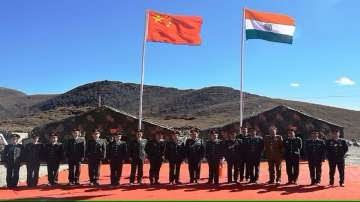
With the upcoming BRICS leaders’ summit in South Africa bringing Prime Minister Narendra Modi face-to-face with Chinese President Xi Jinping, both nations are set to engage in their 19th round of military talks. The talks, scheduled for Monday, aim to de-escalate the prolonged standoff along the Line of Actual Control (LAC) in eastern Ladakh, now entering its fourth year, The Indian Express reports.
The Indian delegation, led by 14 Corps Commander Lt Gen Rashim Bali, will participate in the discussions. The most recent round of talks was held on April 23, preceding the Shanghai Cooperation Organisation (SCO) Defence Ministers’ meeting. During that engagement, efforts were made to address historical friction points along the LAC in eastern Ladakh and to bolster trust between the two military forces.
Officials familiar with the matter have indicated that the upcoming discussions will revolve around confidence-building measures, adherence to border protocols, sharing patrol information to prevent troop clashes, and ensuring seamless communication between ground forces along the LAC and buffer zones.
The urgency of these talks is emphasized by the extended interval of almost four months between this round and the previous one. Notably, this meeting follows recent interactions between the Indian and Chinese Foreign Ministers and National Security Advisors, indicating a collective push to resolve the standoff.
The timing holds significance as well, with Chinese President Xi’s impending visit to India for the G20 summit on September 9 and 10. This summit provides a crucial window of opportunity to make progress in addressing the ongoing border conflict.
Recalling the 2017 Doklam border standoff, it is worth noting that a resolution was achieved shortly before a scheduled meeting between Modi and Xi for the BRICS summit in Xiamen, China.
External Affairs Minister S Jaishankar and NSA Ajit Doval have already held discussions with China’s Foreign Minister Wang Yi, who took over from Qin Gang last month. Wang has played a significant role in negotiating past standoffs between the two countries.
India escalated its stance in July when NSA Doval conveyed to Wang that the LAC situation since 2020 had eroded strategic trust and the fundamental basis of the bilateral relationship. However, in a positive turn of events, India confirmed that the two leaders had discussed the need to stabilize bilateral relations, marking a new direction in their engagement.
Since their meeting in Bali last November, Modi and Xi have exchanged courtesies on multiple occasions, but the resolution to the border standoff remains elusive. Disengagement efforts have led to progress in some areas, yet approximately 50,000-60,000 troops remain stationed on both sides of the India-China border.
In a step forward, both nations had withdrawn troops from Patrolling Point-15 in the Gogra-Hot Springs area of Eastern Ladakh in September of the previous year. Some of the contentious areas, including the Galwan Valley and the north and south banks of Pangong Tso, have witnessed partial resolution through the creation of buffer zones.
The outcome of the upcoming 19th round of military talks holds the promise of de-escalating tensions and paving the way for a more stable bilateral relationship between India and China.
(Inputs from Indian Express)


The Chenab Times News Desk