


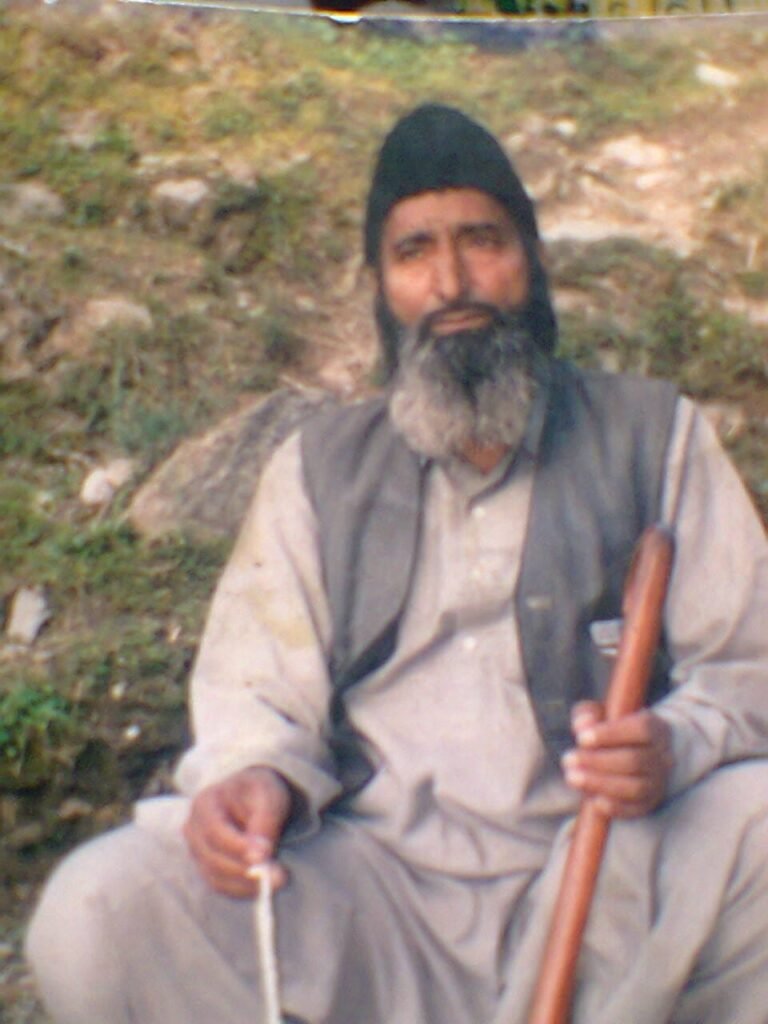
Alhaj Hazrat Ghulam Rasool Owaisi, a Sufi saint of Bhalessa, was born in the village of Dhreveri in Bhalessa, Doda, Jammu and Kashmir on September 1, 1937. Hazrat Ghulam Rasool Owaisi, may Allah be pleased with him, is a prominent figure in the realm of spirituality and Sufi orders. He belonged to the Malik family of Dhreveri in Bhalessa, a remote village situated on a steep slope near Gandoh Bhalessa, where this legendary personality took his first breath. He was the son of Munawar Malik from Dhreveri Bhalessa. His grandfather, Kh. Assad Malik, had migrated from Bhaderwah and settled in Dhreveri, where he earned his livelihood as a tailor, earning respect among the local people. This was an era marked by acute poverty, with limited road connectivity and civic amenities.
Haji Hazrat Ghulam Rasool Sahib was enrolled in an Islamic school (Madrasa) but became an orphan shortly after his enrollment, which hindered his pursuit of formal education. Due to adverse economic and domestic conditions, he had to take care of goats. Haji Ghulam Rasool, who later gained significant respect across society, had an unknown future ahead in the realm of spirituality. He transitioned from a humble shepherd to a spiritual leader, passing through various phases to reach an incredible position. During this journey, the responsibilities of the household rested on the shoulders of his widowed mother. Later, he was able to return to school to continue his education.
In addition to his formal education, Hazrat Ghulam Rasool Owaisi integrated the pursuit of “Khuda shinasi” (Theology) into his life, a path that led him to explore the ways of the Almighty. His mindfulness towards the Almighty began during his school days. He delved into “Deeni Taleemat” alongside his conventional education, and he dedicated nights to fikr i khuda (the search for the Almighty).
During his school days, Haji Sahib would gather young friends and share the path of truth with them. His teachers were pleased with his talent and performance. It’s worth mentioning the names of two revered teachers at the time: Ghulam Rasool Chogani and Mangtoo Khan, both of whom played a significant role in nurturing Alhaj Ghulam Rasool Saheb’s academic talents.
Upon completing his schooling, he began spending nights in Yaad i Illahi (Zikr i Illahi, or remembrance of God), which deepened his spiritual quest. He soon felt the need for a spiritual guide and, after passing his matriculation, was appointed as a teacher in the school education department.
Entry into the Owaisi Silsila (a Sufi order)
Owaisi Tariqat is a form of spiritual transmission in Islamic mysticism, named after Owais al-Qarani, which involves the transmission of spiritual knowledge between two individuals without the need for physical interaction. Those who receive the Sufi spiritual chain from another Sufi without physical contact are referred to as “owaisi.”
During his teacher training, he became friends with Ghulam Mohd Trali, based in Kashmir, who was also a part of the spiritual lineage. Trali shared with him the miracles and teachings of his spiritual guide, Maulana Fazl i Lasani Qutub i Rubani, Alhaj Hazrat Mohammed Amin Sahib Owaisi. Trali’s accounts of Hazrat Amin Sahib Owaisi’s teachings and miracles deeply interested Ghulam Rasool Owaisi, influencing the course of his life.
Trali accompanied Ghulam Rasool Owaisi to the residence of Maulana Fazl i Lasani Qutub i Rubani, Alhaj Hazrat Mohammed Amin Qutub i Rabbani Owaisi (may Allah be pleased with him) in Kasheera Sharief Zangli Lolab, Kashmir, fulfilling Ghulam Rasool Owaisi’s wish. According to Khursheed Dar, Hazrat Moulana Mohammed Amin Owaisi, also known as “Qalandar e zaman,” was a great wali-e-kamil (saint) of his time, and the people in the region were well aware of his living conditions, perfections, blessings, and miracles. This iconic Owaisi mystic was associated with the Owaisi silsila or tradition of Sufism. His resting place in Kasheera Kupwara is a testament to faith and a center of “hanfiyat.”
Ghulam Rasool Saheb, along with Ghulam Mohammed Trali, met this great mystical figure. Khursheed Dar added that the first disciple, Raja Sakhi Wilayet Khan, wrote Hazrat Moulana Molvi Mohammad Amin, Qutub ul Aftab, Owaisi, Qadri, Qalandari (may Allah be pleased with him) in his book “Manazil-e-Faqur.” The same is displayed on the signboard of the holy shrine in Kasheera, Kupwara. It is believed that Raja Sakhi Wilayet Khan, who was a Christian and embraced Islam at the hands of Hazrat Mohammad Amin Owaisi Sahib, became his first disciple.
Spiritual Allegiance of Ghulam Rasool Owaisi
At their first meeting, Maulana Fazl i Lasani, Qutub i Rubani, Alhaj Hazrat Mohammed Amin Sahib, turned towards Ghulam Rasool Owaisi and said, “This man is lucky.” Later that evening, during the Ishah Namaz (evening prayer), Ghulam Rasool Owaisi pledged his allegiance to Maulana Fazl i Lasani Qutub i Rubani, Alhaj Hazrat Mohammed Amin Sahib (may Allah be pleased with him). Bayet (Allegiance) is an act of binding oneself, intellectually or emotionally, to a course of action, commonly practiced in various Sufi orders. Ghulam Rasool Owaisi bound himself to several terms and conditions as per the Sufi order. Subsequently, Ghulam Rasool Owaisi embarked on a path that would impact a large number of people.
Alhaj had hundreds of disciples throughout District Doda who pledged allegiance under the Owaisia Ameenia silsila. There is also a Madrasa named Madersa Owaisia Aminia Dhrevery Bhalessa, providing both conventional and Islamic education to local students, at the premises of Astan Sharief Amin Pura.
Ghulam Mustfa of Bhaderwah, a disciple of Owaisi Sahib, recorded that on June 19, 1962, Owaisi found himself in Madina and witnessed an illuminated substance at the premises of Roza i Pak. Ghulam Mustfa further wrote that Hazrat found himself in Madina on April 14, 1969, and had similar experiences on February 20, 1970, and November 1, 1970, during Tahajjud time. On those days, he had the privilege of witnessing the appearance of the Prophet (peace be upon him) and received divine revelations, which he recorded in a hand
out and shared with Ghulam Mustfa Sahib. He was blessed with unique privileges, such as glimpses of the Prophet (peace be upon him), as well as the opportunity to see Hazrat Yaqoob (AS), Hazrat Ali (RA), Syed Peeran i Peer Baghdadi (Sheikh Abdul Qadir Jeelani), Sultan ul Aarfeen Sheikh Hamza (RA), Hazrat Imam Mehdi, Shah Asrar ud Din Baghdadi (RA), and Shah Fareed ud Din Baghdadi (RA) and his family.
Ghulam Mustfa from Bhaderwah wrote about the detailed life and teachings of Hazrat Ghulam Rasool Owaisi (may Allah be pleased with him). On October 19, 1998, this spiritual figure from Bhalessa departed from this world. Every year, on this day, the Urs (anniversary) of Hazrat Ghulam Rasool Owaisi is celebrated.
For a divine mission, Allah chooses those who possess the capability, and such was the case with Alhaj Hazrat Ghulam Rasool Owaisi. A prolific writer, Alhaj Ghulam Rasool Saheb (may Allah be pleased with him) wrote extensively on Tassawuf (Sufism). His books include “Irfan ba Unwan i Takhleek i Qainaat,” “Shama i Hidayat” (Volumes 1 and 2), and “Roshni ka Minar.” Haji Saheb of Dhrevery also established a Madrasa. He is survived by three sons: Haji Mohammed Iqbal Owaisi, who continues to follow the same Tareeqat and Silsila of Owaisi Sufi order. Notably, Alhaj Abdullah Owaisi is the Gaddi Nasheen (spiritual leader) of Hazrat Owaisi, and many people visit him. Manzoor Ahmed Owaisi has been entrusted with the responsibility of managing Madersa Owaisia Ameenia Amin Pura Dhrevery Bhalessa (Doda). The three sons of Hazrat Ghulam Rasool Owaisi have carried on the legacy of this esteemed saint of their time, Ghulam Rasool Owaisi (may Allah be pleased with him).


Sadaket Malik is a Research Scholar in Centre for Research and Development LPU Punjab, He is based in Bhalessa (Doda) and can be mailed at sadaket.lpu@gmail.com