


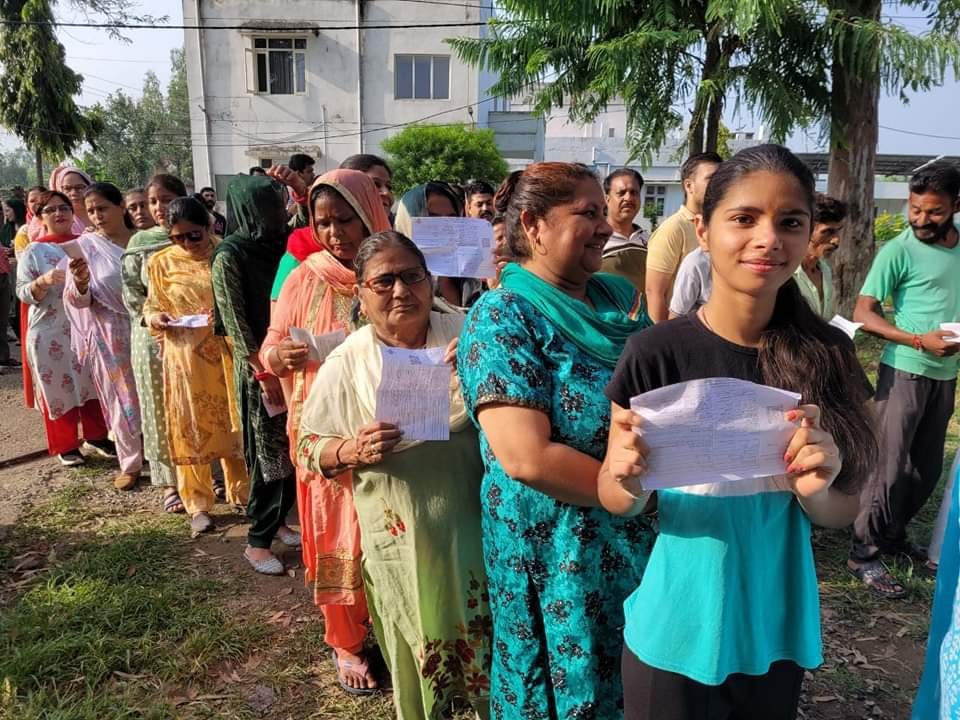
The third and final phase of the Jammu and Kashmir Assembly elections concluded with a robust voter turnout of 65.65%. This marks a critical juncture in the region’s political landscape, as 40 seats across seven districts went to the polls. With a total of 415 candidates in the fray, including prominent leaders like former Deputy Chief Ministers Tara Chand and Muzaffar Beig, the election outcome will shape the union territory’s political future.
Breakdown of Voter Turnout
Polling, which began at 7 AM and concluded at 6 PM on Tuesday, saw significant participation across both the Jammu and Kashmir divisions. Voter turnout in the Hindu-majority Jammu region was notably high, with Samba leading at 73.45%, followed by Kathua at 70.53%, Udhampur at 71.49%, and Jammu itself registering 66.79%. These figures underline the importance of the Jammu division for the Bharatiya Janata Party (BJP), which has traditionally enjoyed a strong base in these districts.
Meanwhile, in the Kashmir division, the turnout was more modest but still significant. Bandipora recorded 64.85%, Kupwara 62.76%, and Baramulla 55.73%. These figures reflect a voter engagement that, while lower than in Jammu, still signals a meaningful participation in the democratic process, especially in a region marked by political volatility and security concerns.
Security Measures and Electoral Significance
Security was tight, with more than 400 companies of paramilitary and police personnel deployed to ensure peaceful polling. This extensive security arrangement reflects the heightened sensitivity of elections in Jammu and Kashmir, where political tensions have often sparked unrest in the past.
The voter turnout across all three phases has been notably strong, with 61.38% in the first phase on September 18, 57.31% in the second phase on September 25, and 65.65% in the third phase. This points to a healthy engagement despite the complex political and security environment.
BJP vs. Congress: A Battle for Influence
The election in Jammu division, comprising 24 of the 40 contested seats, is crucial for both the BJP and Congress. The BJP, buoyed by its strong showing in the 2019 Lok Sabha elections, is aiming for a clean sweep in the Hindu-majority districts of Jammu, Samba, Kathua, and Udhampur. During the 2019 elections, the party led in 22 of the 24 assembly segments in these districts, a dominance it hopes to replicate in this election.
The BJP has centred its campaign on nationalistic themes, particularly the abrogation of Article 370 and its tough stance against separatism. These issues resonate with its base in Jammu but have a more complex reception in Kashmir. The party’s ability to translate these themes into electoral success will be a key indicator of its continued influence in the region.
For the Congress, this election is an opportunity to regain lost ground. The party has focused on local concerns, such as the installation of smart electricity meters, property tax imposition, and recruitment exam irregularities. These bread-and-butter issues have struck a chord with voters frustrated by governance challenges. The Congress is hoping that this localised focus will help it chip away at the BJP’s dominance in the Jammu region, where dissatisfaction over administrative policies could play in its favor.
The Kashmir Division: A Focus on Local Leadership
In the Kashmir division, the electoral dynamics are different. With 16 seats at stake, the region’s political landscape is shaped by local figures like Engineer Rashid and Sajad Lone, whose constituencies have become focal points. Sajad Lone, leader of the People’s Conference, is contesting from both Handwara and Kupwara, while Rashid is defending his stronghold in Langate.
These candidates represent the complexities of Kashmiri politics, where regional leaders play a critical role in mobilizing voters. The BJP’s focus on national issues, such as Article 370, contrasts with the more localized, pragmatic concerns of voters in the Kashmir Valley. How these competing narratives play out in the results will be crucial to understanding the region’s future political direction.
A Divided Landscape
The overall voter turnout and the issues driving the election reflect a deeply divided political landscape in Jammu and Kashmir. In the Jammu division, where the BJP has traditionally held sway, the emphasis has been on nationalism and a strong central government. In contrast, the Kashmir division remains more focused on local leadership and the immediate concerns of governance and development.
As the counting day approaches, all eyes will be on whether the BJP can maintain its dominance in Jammu and make inroads into Kashmir or whether the Congress and regional parties will manage to reassert their influence. The results of this election will not only determine the balance of power in the union territory’s Assembly but also signal the region’s broader political direction in the post-Article 370 era.
The third and final phase of voting in Jammu and Kashmir’s Assembly elections has set the stage for a crucial verdict. With voter turnout reaching 65.65% and key political figures vying for power, the stakes are high. The BJP’s focus on national issues and the Congress’s emphasis on local grievances offer a sharp contrast in electoral strategies. The results, expected soon, will provide a clearer picture of the region’s evolving political dynamics and its future under the new constitutional framework.


Tahir Rihat (also known as Tahir Bilal) is an Indian journalist and online editor at The Chenab Times. Based in Thathri, Doda, he reports on regional affairs, civic governance, and human-interest stories across Jammu and Kashmir. Rihat also maintains a personal website, tahirrihat.com, where he shares professional updates and reflections on journalism in the Chenab Valley.