


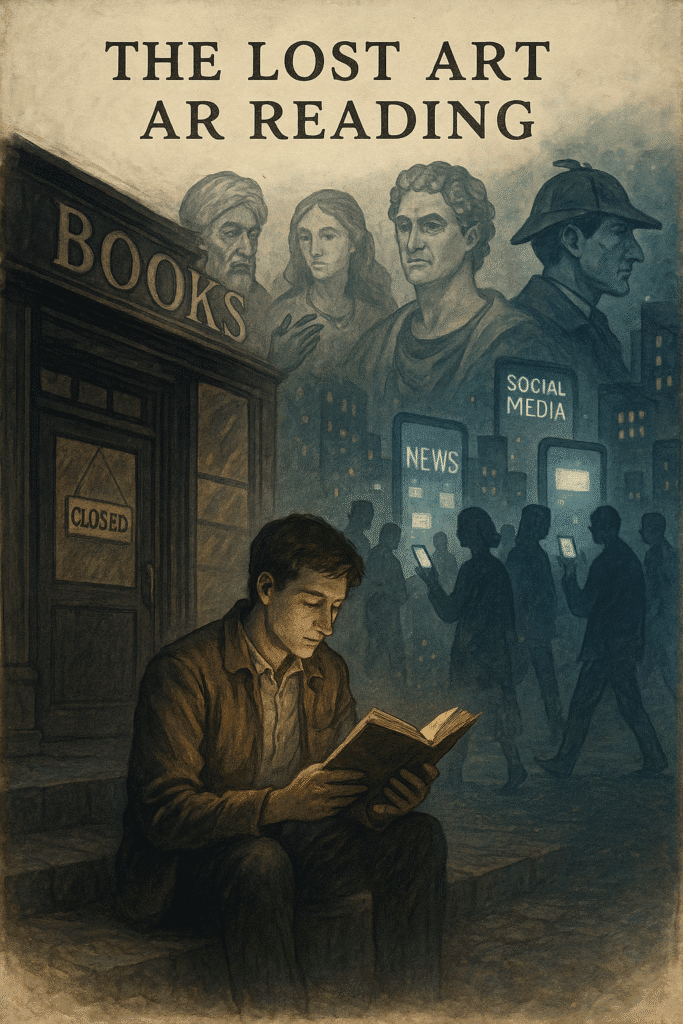
In the month of March, I went to a bookstore opposite Biscoe School in Srinagar and bought some books. I felt the aura — as usual, being around books makes you feel at peace. A few weeks later, I came across an article about the shutdown of that very bookstore. It felt like a dagger to the heart.
Books do not simply appear on dusty tables — someone, somewhere, once bought them. There was a time, around 3500 BCE in Mesopotamia, when storytelling and record-keeping first emerged. In ancient times, knowledge was passed down orally from one generation to the next. Storytelling held a revered position, especially among the youth and children.
From the Greek and Roman eras to the Industrial Revolution, and into the 20th and 21st centuries, the landscape of reading has transformed dramatically. Today, in the age of Kindle, Audible, Goodreads, and hybrid reading, the habit of reading itself feels like a fading fairytale.
Reading is like a potion of intelligence. Gradually, it seeps into every vein, becoming part of your very being. Those who think creatively — who dive deeper than the surface and rise above the masses perpetually buried in screens — have reading etched into their very neurons. A plethora of books is available today, yet carving out time to read amidst our hectic schedules has become a challenge. Though there are valid reasons for this neglect, many remain unaware of what they are truly missing — making life a duller, less vibrant experience.
Also Read | Parenting in the Digital Age: The Role of Classical Conditioning and Parent-Child Interaction
There’s a quote that has stayed with me: “If not now, then never.”
Reading not only enriches vocabulary but also fosters emotional development. If you’re still reading this, it suggests you either already love books or are yearning to cultivate this habit. Within the pages of books, entire worlds unfold — new faces appear, and characters connect with you, not just superficially but deep within, as though you are living their lives. Reading is like flying a kite: you soar so high that the chaos below fades away, and everything seems beautifully distant and calm.
The Decline of Reading
With the rise of pocket-sized technology that robs us of sleep and peace, the art of reading has suffered. This decline has profound effects on future generations — stripping them of wisdom, true intellect, and the ability to engage with complex ideas and imaginative worlds.
Few souls today still find the time to bury their heads in books. Many of us skim online posts, read quick summaries, and abandon half-finished books — all victims of a shrinking attention span. While technology has made books more accessible, compressing entire libraries into a single device, the tactile joy of turning physical pages has become a rarity.
For centuries, Kashmir nurtured a vibrant tradition of knowledge and literature, reflected in its cherished bookstores. One such iconic institution — the Bestseller bookstore — has now, sadly, shut down. Though its closure was perhaps unavoidable, we collectively share the blame. The fall of bookstores stems from many reasons: changing consumer preferences, the growing appeal of online shopping, and the rapid gentrification of the city that has driven rents to unaffordable levels, making it difficult for bookstores to survive.
Reading demands more than just time — it calls for dedication, patience, and a deep thirst for understanding. In an age dominated by speed, noise, and instant gratification, reading asks something almost countercultural: that we slow down. That we sit still, quiet our minds, and give our full attention to something without distraction.
This is more than a simple shift in habit; it marks a growing disconnect from one of the most powerful tools we have for personal growth. Books are not just objects or sources of entertainment — they are vessels of human thought, imagination, and emotion. Within their pages lie entire worlds, shaped by the voices of those who dared to wonder, reflect, and create. Reading allows us to hear those voices across time and culture, offering lessons we might never learn on our own.
What makes reading so powerful is its ability to engage both the mind and the heart. A well-written story does more than pass the time — it helps us develop empathy by placing us in someone else’s shoes. A nonfiction book doesn’t just present facts — it challenges us to think critically, to question, and to understand the complex layers of the world we live in. In every genre, from fiction to biography, poetry to science, books offer an invitation to expand our thinking and deepen our humanity.
Furthermore, reading strengthens essential life skills. It sharpens focus, improves vocabulary, and boosts comprehension. It nurtures imagination and fosters creativity. Children who grow up reading tend to become better thinkers, better communicators, and more curious learners. Adults who continue reading throughout life often report higher levels of mental stimulation, emotional resilience, and personal satisfaction.
As we move forward in a fast-changing world, it’s more important than ever to protect the space for reading. Books are more than entertainment — they are tools for reflection, growth, and transformation. Let us not forget the quiet power they hold. Let us return to the shelves, turn the pages, and rediscover the timeless magic of reading.
(Sheikh Faiza is a Srinagar-based teacher who contributes to The Chenab Times.)


Sheikh Faiza is a Srinagar-based teacher who contributes to The Chenab Times