


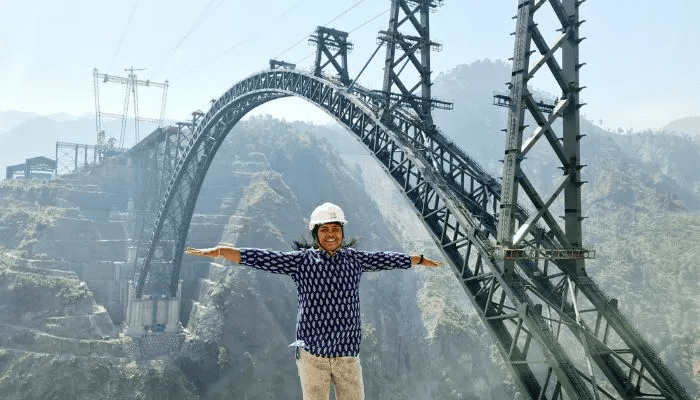
In a momentous occasion steeped in both symbolism and engineering achievement, Prime Minister Narendra Modi on Friday inaugurated the world’s highest railway bridge—the Chenab Bridge—a steel arch structure towering 359 metres above the riverbed in Jammu and Kashmir’s Reasi district. The bridge, which now dwarfs even the Eiffel Tower by 35 metres, represents not only the triumph of modern engineering but also a quiet testament to years of behind-the-scenes scientific rigour, spearheaded in part by Bengaluru-based academic Dr. G. Madhavi Latha.
A professor at the Indian Institute of Science (IISc), Dr. Latha served as a geotechnical consultant on the project for over 17 years. Her role, while not often in the limelight, was integral to overcoming the formidable geological challenges posed by the rugged Himalayan terrain. The Chenab Bridge forms a vital part of the 272-kilometre Udhampur-Srinagar-Baramulla Railway Link (USBRL), a project first sanctioned in 2003 to seamlessly integrate the Kashmir Valley with India’s rail network.
Dr. Latha, currently a Higher Administrative Grade (HAG) professor at IISc’s Department of Civil Engineering, brought decades of geotechnical expertise to bear on the project. Her guidance was central to decisions around slope stabilisation using rock anchors, as well as long-term structural integrity under seismic conditions. Working closely with Afcons Infrastructure—the project’s main contractor—her inputs were instrumental in translating engineering design into a durable ground reality. Her academic contributions on the subject were later chronicled in the Indian Geotechnical Journal.
An alumna of Jawaharlal Nehru Technological University (JNTU), where she completed her B.Tech in Civil Engineering in 1992, Dr. Latha went on to earn a gold medal in her M.Tech in Geotechnical Engineering from NIT Warangal. She completed her doctoral studies at IIT Madras in 2000, carving a niche for herself in a traditionally male-dominated domain. Her accomplishments have earned her national recognition, including the Best Woman Geotechnical Researcher Award by the Indian Geotechnical Society in 2021 and a place in the Government of India’s “Top 75 Women in STEAM” list in 2022.
The Chenab Bridge, constructed at a cost of ₹1,486 crore, has been described by the Ministry of Railways as the “biggest civil-engineering challenge faced by any railway project in India in recent history.” Spanning 1,315 metres, the bridge is an architectural and logistical marvel, resilient to wind speeds of up to 260 kmph and designed with seismic and blast-proof features.
Yet, the saga of the bridge began far from concrete mixers and tower cranes. In its nascent phase, engineers and labourers relied on mules and horses to access the site, traversing the formidable terrain with little more than determination and surveyed maps. It took years of persistent effort—including the laying of 11 km of access roads on the north bank and 12 km on the south—to enable movement of machinery and materials.
Friday’s inaugural walk by the Prime Minister, who waved the tricolour as he crossed the newly completed structure, was as much a ceremonial event as it was a symbolic closing of a chapter in Indian infrastructural ambition. With this milestone, the long-cherished goal of establishing an all-weather rail link to Kashmir inches closer to reality.
For Dr. Latha, whose career has been defined by a steadfast commitment to scientific problem-solving, the Chenab Bridge is more than a professional milestone. It is a steel-and-concrete embodiment of decades of collaborative resilience, driven as much by field engineering as by academic insight.


The Chenab Times News Desk