


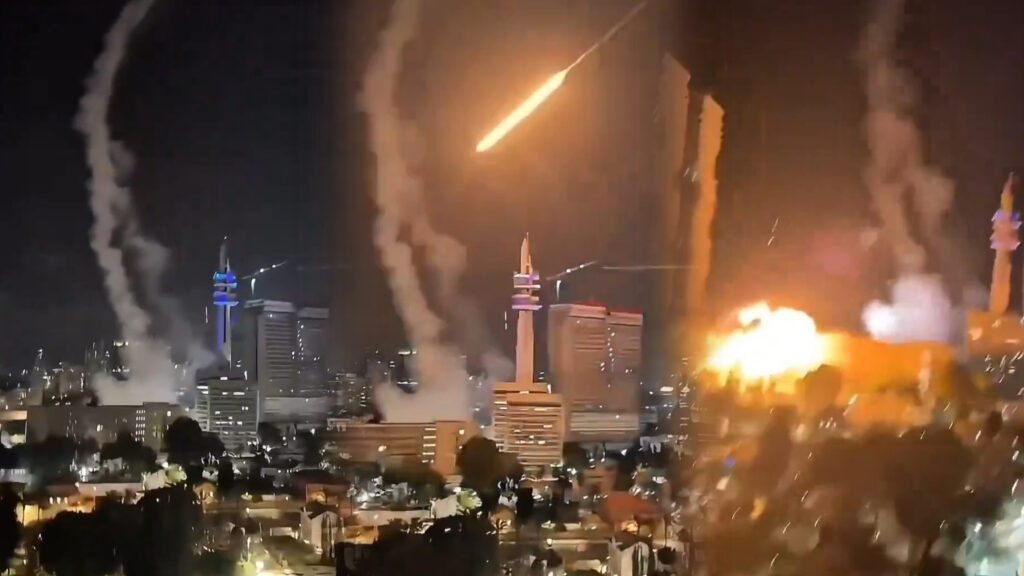
New Delhi, 14 Jun — The spiralling confrontation between Iran and Israel entered a perilous new phase on Saturday, with both sides engaging in sustained missile and drone attacks, marking an unprecedented escalation in their decades-long hostilities. The military exchanges, triggered by a sweeping Israeli air offensive that claimed the lives of several top Iranian generals and nuclear scientists, have now resulted in extensive civilian casualties on both sides and raised concerns of a wider regional conflagration.
In what analysts are calling the most intense direct confrontation between the two rival states in modern history, Iran’s Islamic Revolutionary Guard Corps (IRGC) launched a barrage of ballistic missiles and drones into Israeli territory late Friday, killing at least four civilians and injuring more than 200. Several of the projectiles managed to evade the vaunted Iron Dome air defence system, striking densely populated areas of Tel Aviv, Ramat Gan and Rishon LeZion.
Air raid sirens wailed across central Israel, forcing residents into bomb shelters as Iran’s offensive played out in multiple waves, with around 200 missiles reportedly fired overnight. The Israeli military, confirming for the first time that seven of its soldiers were wounded, disclosed that the attack also caused significant structural damage in urban centres, including the destruction of high-rise buildings.
In a parallel escalation, Israel intensified its aerial campaign in Iran, targeting not just military assets but also urban areas in Tehran, including the Mehrabad airport, which houses a key air force base. The state-run IRNA news agency reported explosions at the airport, though clarified that runways and facilities remained intact.
The Iranian Health Ministry confirmed that at least 80 people, including women and children, had been killed in Israel’s retaliatory strikes, with over 320 others injured. Among the dead were nine nuclear scientists, underlining the strategic nature of Israel’s targeting.
Iran’s Supreme Leader Ayatollah Ali Khamenei, addressing the nation via state television, described Israel’s initial offensive as a declaration of war and vowed severe retaliation. “They started this and initiated the war. We won’t allow them to escape unscathed from this great crime they have committed,” he said, dismissing any suggestion that Iran would accept a cessation of hostilities under pressure.
In response, Israeli Defence Minister Israel Katz issued a stern warning, declaring that “Tehran will burn” if missile strikes against Israeli civilian targets persisted. Accusing Iran’s leadership of endangering its own populace, Katz stated: “The Iranian dictator is turning the citizens of Iran into hostages… If Khamenei continues to fire missiles towards the Israeli home front, Tehran will burn.”
Amidst the intensifying conflict, strategic and nuclear sites have emerged as prime targets. The Fordow enrichment facility in Iran sustained “limited damage” from Israeli air strikes, according to the spokesperson of the Atomic Energy Organization of Iran. He assured the public that sensitive equipment and materials had already been relocated, mitigating the risk of radioactive contamination.
The targeting of nuclear assets is a significant development, suggesting Israel’s intent to degrade Iran’s scientific and military capabilities. However, it has also raised alarm bells internationally about the risks of radioactive exposure and regional destabilisation.
The humanitarian toll of the conflict is mounting rapidly. In Iran, residential neighbourhoods in Tehran bore the brunt of Israeli missile strikes, with hospitals overwhelmed by the influx of casualties. In Israel, multiple residential structures were reduced to rubble, and emergency services worked through the night to evacuate the wounded.
A poignant image captured in Ramat Gan showed a wounded woman being stretchered away by emergency personnel, encapsulating the fear and trauma now gripping civilian populations on both sides.
The crisis has also spread beyond Israel and Iran. The Palestinian news agency Wafa reported that five individuals, including three children, were injured by rocket shrapnel near Sa’ir in the occupied West Bank. Concurrently, Israel imposed sweeping closures and mobility restrictions across the West Bank, raising tensions in the already volatile region.
Iran has issued a stark warning to Israel’s allies — notably the United States, the United Kingdom, and France — cautioning that any attempt to aid Israel militarily would invite retaliation against Western military installations and naval assets in the Persian Gulf and Red Sea. In a statement issued through the semi-official Mehr News Agency, Tehran said, “Any country that participates in repelling Iranian attacks on Israel will be subject to the targeting of all regional bases of the complicit government.”
The statement marks a potential expansion of the conflict’s scope, with implications for regional security architecture and global energy routes.
Meanwhile, U.S. Ambassador to Israel Mike Huckabee reported taking shelter multiple times during Iran’s missile barrages. Posting on X, he described an uneasy atmosphere in Tel Aviv as “entire nation under orders to stay near shelter”.
Experts warn that the entrenched positions of both Tehran and Tel Aviv indicate no imminent de-escalation. Professor Shahram Akbarzadeh, a noted Middle East analyst at Deakin University, said that both governments appeared prepared for a prolonged confrontation. He suggested that Israel’s strategy may, in fact, be predicated on dragging the United States deeper into the conflict.
“When Israel launches attacks on Iran, Iran has to respond, and I think Israel is actually banking on this dynamic — that once the conflict starts, the United States has an obligation and a commitment to Israeli security,” said Prof. Akbarzadeh.
Israeli Prime Minister Benjamin Netanyahu sought to speak directly to the Iranian public, urging them to reject what he called the “evil and oppressive regime” of Ayatollah Khamenei. However, his overture was dismissed in Tehran as ill-timed and unhelpful. Reporting from the Iranian capital, Al Jazeera’s correspondent noted that civilians expressed deep anger and fear — not just over geopolitical conflict, but the everyday toll of war and sanctions.
(With inputs from Agencies)


The Chenab Times News Desk