


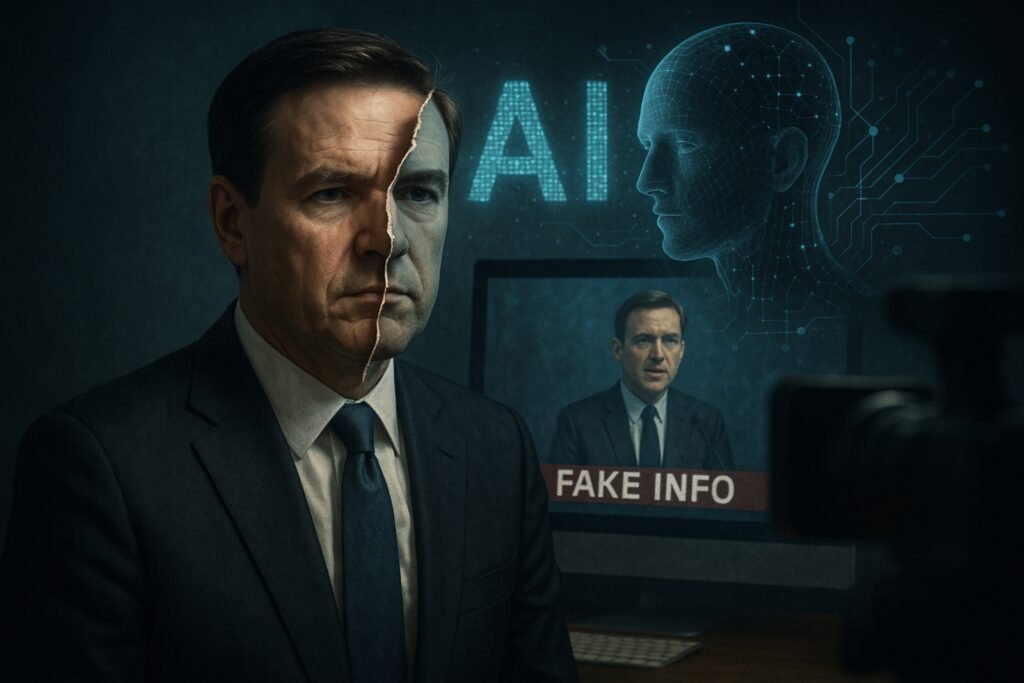
“We live in a world where truth is no longer something we discover, but something we manufacture.”
Amid the rise of digital technologies, we have long grappled with misinformation. But with the rise of artificial intelligence, we now stand at the edge of something far more insidious — a post-truth era where deepfakes and algorithmically engineered disinformation do not merely distort facts but destabilize the very notion of truth itself.
Deepfakes — AI-generated synthetic media that convincingly mimics real people’s faces, voices, or gestures — are no longer experimental novelties. They are now easily accessible, alarmingly realistic, and increasingly weaponized. What once required Hollywood-level technology can now be done on a smartphone, within minutes. From fake political speeches to synthetic scandals, the tools to create reality have been democratized — but with no ethical guardrails.
The Erosion of Evidence
Traditionally, a photograph, a voice recording, or a video served as evidence — a documentation of truth. Today, each of these can be fabricated with eerie precision. This reverses centuries of epistemic trust: now, the burden lies on the viewer to prove authenticity rather than on the source to prove veracity. In such a landscape, skepticism is no longer a virtue — it becomes a necessary survival skill.
This erosion of evidentiary value doesn’t just enable falsehoods — it breeds radical doubt. We are entering a dangerous zone of “plausible unreality,” where nothing can be fully trusted, and every truth can be contested as a fabrication. This is not just a technological problem; it is a philosophical crisis.
Disinformation as a Political Weapon
Autocratic regimes and digital propagandists have already grasped the potential of AI-generated disinformation. Deepfakes are being used not only to discredit opponents or manipulate elections but also to sow chaos, confuse populations, erode social cohesion, and manufacture consent.
What makes this more alarming is the scale and speed of distribution. On social media, engagement often outweighs accuracy. An emotionally charged deepfake circulates far more rapidly than a carefully verified truth. Algorithms designed to maximize attention become complicit in the propagation of lies. The architecture of the internet now rewards falsehood over fact.
Truth in the Age of AI: A Vanishing Consensus
The deeper crisis is ontological. Who owns truth when everyone owns the tools to simulate it? In previous centuries, truth was a matter of verification by institutions — journalism, academia, and law. Today, these institutions themselves are under siege, discredited by populist waves and algorithmic echo chambers.
The result? We no longer have a shared foundation of reality — only competing narratives, many of them artificially generated.
When AI can create a video of a world leader declaring war, or a victim “confessing” to a crime they never committed, the consequences are not limited to reputation. They bleed into policy, justice, even warfare. In such a world, the very idea of accountability is at risk.
Ethics, Regulation, and the Fight Ahead
What then must be done? The answer lies, I believe, in a threefold response:
- Technological safeguards: Watermarking, authentication protocols, and forensic AI tools must evolve in parallel to generative technologies. Platforms must invest not only in removal but in rapid verification and contextual framing.
- Legal and regulatory frameworks: Deepfake legislation remains underdeveloped globally. There is an urgent need for robust legal boundaries that balance freedom of expression with protection against malicious use.
- Media literacy: Perhaps the most important and long-term solution lies in cultivating a digitally literate citizenry — a population trained to critically assess content, to ask not just what they are seeing, but how and why it was made. This is the best defense against engineered manipulation.
A New Moral Imagination
But the problem is not merely technical or legal — it is profoundly moral. The age of AI challenges us to rethink not only what we know, but how we know it, and why we trust it. It demands a new kind of civic ethics — one that refuses to passively consume content, one that holds platforms accountable, and one that treats truth not as a commodity, but as a shared responsibility.
In the end, truth may no longer belong to institutions or algorithms. It must belong to communities — and communities bound not by ideology, but by a common commitment to reality, integrity, and discernment.
As deepfakes continue to evolve, the question is not just whether we can detect the next fabrication — but whether we can preserve the very fabric of trust that binds our societies. In a world where seeing is no longer believing, believing must begin with questioning. And truth, if it is to survive, must become an active pursuit — not a passive inheritance.


The author is a lecturer in Educational Technology & ICT at Islamia Faridiya College of Education, Kishtwar.