


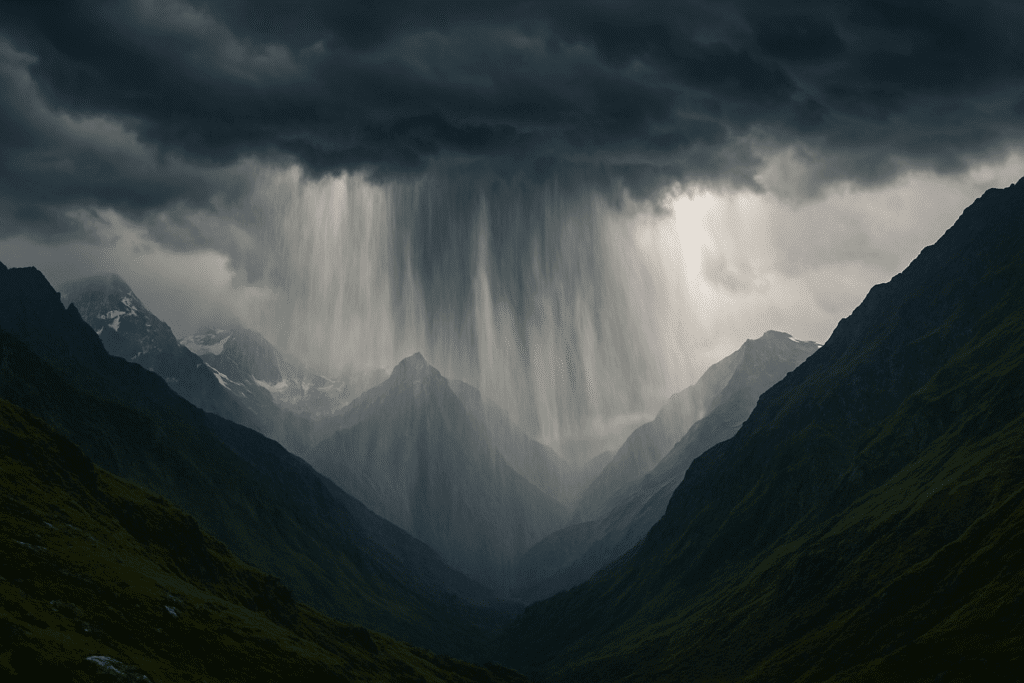
Natural disasters often strike without warning, leaving destruction in their wake. Among them, cloudbursts have become one of the most devastating weather events in mountainous regions like the Himalayas and Kashmir. But what exactly is a cloudburst, and why do these events seem to be happening more often in recent years?
What is a Cloudburst?
A cloudburst refers to a sudden, extremely heavy downpour of rain over a small area in a very short time—often less than an hour. Unlike normal rainfall, which is more gradual and spread out, a cloudburst is highly concentrated, almost as if the clouds have burst open and released all their water at once.
This phenomenon is most common in mountainous regions such as the Himalayas, where warm, moist air rises and collides with cold air in the upper atmosphere. This rapid interaction causes clouds to form quickly and store large amounts of moisture. When they can no longer hold it, they collapse, releasing torrents of rain in a violent, localized downpour.
The term cloudburst itself conveys suddenness and intensity—more than just heavy rain. It is a natural event so forceful that it can flood rivers, wash away villages, trigger landslides, and destroy roads and bridges within minutes.
Today, cloudbursts are seen as both a reminder of nature’s unpredictability and a warning sign of climate change. Scientists note that global warming has increased the amount of water vapor in the atmosphere, making such extreme events more frequent and destructive. A cloudburst, therefore, is not just “a sudden rainfall” but a dramatic display of nature’s raw power—both beautiful and terrifying.
Scientific Causes of Cloudbursts
Orographic Effect – Moist Air Hitting Mountains.
When moisture-filled winds rise over mountains, they cool quickly and condense into water droplets. If the clouds carry too much moisture, they may suddenly release it all at once, causing a cloudburst.
Excess Moisture Build-Up.
Due to higher temperatures, clouds absorb and hold more water vapor. Once they reach their limit, they release it in one massive downpour, leading to extremely heavy rain.
A Localized Event.
Unlike widespread rainfall, a cloudburst typically impacts a very small area. A single valley or village may face torrential rain, while a nearby area just a few kilometers away may stay completely dry.
The Role of Climate Change
Scientists believe climate change is a major factor behind the rising frequency and severity of cloudbursts.
Rising Temperatures:
As global temperatures climb, the air can hold more moisture. Research shows that for every 1°C rise in temperature, the atmosphere’s ability to retain moisture increases by about 7%. This makes rainfall events far more intense.
Disruption of Monsoon Patterns:
Climate change has disturbed the traditional cycle of monsoons. Instead of steady rainfall, regions now experience erratic weather—sometimes too much rain, sometimes too little—raising the risk of cloudbursts.
Higher Risk in Mountainous Areas:
Mountain regions like the Himalayas, Hindu Kush, and Kashmir are especially vulnerable. Moist air collides with steep terrain, condenses rapidly, and transforms into intense rain—making these regions hotspots for cloudburst disasters.
Cloudbursts are no longer rare. With the climate crisis worsening, such extreme weather events are expected to increase in both frequency and intensity. While we cannot control nature, understanding the science of cloudbursts and recognizing the role of climate change can help communities prepare better, adapt to shifting weather patterns, and reduce the damage caused by these sudden disasters.

