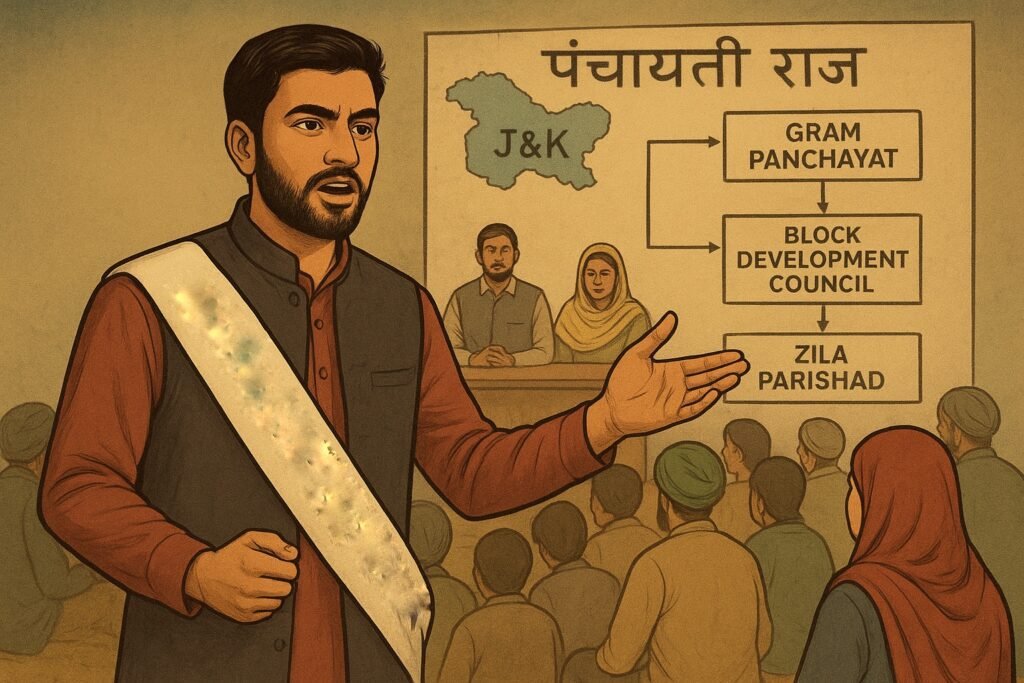
The Panchayati Raj system, a decentralized form of democratic government in which each village or small group of villages is governed by elected representatives, has been the backbone of rural governance in India. It empowers local people, ensuring their participation in decision-making at the grassroots level. In most states of India, the Panchayati Raj operates under a three-tier system consisting of Gram Panchayats (Panch and Sarpanch at the village level), Block Development Councils (intermediate or block level), and Zila Parishads (DDCs at the district level). However, the implementation and efficacy of this system vary across states, and Jammu & Kashmir has had a unique and interesting historical journey in this regard, particularly after the abrogation of Article 370 and its reorganization in 2019.
The story of Panchayati Raj in Jammu and Kashmir (J&K) has been one of both neglect and hope. The state government, before the abrogation of Article 370, delayed implementing the Panchayati Raj Act of 1989 and the 73rd Constitutional Amendment, both designed to empower local governance. This delay denied people in rural areas their right to self-governance and restricted the power of elected bodies. The decision to withhold meaningful local governance left rural citizens without access to administration, keeping them disconnected from the decision-making process that directly impacted their lives.
Before the abrogation of Article 370 in 2019, J&K operated under special status, which allowed its state government to limit the implementation of central laws, including those that applied to local governance. The Panchayati Raj Act of 1989, along with the 73rd Constitutional Amendment, was aimed at decentralizing governance across the nation. This amendment gave constitutional recognition to the panchayats, making them a vital component of grassroots democracy. However, in J&K, this Act was only partially adopted, and even then, it was watered down to leave local bodies powerless. The state government repeatedly avoided holding elections for local bodies. When they did conduct elections, as in 2001, they did so reluctantly and without giving any real authority to the elected panchayats. The main functions, funds, and decision-making powers remained in the hands of the state government, making these elections feel symbolic rather than transformative.
While the implementation of Panchayati Raj in J&K has been a significant step forward, some key aspects of the 73rd Constitutional Amendment have yet to be fully realized. For instance, the amendment includes the establishment of District Planning Committees and a mechanism to provide financial autonomy to local bodies. Although the Jammu and Kashmir Reorganization Act of 2019 has provided room for district planning committees, they remain toothless and unable to take even a small step. These provisions are meant to ensure that local governance is financially supported and that local leaders can make planning decisions specific to their area’s needs. Furthermore, the 73rd Amendment provides for the reservation of seats for Scheduled Castes, Scheduled Tribes, and women in local governance bodies, ensuring fair representation and inclusion. Although some of these provisions have been initiated in J&K, there remains room for further strengthening to fully realize the benefits of Panchayati Raj.
Jammu & Kashmir’s Downgrade to a Union Territory and the Introduction of the DDCs
Before 2019, Jammu & Kashmir enjoyed special status under Article 370, allowing it to have its own constitution and autonomy over its local governance system. However, this changed when the Central Government abrogated Article 370 unilaterally and bifurcated the state into two Union Territories—Jammu & Kashmir and Ladakh—through the Jammu & Kashmir Reorganization Act of 2019. Along with this transformation, the Central Government introduced the three-tier Panchayati Raj system in Jammu & Kashmir for the first time, bringing the region at par with the rest of the country.
A key element of this change was the creation of District Development Councils (DDCs) at the district level. The DDC elections in 2020 were the first democratic exercise in Jammu and Kashmir after August 2019, and they paved the way for the empowerment of councils at the district level. These councils, consisting of 14 elected representatives per district, were meant to be a significant step in empowering local governance. Local political parties, including the National Conference and PDP, came together and contested the elections jointly.
The Disempowerment of DDCs in Jammu & Kashmir
Despite the initial enthusiasm surrounding the introduction of the DDCs, it quickly became clear that the system was not functioning as intended. In many other states, the three-tier system operates with clearly defined powers and responsibilities for each level of governance. However, in Jammu & Kashmir, the situation has been quite different. The DDCs, although elected, have been rendered powerless due to the bureaucratic control exercised by the Union Territory Administration led by the Lieutenant Governor (LG).
Several reports and complaints have surfaced from elected DDC members about being sidelined in the decision-making process. A report by The Hindu highlighted: “Elected representatives complain of bureaucratic hurdles, exclusion in decision-making, non-budgetary powers, and poor accommodation.” As reported by the Hindustan Times, “The honorarium is low and the rank granted to DDC members is much lower than expected, which has made many feel disrespected.” Sajjad Lone, chairman of the Peoples Conference (JKPC), called the protocol powers a “disappointment” and even a “humiliation.” According to Frontline magazine, “DDC members have expressed frustration over the lack of clarity from the administration. While the elections were conducted as a step towards grassroots democracy, the actual functioning of the councils seems to be mired in bureaucratic delays and minimal powers.”
The Failure of the LG Administration
The role of the bureaucracy under the LG administration has been one of the major stumbling blocks for the functioning of the DDCs. Even though the elected members are supposed to represent the people and have a say in district-level decisions, the bureaucracy continues to wield disproportionate power, making decisions without consulting the DDCs. This disempowerment is further compounded by the meagre salaries and allowances provided to DDC members. As reported in Greater Kashmir, many DDC members have expressed disappointment over the meagre financial incentives, which demotivate them and restrict their ability to work effectively. In comparison, states like Himachal Pradesh and Rajasthan provide their DDC members with substantial funds and autonomy, allowing them to plan and execute development projects more effectively.
Comparison with Other States’ Panchayati Raj Systems
In Maharashtra, the Zilla Parishad (equivalent to DDC) has substantial control over district planning and development. They manage education, health, and infrastructure projects and have the authority to make key decisions on these issues. Similarly, in West Bengal, the Panchayat Samiti and Zila Parishads are empowered to manage resources and ensure that development projects align with the local population’s needs. In contrast, the DDCs in J&K have been stripped of such powers. Their role remains largely ceremonial, with the bureaucrats under the LG’s administration making key decisions. While DDCs in other states have powers to sanction budgets and monitor development activities, the DDCs in J&K have to rely on the bureaucracy for even the smallest tasks. DDCs are public representatives with huge expectations, but they cannot deliver much without bureaucratic support.
IIPA, PDI, RDGA Reports
Reports from the Indian Institute of Public Administration (IIPA), Participatory Development Index (PDI), and Rural Development and Governance Assessment (RDGA) provide data-rich comparisons of Panchayati Raj efficacy across Indian states. According to the latest Kurukshetra magazine (2024), states like Karnataka and Kerala have implemented advanced models of decentralized planning.
- Karnataka: Gram Panchayats in Karnataka have direct control over planning and budgeting. They receive timely grants and participate in the formulation of local development plans through District Planning Committees (DPCs), which are fully functional.
- Kerala: Known for the People’s Plan Campaign, Kerala has institutionalized participatory governance. DPCs not only function but have a statutory mandate to integrate village and block-level plans into district plans.
By contrast, DPCs in J&K, although mentioned in the 2019 Reorganization Act, remain toothless and inactive. No functional integration has occurred, and there is little transparency in how local plans are considered. According to the RDGA 2023 report (accessible at rdga.gov.in/reports), J&K ranks among the bottom five Union Territories/States in terms of financial devolution and local planning autonomy. The PDI 2022 report (available at pdi-india.org) highlights that while 85% of Gram Panchayats in Kerala are involved in developmental projects, the figure for J&K is below 15%.
Panchayati Raj in the Constitutional Framework
The Panchayati Raj system derives its legitimacy from Part IX of the Indian Constitution, which was introduced through the 73rd Constitutional Amendment Act in 1992. This amendment mandates the establishment of Panchayati Raj institutions at the village, block, and district levels and provides for regular elections, financial autonomy, and the devolution of powers to these bodies.
However, the unique constitutional position of Jammu & Kashmir complicated the implementation of this system. Before the abrogation of Article 370, J&K had its local governance framework, and Panchayati Raj institutions were never fully operationalized in the region. After the reorganization in 2019, the Central Government had the opportunity to implement the 73rd Amendment in its true spirit, but this has not been the case.
The Panchayati Raj system comes under the State List, meaning state governments have the authority to define and implement it. In J&K’s case, the absence of a state government and the direct control of the Union Territory by the Central Government has led to the stagnation of the Panchayati Raj system. Unlike other states where local bodies are empowered by state governments, J&K’s DDCs remain at the mercy of the LG administration, which has shown little interest in decentralizing power.
The Role of the Central Government: A Missed Opportunity
When the Central Government abrogated Article 370, it promised a new dawn of development and democracy for Jammu & Kashmir. However, in the context of Panchayati Raj, this promise has not been fulfilled. Instead of empowering local governance, the Central Government has maintained tight bureaucratic control over the region.
The creation of the DDCs was hailed as a significant step, but without proper empowerment, it has become a mere exercise to portray normalcy post-August 5. The Central Government could have used its direct control over J&K to strengthen local governance by fully implementing the 73rd Amendment and ensuring that the DDCs had clear powers and responsibilities. Unfortunately, the lack of clarity, financial autonomy, and coordination with the bureaucracy has left the system in limbo.
The J&K state government has historically not been very supportive of Panchayati Raj, which was implemented much earlier in other states of India. Despite being a key part of grassroots governance, J&K remained distant from its full implementation. With the recent elections and the formation of a government by the Jammu and Kashmir National Conference-led alliance, it will be interesting to see whether they prioritize empowering grassroots development through Panchayati Raj institutions.
In my view, if any state disempowers its Panchayati Raj system, it reflects a failure of governance. A strong and empowered Panchayati Raj system is crucial for the balanced development of rural areas and for ensuring that people’s voices are heard at the local level. This will shift the focus of MLAs toward policymaking and bringing big projects into their constituencies, while local developmental issues can be addressed through a strong three-tier Panchayati Raj system in Jammu and Kashmir.
Local governance also provides a chance for budding and aspiring leaders to make a name for themselves, making electoral politics more interesting and competitive. We have seen in the recently concluded assembly elections that some DDCs took part and fought well, which is a really positive step toward fostering democracy in a state like Jammu and Kashmir, where mainstream politics was often seen as a curse.
(The views expressed are author’s own doesn’t necessarily reflect that of The Chenab Times)