


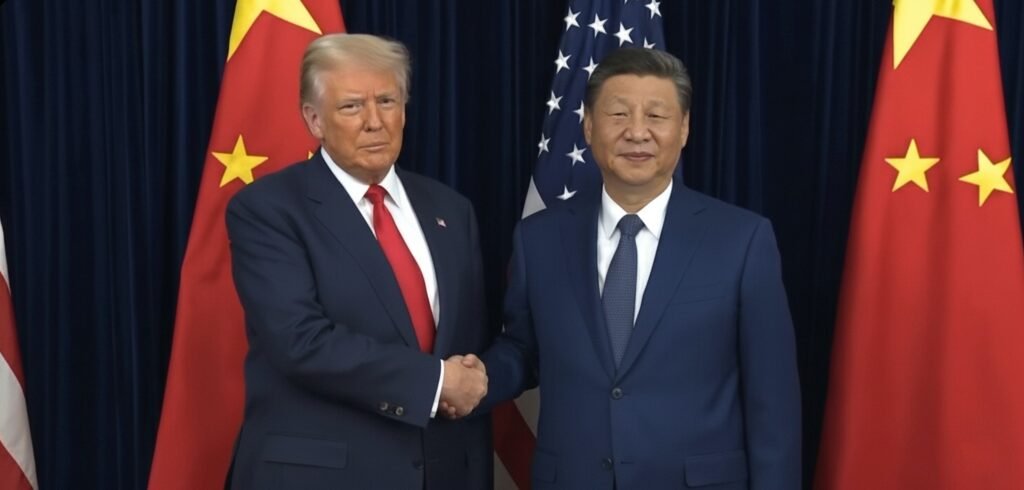
U.S. President Donald Trump and Chinese President Xi Jinping began bilateral talks in Busan on Thursday, marking their first in-person meeting since Trump’s return to the White House and centering on efforts to ease ongoing trade tensions.
The leaders convened on the sidelines of the Asia-Pacific Economic Cooperation (APEC) Economic Leaders’ Meeting, with discussions expected to cover rare earth minerals, tariffs, and a potential truce in the U.S.-China trade war, according to Reuters. The session started at 11 a.m. local time (0200 GMT), details received by The Chenab Times confirm.
Trump arrived in Busan earlier in the day as part of the final leg of his Asia tour, while Xi landed at Gimhae International Airport for his first state visit to South Korea in 11 years, spanning Thursday to Saturday, as reported by Al Jazeera and CNBC. The meeting follows the recent finalization of a U.S.-South Korea trade deal, announced ahead of the summit, NBC News noted.
Key agenda items include negotiations over Chinese exports of rare earths critical for U.S. technology sectors and reductions in tariffs imposed during Trump’s first term, according to The Guardian. Additional topics reportedly involve TikTok’s operations in the U.S. and efforts to curb fentanyl flows from China, CBS News and Fox Business reported.
This encounter revives hopes for a broader trade agreement, amid stalled progress since Trump’s January inauguration. The U.S. has maintained high tariffs on Chinese goods, while Beijing has restricted rare earth supplies, exacerbating supply chain issues.
No official statements or outcomes from the talks were released immediately after they began. Updates are expected as the APEC summit continues through the weekend.


Global Affairs Desk at The Chenab Times covers international developments, global diplomacy, and foreign policy issues through fact-based reporting, explainers, and analytical pieces. The desk focuses on major geopolitical events, diplomatic engagements, and international trends, with an emphasis on verified information, multiple perspectives, and contextual understanding of global affairs.