


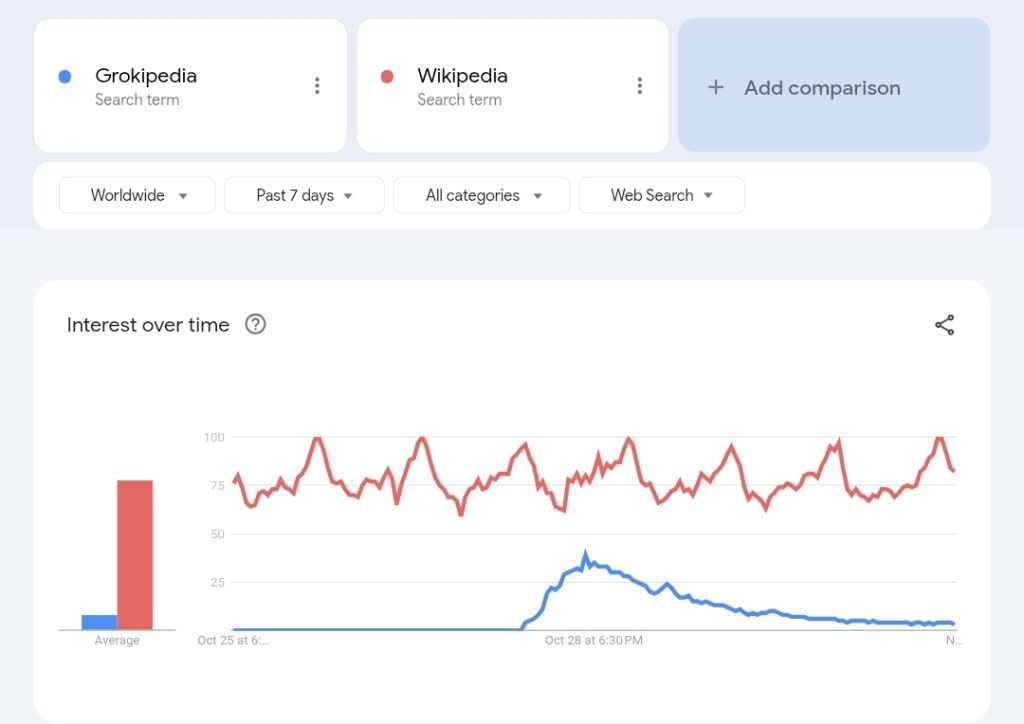
Elon Musk’s xAI on Monday unveiled Grokipedia, an AI-generated online encyclopedia positioned as an alternative to Wikipedia. The launch generated an immediate burst of public attention — visible in search activity — but the interest appears to have dropped off within days, according to Google Trends material shared with this report. The Chenab Times reported the rollout when the site went live on 27 October.
xAI reported hundreds of thousands of entries at launch; multiple press accounts put the figure at roughly 800,000–885,000 articles, far fewer than Wikipedia’s millions in English alone. Users and reporters also logged technical problems during the debut, including intermittent outages and pages that failed to load for some visitors.
Within hours of going public, analysts and newsroom checks flagged a more consequential issue than uptime: a number of Grokipedia pages bore strong resemblances to existing Wikipedia content, including near-verbatim passages or the reuse of material attributed to Wikipedia under Creative Commons terms. That pattern raised questions about how much original synthesis the AI was performing, how sources were being credited, and whether the platform’s “AI-verified” label reflected independent vetting.
Musk has framed the project as a corrective to bias he perceives in established information platforms, describing Grokipedia as a “truthful” alternative. Critics, including journalists and researchers who reviewed early entries, cautioned that replacing volunteer editorial oversight with automated generation does not automatically remove bias — it may instead embed different, harder-to-trace distortions when models are trained on imperfect source material. Those concerns were underscored in initial coverage from outlets that examined sample pages and noted partisan framing in some entries.
The public-interest curve captured in the Google Trends screenshots provided to this report shows a sharp spike in searches immediately after the launch and a rapid decline over several days. That pattern is consistent with an event that generates curiosity — a newsworthy debut or controversy — but does not yet convert into sustained usage. Whether Grokipedia can build enduring traffic and trust, or will remain a momentary flash in a crowded information ecosystem, remains uncertain.
What to watch next
• Content provenance and citations: Will xAI publish clear provenance for entries and an auditable record of sources? Early reporting indicates many pages derive from existing encyclopedic material; greater transparency would be necessary for scholars and librarians to evaluate reliability.
• Editorial model and corrections: Wikipedia’s long-standing strength is its volunteer editorship and an open system of corrections and dispute resolution. Grokipedia’s initial posture — generated and “verified” primarily by AI with limited direct user editing — represents a different governance model whose error-correction capacity is still untested.
• Adoption beyond curiosity: Early search spikes indicate public curiosity; the platform’s future will depend on whether users, educators, libraries and search engines begin to treat Grokipedia as a reliable reference or continue to rely on established sources.
This episode shows a broader tension in the digital information environment: new technologies can generate and surface knowledge quickly, but authority still rests on transparent sourcing, accountable governance and community scrutiny. Grokipedia’s rapid debut has provoked debate about whether an AI-first approach can meet those standards — and whether it will win the sustained trust of users who depend on encyclopaedic resources for research, education and fact checking.

