


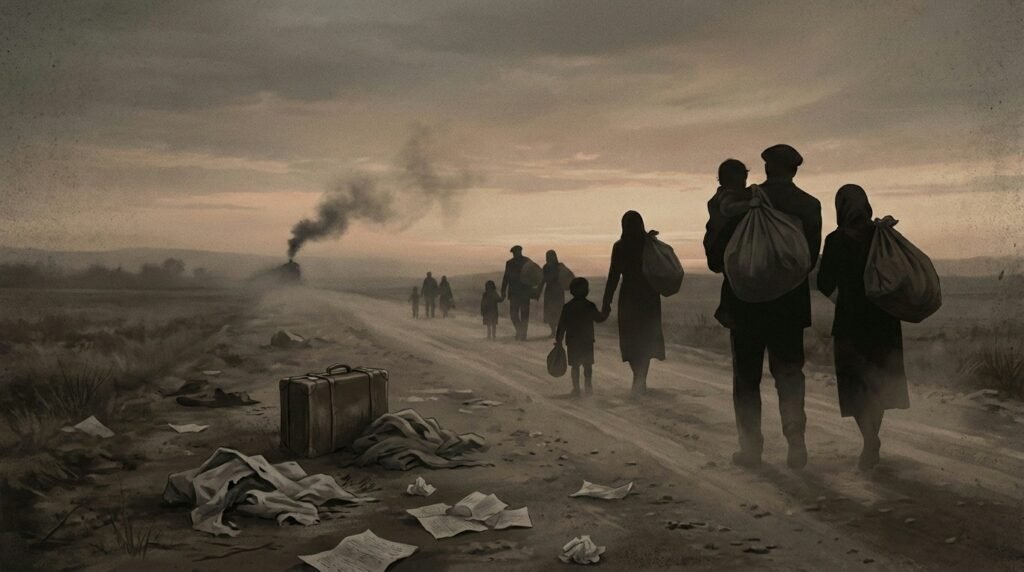
The Partition of India in 1947 remains one of the most disturbing events in the history of South Asia—an event unprecedented in its scale, intensity, and human cost. Conceived in the final, hurried months of British colonial withdrawal, Partition was imagined as a political compromise to address competing nationalisms and communal tensions. Instead, it unleashed a humanitarian disaster that transformed the subcontinent’s social fabric forever. What began as a geopolitical division on paper soon translated into one of the largest forced migrations in human history. Historians such as Yasmin Khan, in The Great Partition, estimate that between 14 and 18 million people were displaced across the newly drawn borders of India and Pakistan within a matter of months. Amid the dust of departing trains, burning villages, and collapsing administrative systems, millions found themselves stripped of basic dignity, security, and identity. It is within this context that the metaphor “blood in the dust of Partition” captures not merely the violence, but the profound erosion of human rights at the very birth of two nations.
In Punjab, Bengal, Sindh, and the North-West Frontier Province, entire communities—Hindus, Muslims, and Sikhs—were transformed from neighbours into adversaries. The events of 1947 exposed the fragility of human rights in moments of political upheaval. Trains arrived at stations laden with corpses, villages were razed overnight, and countless individuals disappeared without record or acknowledgment. According to historian Gyanendra Pandey, the collapse of authority during the transfer of power allowed violence to escalate rapidly and unchecked. Women experienced uniquely harrowing forms of violence: mass abductions, forced conversions, honour killings within families, and sexual violence used systematically as a weapon of humiliation and control. Feminist historians Urvashi Butalia, Ritu Menon, and Kamla Bhasin have documented how women’s bodies were turned into symbolic sites of communal revenge. Children were separated from families, abandoned in refugee camps, or absorbed into unfamiliar communities. For many survivors, the trauma of these violations never found institutional recognition, leaving memories carried privately across generations.
The hurried boundary-making process by the Radcliffe Commission, the unpreparedness of military and police forces, and the withdrawal of British authority created a vacuum that allowed mobs, militias, and vigilante groups to operate with impunity. Historian Yasmin Khan notes that state structures meant to protect civil liberties disintegrated precisely when they were needed most. In many regions, violence unfolded in phases—first spontaneous, then organized—shaped by local politics, rumours, retaliatory logic, and the psychology of fear. This environment made systematic human rights violations not just possible, but widespread.
Refugee camps in Delhi, Lahore, Karachi, and Calcutta became sites of both suffering and resilience. Thousands of people—social workers, local communities, and voluntary organizations—attempted to provide relief despite severe shortages. Yet the overwhelming scale of displacement exposed how unprepared state institutions were to safeguard even basic rights such as food, shelter, safety, and legal recourse. Research by Ritu Menon and Kamla Bhasin shows that for many women, post-Partition “recovery operations” run by governments became another site of coercion, raising questions about consent, protection, and the politics of nation-building. These contradictions reveal that human rights violations during Partition were not confined to the moment of violence alone; they continued in the long, uncertain aftermath.
This article examines these violations with a focus on both their historical context and human consequences. Drawing from survivor testimonies, official reports, archival documents, and scholarly work, the analysis seeks to map how and why such massive human rights breakdowns became possible. It considers the political climate leading up to 1947, the mechanization of violence during the months of transfer, and the prolonged trauma that followed, by foregrounding the lived experiences of victims rather than only high-level political narratives.
“Women’s breasts were cut, and religious symbols were branded on them.”
During the Partition, women faced some of the most brutal violence ever recorded in South Asian history. In many parts of Punjab and Bengal, law and order had completely collapsed. Different communities were attacking each other, and women became the easiest and most painful targets.
Survivor testimonies collected by historians such as Urvashi Butalia, and reflected in Partition literature by writers like Saadat Hasan Manto and Bapsi Sidhwa, describe acts of extreme brutality inflicted on women. As mobs entered villages, refugee camps, and caravans, women were dragged out of their homes. Many were beaten, assaulted, and taken away. To humiliate the opposite community, attackers would sometimes mutilate women’s bodies, burn their skin, or brand them with hot metal religious symbols. These acts were intended to send a message:
“We have defeated your men. We have taken your honour.”
Women were also paraded through the streets without clothes. This was done intentionally so the entire community would feel ashamed and helpless. Survivors later said that the pain was not only physical—it was meant to break their spirit. But the horror did not end there.
In many Sikh villages of Rawalpindi district, especially in Thoa Khalsa, rumours spread about what was happening to women outside. Families heard that women were being kidnapped, forced to convert, or made “wives” of the attackers. With surrounding villages already attacked, families realised they would not be able to protect their women. In that moment of fear and chaos, something heartbreaking happened.
Historical accounts documented by Urvashi Butalia and corroborated by oral histories in the 1947 Partition Archive record how nearly ninety Sikh women and children jumped into a village well to avoid abduction during communal attacks. Women gathered inside a large haveli, prayed, took amrit for courage, and chose death over capture. Some held hands. Some carried their children. Mothers jumped in clutching their babies close to their chests.
The men of the village stood outside, fighting as long as they could. Some even killed their own wives and daughters, believing it was the only way to save them from torture.
Similar tragedies occurred across many regions. Women disappeared without a trace. Some were taken to cities and sold. Some were kept as prisoners for months. When the governments of India and Pakistan later attempted to “recover” abducted women, many refused to return, having been forced into marriages or having children by then—a reality documented in post-Partition government reports and feminist scholarship.
Partition turned women’s bodies into battlegrounds. The violence inflicted on them was not only physical; it was symbolic. Their suffering became a way for one community to insult the other. Even today, survivors say the deepest wounds of Partition are not the borders on a map, but the pain carried by the women who lived through those days.
Long-term impact
The long-term impact of Partition violence continues to shape India and Pakistan in ways that extend far beyond 1947. Historians such as Ian Talbot and Yasmin Khan argue that the trauma of killings and displacement became embedded in national memory, contributing to deep mistrust between the two new nations. This mistrust later shaped diplomacy, military policy, and the overall tone of bilateral relations, sharpening conflicts over borders and identity.
Partition violence also transformed the internal social fabric of both countries. The massive migration created new demographic realities, permanently altering several regions. Entire communities vanished from areas where they had lived for centuries, while refugee settlements created new social and economic pressures. Many refugee families carried trauma that influenced how future generations understood identity, religion, and belonging. Scholars note that these unresolved memories made communal tensions easier to revive during later political crises.
At the cultural level, the shared traditions of the subcontinent suffered a rupture that has never fully healed. The violence broke centuries of coexistence in regions like Punjab and Bengal. Literature, cinema, and oral histories on both sides of the border continue to reflect this enduring pain. The silence surrounding women’s experiences—documented but long marginalised—represents a hidden trauma that has only recently begun to receive sustained attention.
Economically, the sudden loss of land, property, and livelihoods destroyed financial security for millions. Both states struggled to rebuild disrupted administrative systems, markets, and infrastructure. The uneven redistribution of resources created new inequalities, while the division of industrial and agricultural zones shaped long-term development patterns marked more by competition than cooperation.
Above all, the long-term impact of Partition violence lies in its persistence within collective memory. It remains a reference point in political debates, social anxieties, and ideas of nationalism and the “other.” Although many wish to move beyond the past, the scars of 1947 continue to influence South Asian society, reminding us that violence does not end when events conclude. It lingers quietly in emotions, institutions, and relationships, shaping futures that the people of that time could never have imagined.
This article draws on survivor testimonies, historical scholarship, and archival research on the 1947 Partition.

