


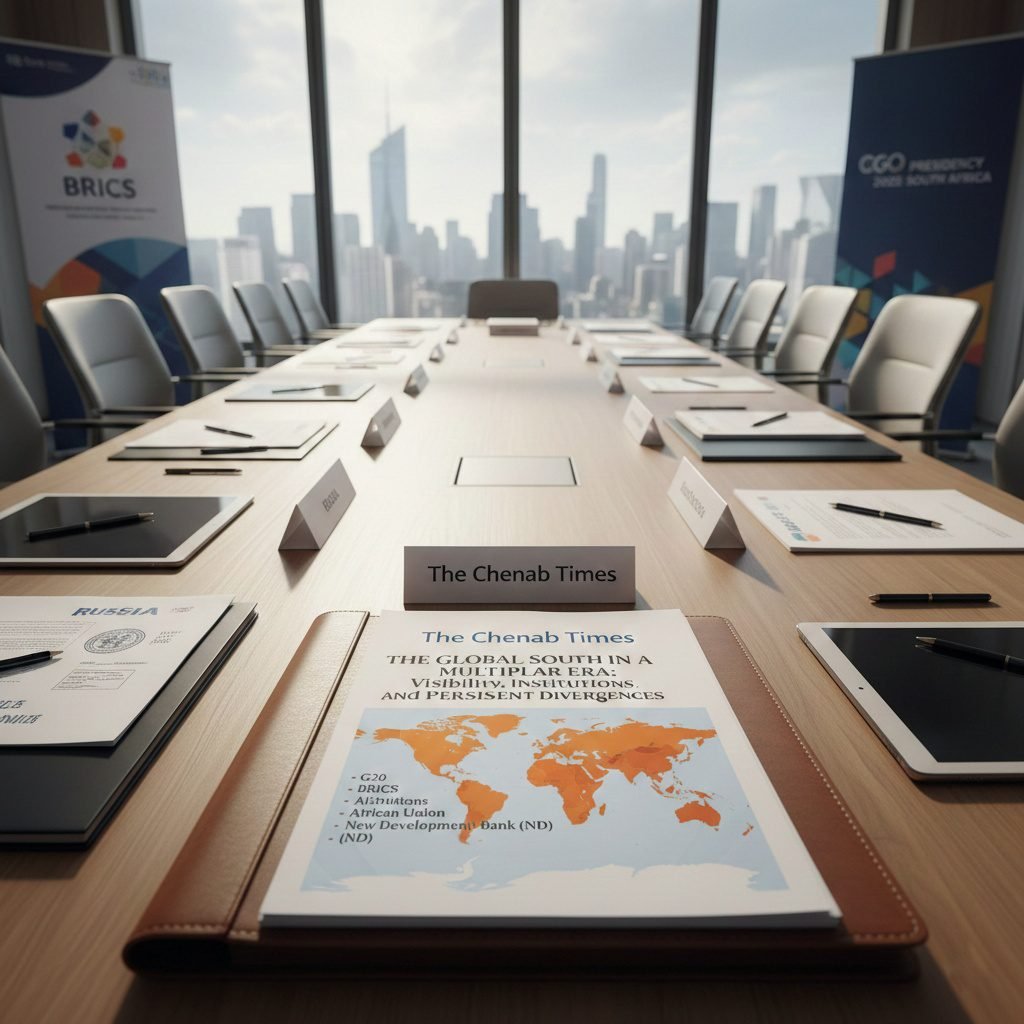
The term “Global South” has gained renewed prominence in international discourse since the COVID-19 pandemic and particularly following Russia’s invasion of Ukraine in February 2022. Leaders from emerging economies have increasingly invoked the phrase to argue for greater representation in global institutions and a rebalancing of power within the international system. This resurgence has been visible across forums such as the G20, BRICS summits, and the United Nations, where calls for reforming multilateral structures have grown more frequent.
The concept itself is not new. It traces back to post-colonial solidarity movements, including the Non-Aligned Movement and the Group of 77, which sought collective bargaining power for developing states during the Cold War. In recent years, new platforms have emerged to re-articulate these concerns. India’s Voice of the Global South Summit is one such initiative. India hosted the first virtual summit on 12–13 January 2023, followed by a second on 17 November 2023 and a third on 17 August 2024, according to official statements covered by Reuters and the Associated Press. These meetings brought together representatives from over 100 countries to discuss development priorities and institutional reform.
A notable milestone came during India’s G20 presidency. On 9 September 2023, the African Union was admitted as a permanent member of the Group of 20, a move announced by Prime Minister Narendra Modi and reported by Reuters and the BBC. The decision elevated the AU—representing 55 African states—to a status comparable to that of the European Union within the G20, marking the first expansion of the grouping beyond individual countries and the EU.
The BRICS grouping—originally comprising Brazil, Russia, India, China, and South Africa—has also played a central role in Global South discourse. At the 15th BRICS Summit in Johannesburg from 22–24 August 2023, leaders agreed to invite six countries—Argentina, Egypt, Ethiopia, Iran, Saudi Arabia, and the United Arab Emirates—to join the bloc from 1 January 2024. Argentina later declined the invitation, while Egypt, Ethiopia, Iran, and the UAE became full members in 2024. Indonesia joined as a full member in January 2025, according to Reuters and Al Jazeera. Saudi Arabia has continued to participate in BRICS activities but has not formalised full membership as of late 2025, per reports from Reuters.
The first summit featuring several new members was held in Kazan, Russia, from 22–24 October 2024. Reuters reported that the Kazan Declaration reiterated support for reforming multilateral institutions, explored cooperation in trade and local-currency financing, and introduced a partner-country category, with over 30 nations expressing interest in closer ties.
Brazil hosted the 17th BRICS Summit in Rio de Janeiro on 6–7 July 2025. According to the Associated Press and Reuters, discussions focused on inclusive governance, climate finance in preparation for Brazil’s hosting of COP30, and frameworks for artificial intelligence governance. Outcomes included endorsements for multilateral guarantees within the New Development Bank to facilitate investment and a framework declaration on climate finance, reflecting efforts to align priorities amid diverse membership.
Institutionally, BRICS has relied on mechanisms such as the New Development Bank, established in 2015 to finance infrastructure and sustainable development projects. Reuters, citing official updates, reported that by the end of 2024 the NDB had approved projects worth approximately $39 billion, with further approvals in 2025 contributing to ongoing expansion.
Despite heightened visibility and institutional activity, cohesion within the Global South remains limited. Analysts at the Brookings Institution have noted that while expansion signals growing outreach, progress on alternatives to dollar-dominated finance—such as local-currency trade—remains incremental. Carnegie Endowment for International Peace assessments similarly highlight divergent economic models, strategic priorities, and security alignments among participants.
These differences extend to geopolitics. Some states maintain close partnerships with Western powers, while others emphasise multipolarity. Chatham House analyses observe that this diversity constrains unified positions on issues from trade to global conflicts, often resulting in declarations emphasising broad principles over binding commitments.
The Kazan Declaration reflected this approach, stressing multilateralism and sustainable development while endorsing modalities for partner countries. G20 outcomes under recent presidencies, including India’s in 2023 and Brazil’s in 2024, have incorporated Global South concerns—such as debt relief and climate finance—within consensus frameworks. South Africa assumed the G20 presidency on 1 December 2024, providing another platform for advancing developing-country priorities through 2025.
Looking ahead, Global South discourse is likely to remain prominent. BRICS outreach through partner arrangements and successive G20 presidencies offer venues for dialogue. Yet persistent economic disparities, geopolitical alignments, and competing interests suggest influence will manifest more as a constellation of voices than a unified bloc. Growing visibility underscores demands for reform, even as fragmentation limits coordinated action in a multipolar world.


Anzer Ayoob is the Founder and Chief Editor to The Chenab Times