


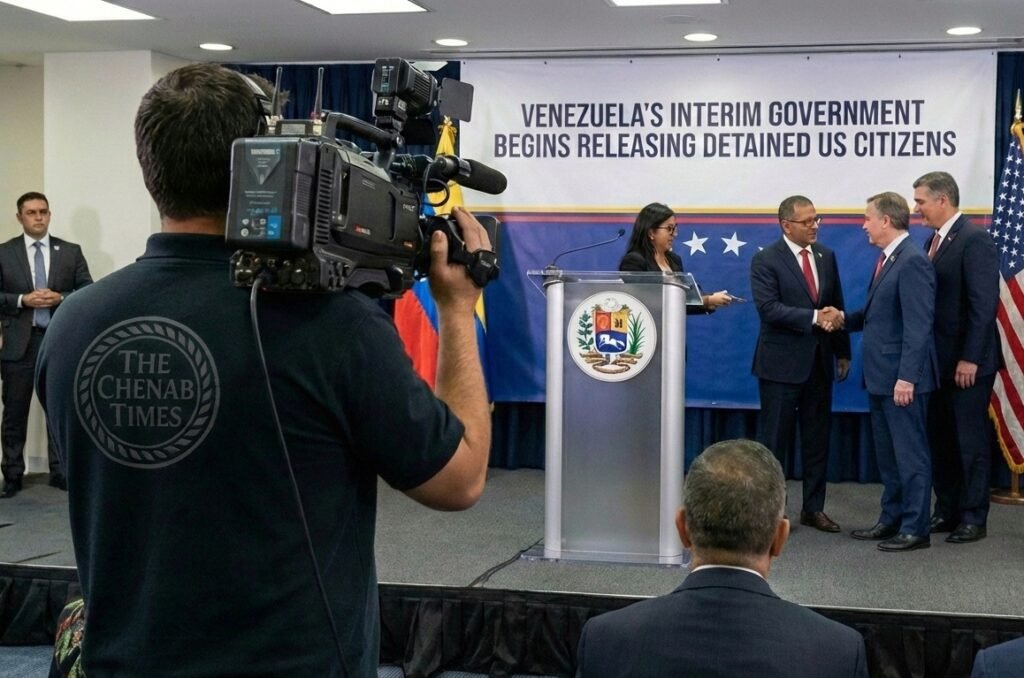
The interim Venezuelan government has started freeing individuals with US citizenship who were detained under the previous administration of Nicolás Maduro, marking an initial step toward addressing longstanding prisoner issues amid heightened US involvement in the country.
This development follows the US military capture of former President Nicolás Maduro earlier this month on alleged drug-trafficking charges and comes as the interim administration, led by Delcy Rodríguez, has initiated broader releases of political prisoners as a gesture toward national unity and improved relations with Washington.
Venezuela’s interim authorities have begun releasing detainees holding US citizenship, with at least four Americans confirmed freed in recent days. The releases represent the first known instances of American detainees being let go since Maduro’s ouster by US forces and align with announcements from Venezuelan officials about freeing both Venezuelan and foreign prisoners.
According to details received by The Chenab Times, the process of releasing US citizens started gradually in early January 2026, following Maduro’s capture and transfer to the United States for arraignment in New York. Sources familiar with the matter, cited by CNN and Bloomberg, confirmed that multiple Americans previously detained in Venezuela have now been freed, though exact details on identities and total numbers remain limited in public statements. The Trump administration has described the move as a positive outcome of sustained pressure, with officials noting it demonstrates the effectiveness of US leverage in securing the release of detained Americans.
The releases are part of a larger effort announced by National Assembly President Jorge Rodríguez, who stated last week that a significant number of Venezuelan and foreign prisoners would be freed to promote peace and stability following recent events. Human rights organizations, including Foro Penal, have verified dozens of overall releases—around 56 political prisoners as of mid-January—while emphasizing that only a small fraction of an estimated 800 or more political detainees have been released so far. Earlier confirmed frees included high-profile opposition figures, activists, journalists, and foreign nationals such as five Spanish citizens, including human rights advocate Rocío San Miguel.
These actions occur against the backdrop of significant US-Venezuela tensions in late 2025 and early 2026. Venezuelan authorities detained several Americans in recent months amid escalating US sanctions, military operations, and pressure campaigns targeting the Maduro government. Prisoner exchanges and releases have occasionally served as limited avenues for engagement between Washington and Caracas, with prior instances in 2025 involving groups of US citizens and permanent residents. The current interim government has presented the ongoing releases as unilateral steps to foster reconciliation, even as the US continues to advise its citizens against travel to Venezuela due to risks from pro-government militias and persistent instability.
US officials, including those from the State Department, have welcomed the releases as progress under the interim leadership but stressed the need for continued efforts. President Donald Trump has publicly highlighted the development as aligning with US demands for the liberation of detained Americans. Rights groups and the United Nations fact-finding mission on Venezuela have urged the immediate and unconditional release of all arbitrarily detained individuals, pointing out that many remain in custody and that transparency in the process has been lacking.
The situation continues to evolve, with families of remaining detainees expressing hope tempered by concerns over the slow pace and conditions in facilities such as El Helicoide. While the releases indicate an effort by Venezuela’s interim authorities to respond to international concerns—particularly from the United States—following Maduro’s removal, broader issues including full accountability, human rights improvements, and democratic reforms remain under scrutiny by observers worldwide.


Global Affairs Desk at The Chenab Times covers international developments, global diplomacy, and foreign policy issues through fact-based reporting, explainers, and analytical pieces. The desk focuses on major geopolitical events, diplomatic engagements, and international trends, with an emphasis on verified information, multiple perspectives, and contextual understanding of global affairs.