


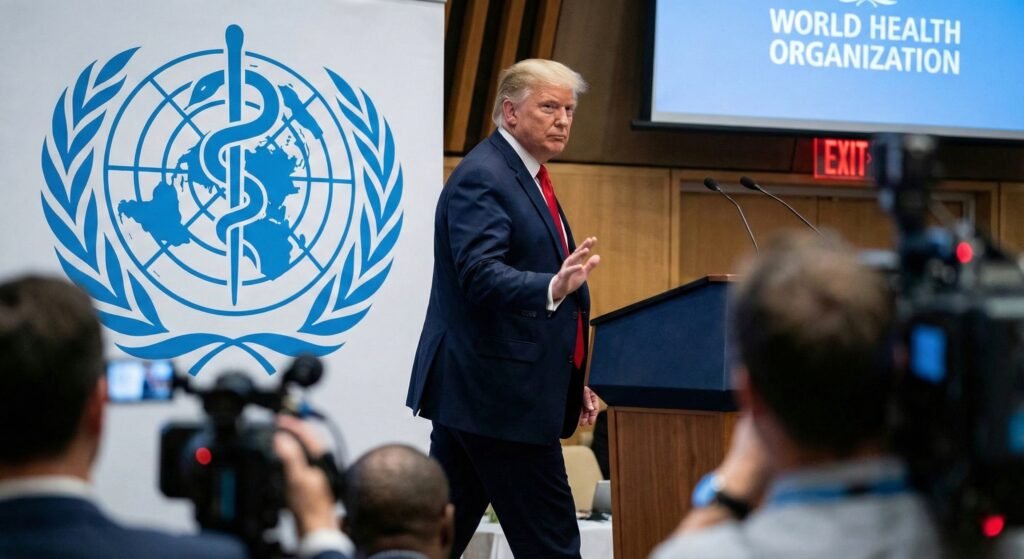
WASHINGTON: The United States has formally completed its withdrawal from the World Health Organization (WHO), ending all participation in the United Nations health agency and terminating funding and personnel involvement, though it leaves behind an unpaid debt estimated at approximately $260 million.
The process concluded on January 22, 2026, exactly one year after President Donald Trump signed an executive order on his first day in office directing the exit. The move ends US engagement in WHO leadership bodies, working groups and operations worldwide.
According to details received by The Chenab Times, the Department of Health and Human Services confirmed the withdrawal, stating that all funding to the agency has been halted and US personnel recalled from WHO offices and headquarters in Geneva. Reports from Bloomberg and Reuters indicate the unpaid dues cover assessed contributions for 2024 and 2025, as documented in WHO financial summaries from January 2025.
Under a 1948 US Congressional resolution, withdrawal requires one year’s notice and settlement of outstanding obligations before departure. However, administration officials have maintained there is no statutory requirement to pay the debt prior to exit, with a spokesperson asserting that “the American people have paid more than enough” to the organisation, citing perceived past inefficiencies and disproportionate contributions compared to other members.
The WHO has expressed regret over the loss of its largest historical donor, noting potential impacts on global programmes addressing diseases such as HIV, polio, Ebola and emerging outbreaks. Director-General Tedros Adhanom Ghebreyesus indicated in an internal memo that the agency would implement cost-cutting measures, including reduced travel, halted non-critical recruitment and a review of programme priorities to address the funding shortfall.
Trump’s decision revives his first-term criticisms of the WHO, accusing it of politicisation, mishandling the COVID-19 pandemic and undue influence from other member states. The executive order cited failures in independent action and “unfairly onerous payments” from the US.
Global health experts have warned that the withdrawal could weaken international coordination on pandemics, reduce US access to critical disease surveillance data and strain WHO operations reliant on American funding. Some have described the unpaid dues as creating a “messy divorce,” with member states expected to discuss the implications, including handling of arrears, at the WHO executive board meeting in February 2026.
The exit aligns with broader administration policies emphasising national priorities over multilateral commitments. Officials have dismissed the debt as minor relative to historical US contributions and emphasised that voluntary earmarked funds—beyond assessed dues—have also been withheld.
The development has sparked debate on global health governance, with calls from some quarters for other nations to increase support to offset the gap. The WHO’s two-year budget for 2024-2025 stood at $6.8 billion, and the US absence is expected to prompt adjustments in resource allocation and programme delivery.
The withdrawal follows a pattern of US disengagement from certain international bodies under the current administration, reflecting ongoing tensions over multilateral organisations and funding responsibilities. The unpaid amount remains a point of contention, with no immediate resolution indicated as the US shifts focus to domestic and bilateral health initiatives.

