


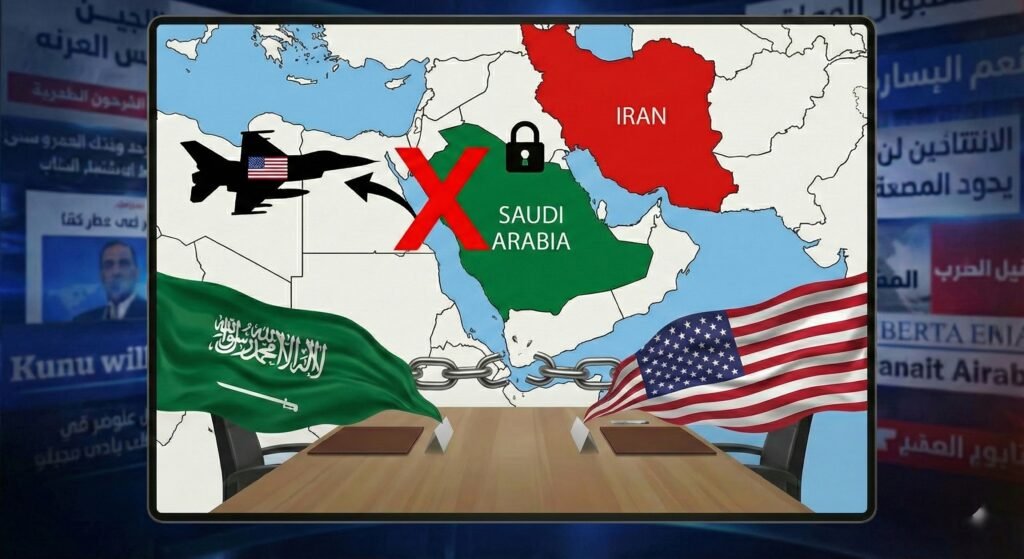
Saudi Arabia has firmly ruled out allowing the United States to use its airspace or territory for military strikes against Iran, according to reports citing Saudi officials and sources close to the kingdom’s government. The decision reflects Riyadh’s efforts to avoid entanglement in a potential conflict between Washington and Tehran, as fears grow over disruptions to oil markets and broader regional instability.
According to details received by The Chenab Times, Saudi Arabia has directly informed both the US administration and Iranian authorities of its position. Sources close to the Saudi military told AFP that Riyadh conveyed to Tehran that it “will not be part of any military action taken against it, and that its territory and airspace will not be used for that purpose.” This message was confirmed by a second source familiar with the government’s communications. Separately, reports in The Wall Street Journal, quoting Saudi officials, indicated that Riyadh has assured Washington it will stay out of any potential conflict and will not permit US forces to operate from its airspace for strikes on Iran.
The stance comes against the backdrop of escalating US warnings to Iran over its government’s crackdown on widespread protests, which rights groups have described as one of the most severe since the 1979 Islamic Revolution. US officials have indicated possible military responses if the situation worsens, including threats of harsh measures should Iranian authorities execute protesters. In turn, Tehran has warned that it would target US military assets and shipping in the region if attacked, raising concerns about retaliation against American bases in Gulf states.
Saudi Arabia’s position aligns with similar caution expressed by other Gulf countries, including Qatar and Oman, which have reportedly urged the US to refrain from strikes due to risks of oil market turmoil and spillover effects on their own territories. Gulf states have expressed worries that any attempt at regime change in Iran could destabilize the region further, potentially affecting global energy supplies through the Strait of Hormuz. Riyadh has also faced Iranian warnings that US bases on its soil could become targets in the event of American action.
The kingdom maintains military cooperation with the US, including hosting American assets in the Gulf, but its current posture underscores a strategic choice to prioritize de-escalation and neutrality amid shifting regional dynamics. This includes recent diplomatic outreach between Saudi and Iranian leaders, with Crown Prince Mohammed bin Salman later stating publicly that Riyadh would not allow its airspace or territory for military actions against Tehran, as reported by state news agency SPA.
Analysts note that such assurances from Saudi Arabia and other Gulf monarchies aim to prevent a wider conflict that could threaten energy infrastructure and economic stability. The US has bolstered its military presence in the Middle East, including deployments of naval assets, but any large-scale operation against Iran would face logistical challenges without full regional support for overflight or basing rights.


Global Affairs Desk at The Chenab Times covers international developments, global diplomacy, and foreign policy issues through fact-based reporting, explainers, and analytical pieces. The desk focuses on major geopolitical events, diplomatic engagements, and international trends, with an emphasis on verified information, multiple perspectives, and contextual understanding of global affairs.