


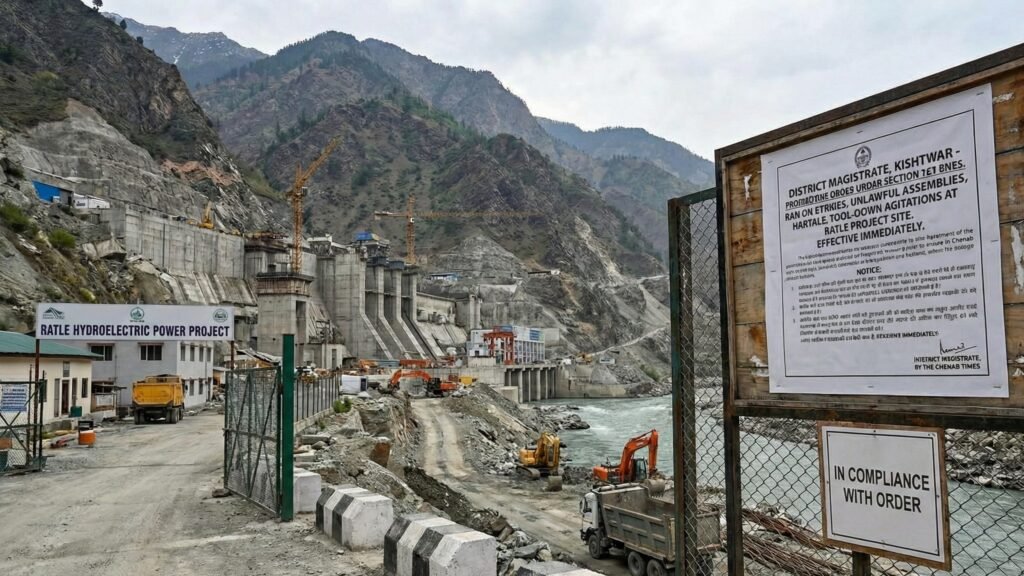
The District Magistrate of Kishtwar has issued a prohibitory order banning unlawful assemblies, strikes, hartals, tool-down agitations, gate meetings, and any form of obstructionist activity at the 850 MW Ratle Hydroelectric Power Project in Jammu and Kashmir’s Kishtwar district.
The order, issued under Section 163 of the Bharatiya Nagarik Suraksha Sanhita (BNSS), 2023, aims to prevent disruptions to the project, which is classified as one of national importance and is currently at a critical stage of execution. It prohibits such activities at the project site, camps, approach roads, and operational areas in the vicinity, including near Drabshalla village along the Chenab River. The measure comes into immediate effect and will remain in force for two months from February 4, 2026, unless modified or withdrawn earlier.
According to details received by The Chenab Times, credible inputs from the project authorities of the Ratle Hydroelectric Power Project, corroborated by field-level reports and intelligence inputs, indicate frequent, deliberate, and orchestrated obstructions at the site by certain individuals and self-styled labour unions. These have involved unlawful gate meetings, instigation of workers, coercive tactics, intimidation, and disruption of normal working hours. Such activities have reportedly exhorted the workforce to resort to unlawful assemblies, strikes, hartals, and tool-down agitations on various pretexts, often to serve vested or extraneous interests rather than genuine labour grievances.
The Ratle project, a run-of-the-river scheme developed by the Ratle Hydroelectric Power Corporation Limited—a joint venture between NHPC Limited and the Jammu and Kashmir State Power Development Corporation—is being implemented by contractor Megha Engineering and Infrastructure Limited (MEIL). Dam concreting commenced in early January 2026 in the presence of Union Power Minister Manohar Lal Khattar, marking a significant milestone. As of recent updates, the project has achieved around 26-27 per cent physical progress, with an anticipated commissioning targeted for 2028, following earlier delays due to litigation and other issues. The project, sanctioned at an estimated cost exceeding Rs 5,000 crore, is closely monitored at the highest levels of the Government of India.
The order highlights that disruptions at this stage could lead to serious delays, financial losses to the public exchequer, contractual complications, and grave prejudice to public interest. It notes that most issues raised in support of such agitations are amenable to resolution through lawful channels, including the Labour Department, competent courts, or a District Level Committee constituted earlier for examining grievances on merits. The cumulative circumstances, according to the order, point to an imminent likelihood of disturbance to public order, obstruction to the project’s execution, exploitation of the labour force, and erosion of industrial peace, necessitating preventive intervention.
The Senior Superintendent of Police, Kishtwar; Tehsildar Drabshalla; Assistant Labour Commissioner, Kishtwar; and the Head of Project have been directed to ensure strict compliance and enforcement. Any contravention will invite prosecution under Section 223 of the Bharatiya Nyaya Sanhita, 2023, and other relevant laws. Given the impracticality of serving individual notices, the order has been passed ex-parte and promulgated publicly through the district website, leading newspapers, and by affixing copies at key offices, including those of the SSP Kishtwar, Tehsildar Drabshalla, SHO Police Station Kishtwar, and In-Charge Police Post Drabshalla.
The Ratle project has faced prolonged challenges, including earlier protests, contractual terminations, and disputes over local employment and worker backgrounds. Recent months have seen tensions involving allegations of political interference, retrenchment of workers, and concerns over site security, prompting repeated calls from project authorities for measures to safeguard operations and worker safety. The latest prohibitory order follows similar past restrictions in the district to maintain order at hydropower sites.


The Chenab Times News Desk