


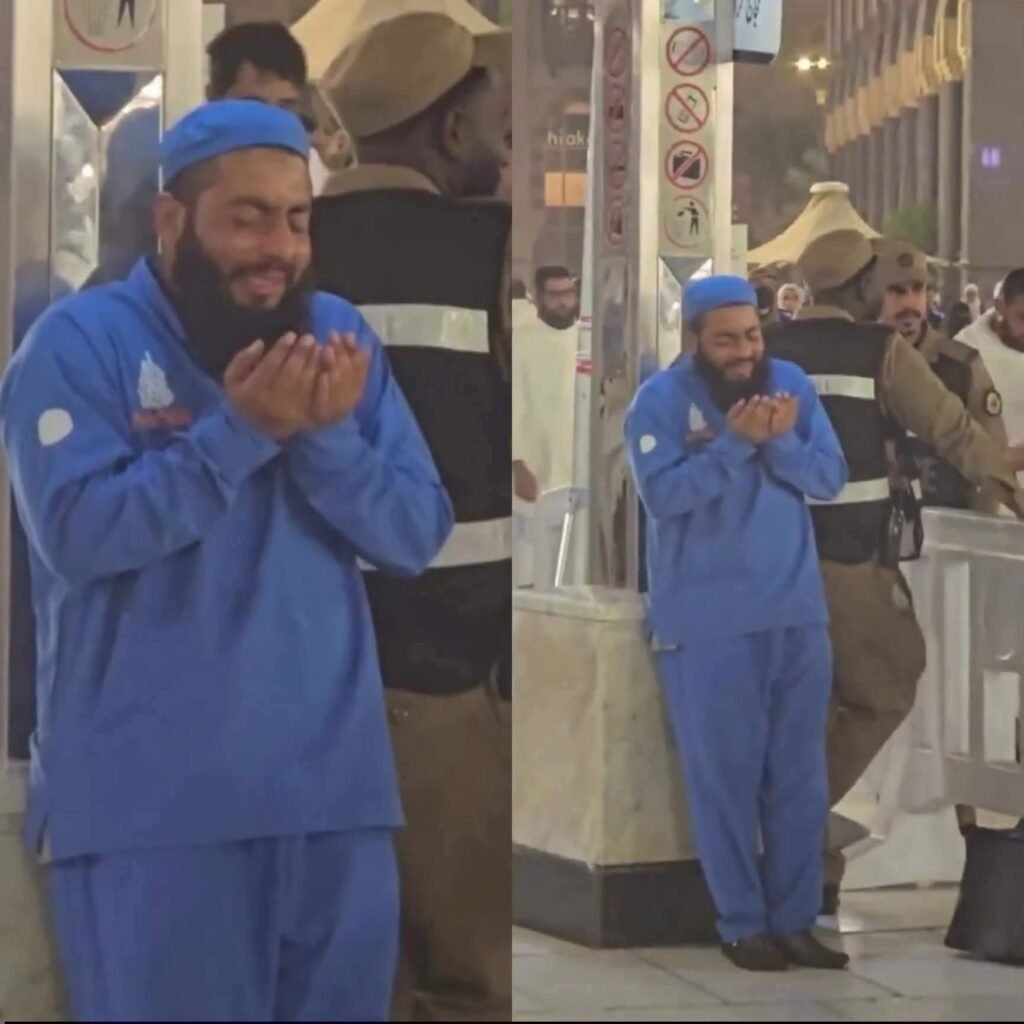
A short video clip showing a Pakistani sanitation worker in deep supplication near the Grand Mosque has circulated widely on social media in recent weeks, inspiring thousands with its display of humility and faith amid personal hardship.
The footage, captured in the evening hours outside the Haram area, depicts the man—dressed in the standard blue uniform worn by cleaning staff tasked with maintaining the sanctity and cleanliness of Islam’s holiest site—standing with hands raised and eyes closed in earnest dua (supplication). According to captions accompanying the video across platforms including X (formerly Twitter), Instagram, and Facebook, he was praying for relief from significant debts accumulated back in Pakistan, burdens exacerbated by his work abroad to support his family.
The narrative shared in numerous posts describes how the clip went viral, drawing the attention of an anonymous philanthropist in Saudi Arabia, often referred to as “one of the benefactors in the land of the Two Holy Mosques.” Upon contacting the worker and learning the details of his financial struggles, the individual reportedly paid off the full amount of his debts—an act presented as a timely answer to sincere prayer.
In follow-up accounts included in the viral posts, the worker is said to have explained that he was reciting a specific supplication attributed to the Prophet Muhammad (peace be upon him). The hadith recounts a moment when the Prophet ﷺ hosted a guest with no food available in the household. After his wives confirmed they had nothing, he supplicated: “O Allah, I ask You from Your bounty and mercy, for no one possesses them but You” (Allahumma inni as’aluka min fadlika wa rahmatika fa innahu la yamlikuha illa anta). Provision arrived shortly afterward in the form of a gifted roasted sheep.
Posts frequently close with another prophetic dua: “O Allah, suffice us with what is lawful from what is unlawful, and enrich us through Your bounty from all besides You” (Allahumma ikfina bi halalika ‘an haramika wa aghnina bi fadlika ‘amman siwaka)—a plea for halal sustenance and reliance solely on divine provision.
The story has resonated strongly within online Muslim communities, garnering thousands of likes, shares, and comments expressing admiration for themes of tawakkul (reliance on God), humility in service, and the power of dua. Accounts focused on Islamic inspiration, such as @Cool_Ustaz and @SpeaksUmmah on X, have amplified the tale, framing it as a contemporary parallel to prophetic tradition.
However, the account of the debt repayment remains unverified by independent sources. No major Saudi news outlets nor official statements from the Makkah municipality or Haram authorities have confirmed the philanthropist’s intervention, the worker’s identity, the amount involved, or any follow-up details. Searches for corroborating reports yield primarily recirculated social media content rather than journalistic verification.
Similar heartwarming stories involving foreign workers in Makkah frequently gain traction online. For instance, recent viral cases have highlighted Bangladeshi cleaners honored by the Makkah Mayoralty for selfless acts, such as giving away personal prayer rugs to pilgrims—incidents that received official recognition and media coverage. In contrast, this particular resolution appears limited to faith-oriented social media circles without broader substantiation.
Migrant workers from Pakistan and other South Asian countries form a vital part of the workforce supporting the annual Hajj and Umrah seasons, often facing economic pressures including family debts back home. Such anecdotes underscore the challenges they encounter alongside the profound spiritual significance of serving in the holy cities.
While the images and video footage appear authentic and align with the environment around the Grand Mosque, the full chain of events—from viral spread to alleged debt clearance—should be treated as anecdotal pending confirmation. In an age of rapid online sharing, stories like this continue to inspire reflection on faith, charity, and compassion, even as questions of verification persist.


The Chenab Times News Desk