


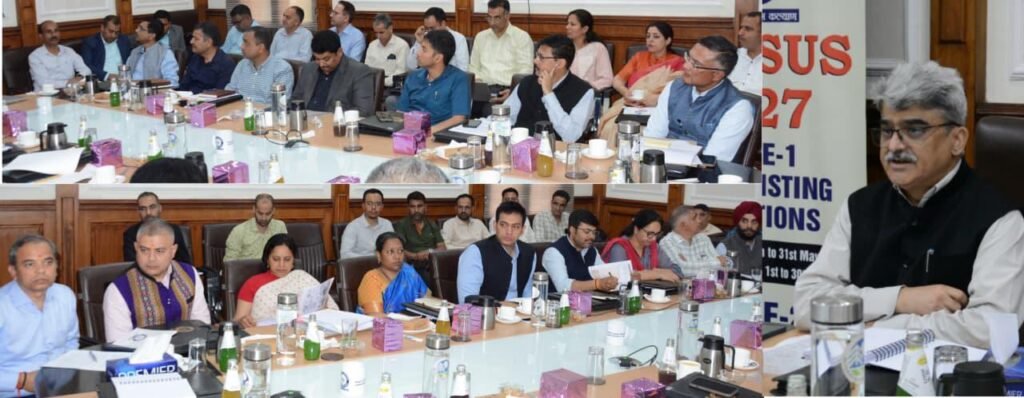
JAMMU: Jammu and Kashmir has intensified preparations for the upcoming Census-2027, with a high-level sensitisation meeting held to review and strengthen coordination for the exercise, which will mark India’s first fully digital population count.
The meeting, held in Jammu, was chaired by Chief Secretary Atal Dulloo in the presence of Registrar General and Census Commissioner of India Mritunjay Kumar Narayan. It brought together Administrative Secretaries, senior officers from the Union Territory administration, divisional and district officials, and representatives from various government departments. According to details received by The Chenab Times, the session focused on defining roles, responsibilities, and strategies to ensure the census is conducted systematically, transparently, and efficiently across the Union Territory.
Chief Secretary Atal Dulloo emphasised the importance of proactive and coordinated efforts among all departments and field functionaries to support the census machinery. He highlighted the critical role of public awareness and outreach, urging officials to encourage citizens to participate actively and provide accurate information. The success of the census, he noted, hinges on strong cooperation between the administration and the public to guarantee the credibility and completeness of the collected data.
Registrar General and Census Commissioner Mritunjay Kumar Narayan expressed satisfaction with the level of preparedness in Jammu and Kashmir. He stated that the discussions and briefings indicated diligent completion of both census phases within prescribed timelines. He underscored the foundational importance of census data in determining states’ and Union Territories’ shares in Finance Commission allocations and guiding development programmes over the next decade. Reliable data, he added, is essential for evidence-based policy planning and decision-making.
Director Census Operations for Jammu and Kashmir and Ladakh Amit Sharma presented a detailed overview of the strategy, methodology, administrative arrangements, and digital systems planned for the Union Territory. Census-2027 will proceed in two phases nationwide. Phase-I involves House Listing Operations (HLO) and Housing Census, starting with a 15-day self-enumeration window from May 17 to May 31, 2026, followed by 30 days of house-to-house enumeration in June 2026. This phase will cover housing conditions, household amenities, and infrastructure.
Phase-II, Population Enumeration, will account for Jammu and Kashmir’s unique climatic conditions, beginning in September 2026 for snow-bound areas and February 2027 for non-snowbound regions. This phase will collect detailed demographic, socio-economic, and cultural data. The Census Reference Date is fixed as March 1, 2027, for most areas, with October 1, 2026, for snow-bound regions.
A key innovation is the use of a dedicated mobile application for digital data collection, available on Android and iOS platforms and supporting languages including Hindi, English, and Urdu in Jammu and Kashmir. The app functions in offline mode in areas with limited connectivity, requiring internet only for device registration and data upload. To ensure transparency and accuracy, only registered enumerators on the Census Management and Monitoring System (CMMS) will collect and upload data, with supervisors verifying entries through the system.
Training arrangements include National Trainers and Master Trainers preparing 614 Field Trainers, who will in turn train approximately 30,871 Enumerators and Supervisors across the Union Territory. Specialised three-day training programmes are scheduled between May 7 and May 25, 2026.
The government has sanctioned an honorarium of ₹25,000 each for Enumerators and Supervisors, comprising ₹9,000 for the Houselisting phase and ₹16,000 for Population Enumeration. The census will cover 20 districts, 207 tehsils, 6,462 villages, 78 towns, and two Municipal Corporations in Jammu and Kashmir.
Officials stressed that the exercise will capture comprehensive information on housing, assets, demographics, language, literacy, education, economic activity, migration, and other socio-economic indicators to inform policy formulation and development planning at national and local levels. The meeting reflected Jammu and Kashmir’s commitment to a smooth, technology-driven census after a gap since 2011, aligning with national timelines while addressing regional challenges.


The Chenab Times News Desk