


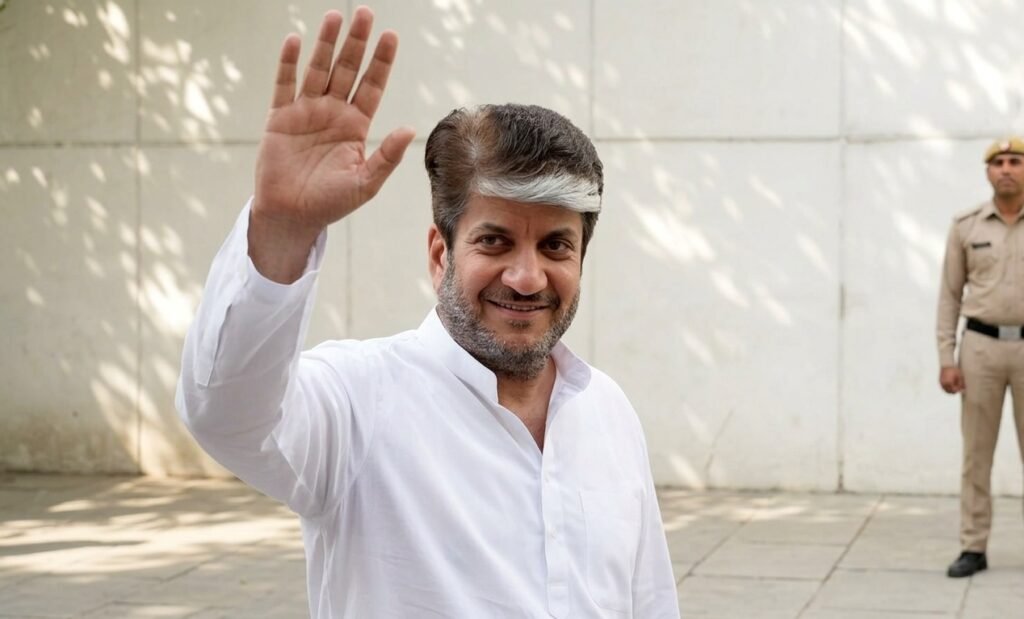
New Delhi: The Supreme Court has granted bail to Kashmiri separatist leader Shabir Ahmed Shah in a high-profile terror funding case investigated by the National Investigation Agency (NIA), citing unexplained delays in the trial process and his prolonged incarceration.
According to details received by The Chenab Times, a bench comprising Justices Vikram Nath and Sandeep Mehta passed the order on Thursday after hearing arguments from senior advocate Colin Gonsalves, representing Shah, and senior advocate Siddharth Luthra for the NIA. The court noted that the delay in the trial could not be justified and observed anomalies in the proceedings. A detailed order with stringent bail conditions is expected to follow.
Shah, founder of the Jammu Kashmir Democratic Freedom Party (JKDFP), was arrested by the NIA on June 4, 2019, and included as an accused in the second supplementary chargesheet filed on October 4, 2019. The allegations against him include playing a key role in building a separatist movement in Jammu and Kashmir, paying tributes to families of slain militants, receiving funds through hawala channels, and utilising Line of Control (LoC) trade to channel money for subversive and militant activities. The case is registered under various sections of the Unlawful Activities (Prevention) Act (UAPA) and other laws, with the NIA claiming a conspiracy to raise and collect funds to disrupt the Kashmir valley and wage war against the Government of India.
Shah had challenged a July 7, 2023, order by a special NIA court in Delhi rejecting his bail plea, which was upheld by the Delhi High Court. In his appeal to the Supreme Court, Shah argued that he was not named in the main chargesheet or the first supplementary chargesheet, and that the offences were alleged to stem from a conspiracy in which he had no direct involvement. He highlighted his prolonged detention—now exceeding six years—and the impracticality of a speedy trial given the prosecution’s plan to examine around 400 witnesses.
The NIA opposed the bail, asserting that Shah and other accused had conspired to fund activities aimed at destabilising the region. During hearings, the agency presented evidence including alleged inflammatory materials, but the Supreme Court had previously questioned reliance on outdated references, such as speeches from the 1990s, and sought contemporary proof to justify the extended custody.
The development comes amid ongoing scrutiny of prolonged undertrial detentions in sensitive cases involving national security laws. Shah’s bail follows earlier Supreme Court observations on the need to balance investigative requirements with the right to liberty, particularly when trials face significant delays.
Legal experts note that the court’s emphasis on trial delays reflects a broader concern over pendency in UAPA-related matters, where stringent bail provisions often result in extended pre-trial imprisonment. The stringent conditions accompanying the bail are anticipated to include restrictions on movement, communication, and activities to prevent any potential influence on witnesses or repetition of alleged offences.
Shah, a prominent figure in the separatist landscape of Jammu and Kashmir for decades, has been a vocal advocate for the region’s political aspirations. His release is likely to draw attention in the Chenab Valley and broader Kashmir region, where he retains influence among certain sections. Authorities have maintained that the case pertains to funding networks linked to militant activities, though the trial is yet to conclude.
The matter, registered as SLP (Crl) No. 13399/2025, titled Shabir Ahmed Shah Versus National Investigation Agency, underscores the complexities of adjudicating bail in terror-related prosecutions under stringent statutes like the UAPA.


The Chenab Times News Desk