


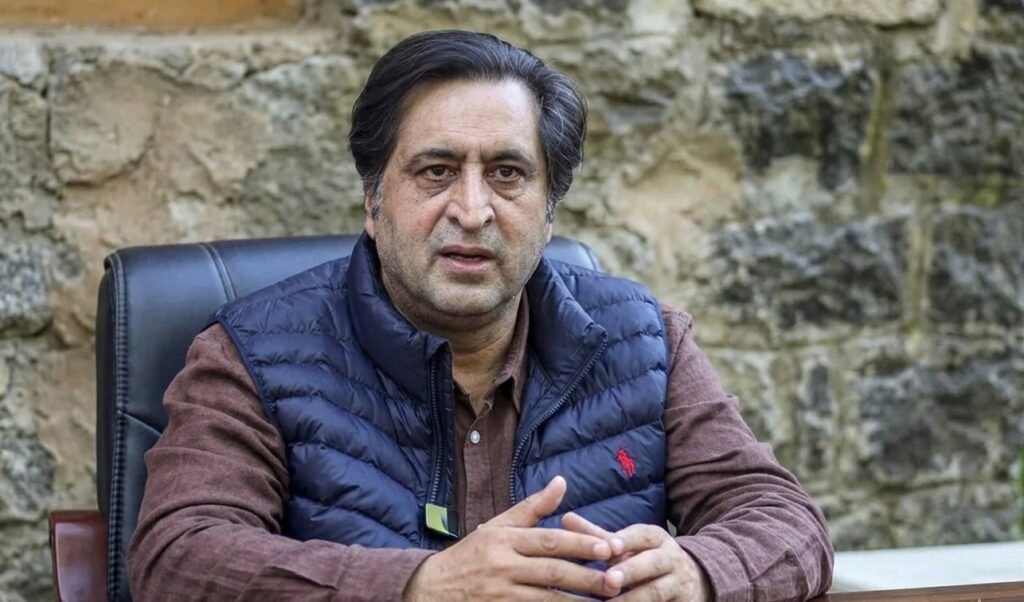
SRINAGAR: Sajad Lone, president of the Jammu and Kashmir Peoples Conference and a Member of the Legislative Assembly representing Handwara, has raised significant concerns regarding inconsistencies in the definition of economic vulnerability across various government departments in Jammu and Kashmir. Speaking in the Legislative Assembly on Monday, Lone highlighted these disparities as a structural flaw that impacts the equitable distribution of welfare benefits and employment opportunities.
Information was available with The Chenab Times indicating that Lone cited official data to illustrate the discrepancies. He noted that the Food Department identifies approximately 39 lakh individuals in Kashmir and 27 lakh in Jammu as economically disadvantaged under the Public Distribution System (PDS) categories of Below Poverty Line (BPL) and Antyodaya Anna Yojana (AAY). In stark contrast, the Social Welfare framework presents a different scenario, classifying nearly 90 per cent of Jammu’s population as economically weak, while only about 10 per cent in Kashmir fall under similar classifications.
Contradictory Definitions Undermine Fairness
Lone described this contradiction as a policy failure with profound implications, particularly concerning recruitment processes that utilize the Economically Weaker Sections (EWS) quota. He drew attention to recent appointments, including those in judicial services and the Jammu and Kashmir Administrative Service (JKAS), stating that such pronounced disparities in classification have not been observed since 1947. The discrepancy, he argued, is actively disadvantaging candidates from the Kashmir region.
The Handwara MLA questioned the existing approach, pointing out that individuals are deemed poor enough to receive rations and subsidies, yet they are concurrently considered ineligible under EWS criteria when applying for job vacancies. This inconsistency, he asserted, undermines the very principles of good governance and fairness.
Concerns Over Future Recruitment
Lone also expressed apprehension regarding upcoming recruitment drives. He noted that out of an anticipated 30,000 job opportunities, only a limited number might be allocated to candidates from Kashmir under the prevailing EWS framework. He contrasted this projection with the BPL data, which, according to his interpretation, would justify a substantially higher allocation for the Kashmir region.
Call for Policy Coherence
Urging the administration to implement corrective measures, Lone called for the adoption of a uniform definition of poverty that would be consistently applied across all government departments. Such a measure, he emphasized, is crucial to ensure fairness and consistency in policy implementation. Lone underscored that the issue requires policy coherence rather than simply legislative amendments to rectify the prevailing discrepancies.


The Chenab Times News Desk