


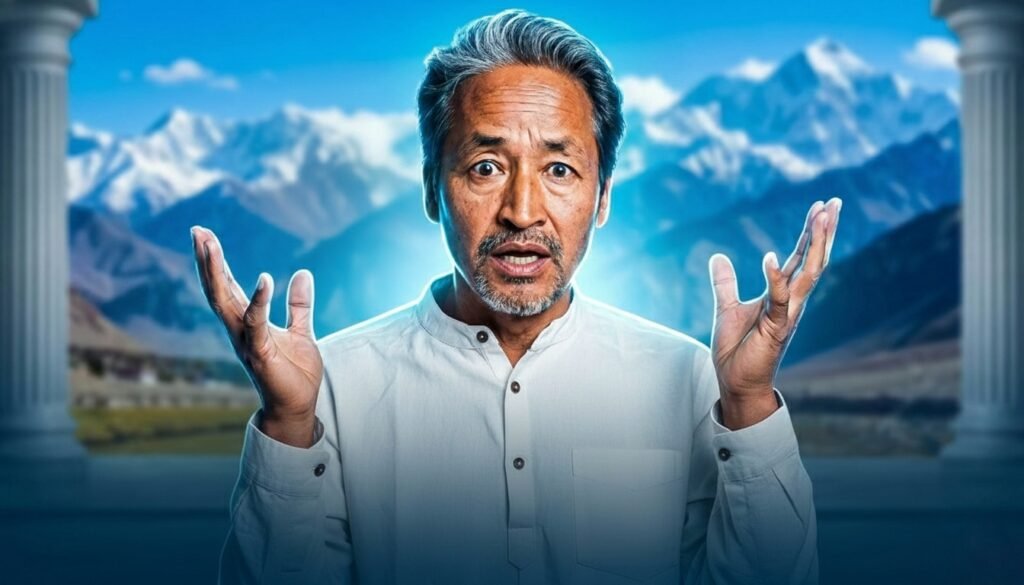
Kargil, Ladakh – Climate activist Sonam Wangchuk received a warm reception in Kargil on Sunday, where he emphasized the need for national unity and reiterated calls for democratic and constitutional rights for the Union Territory of Ladakh.
Information was available with The Chenab Times that this visit marked Wangchuk’s first to Kargil following his release on March 14. He had been detained for nearly six months in Jodhpur jail under the National Security Act (NSA) before the grounds for his detention were revoked by the central government, subsequent to a habeas corpus petition filed by his wife in the Supreme Court of India.
Leaders from the Kargil Democratic Alliance (KDA) and Leh Apex Body (LAB), organizations spearheading the agitation for statehood and the implementation of the Sixth Schedule in Ladakh, pressed for the next round of discussions with the High Powered Committee established by the Ministry of Home Affairs. They warned that persistent delays and a lack of decisive action could escalate the ongoing movement.
Wangchuk, accompanied by LAB co-chairman Chering Dorjey, was greeted enthusiastically by KDA leadership, including co-chairman Asgar Ali Karbalai, Member of Parliament Haneefa Jan, and prominent leader Sajjad Kargili. He was then escorted to a rally venue amidst a procession where participants chanted slogans in his support.
Expressing gratitude to the people and leadership of the KDA for their solidarity during his detention, Wangchuk underscored the importance of unity across Ladakh and the entire nation. He urged citizens to transcend divisions and collaborate towards a more promising future.
“What should unite us is humanity and a shared sense of being Indian. We should not get divided into ‘this side’ or ‘that side,’ nor into religion or sect; we must come closer to one another, not drift apart,” Wangchuk stated during the event.
He highlighted that Ladakh’s present demands concern the entire region and necessitate a collective approach for their resolution. “The rights that Ladakh deserves, democratic rights, constitutional rights, and rights over its resources, should be ensured just like in the rest of the country,” he added.
Wangchuk noted that the unity demonstrated between regions like Leh and Kargil has significantly strengthened the movement. “For the first time, people from different parts of Ladakh came together and raised their voice in unity – this spirit must be preserved,” he remarked.
Describing his detention as an arduous yet significant experience, Wangchuk stated, “It was not easy, but if it serves Ladakh, it is a valuable experience; there is a new dawn ahead.” He acknowledged that numerous others had faced even greater hardships to keep the region’s issues in public discourse.
Advocating for a broader perspective, Wangchuk urged, “If we move forward seeing each other simply as human beings, leaving behind divisions, then not just Ladakh but the whole country can become more peaceful and prosperous.”
Ladakh MP Haneefa Jan characterized Wangchuk’s release as “a victory of our honesty and our truth.” He emphasized that while the movement has maintained a firm stance, its primary approach remains dialogue, urging the government to engage sincerely with the people of Ladakh.
“We have always wanted a solution through dialogue, but this dialogue must be sincere and genuinely reflect the aspirations of the people of Ladakh,” Jan said. He appealed to Union Home Minister Amit Shah to resume talks at the earliest, stressing that discussions should lead to concrete outcomes.
Jan cautioned against using dialogue as a mere delaying tactic, pointing out that Ladakh’s populace has been articulating their demands for five to six years without substantial resolution. “We are peace-loving people and have always expressed our protests in a calm and dignified manner, but our patience should not be tested,” he warned.
Reiterating the necessity of unity to bolster negotiations, he cautioned against efforts to divide the region and weaken the movement. “We must stay united and not allow any forces to create differences among us,” Jan stated, adding that a united Ladakh would be better positioned to achieve a just and lasting solution through dialogue.
Chering Dorjey expressed gratitude for public support, interpreting the warm reception as a reflection of widespread solidarity with the movement. He asserted that Wangchuk’s release was “not a favour” from the government but a consequence of legal pressure, alleging that the Centre had “virtually lost the case” in the Supreme Court.
Dorjey claimed that serious charges were withdrawn as a “face-saving measure” and described the “anti-national” label against Wangchuk as an attempt to discredit the movement. He also highlighted ongoing concerns regarding the detention of approximately 80 workers following violence in Leh on September 24, with two still imprisoned and cases against others pending withdrawal.
He warned of deliberate attempts to foster divisions and urged the public in both districts to remain vigilant and unified. “Do not allow anyone to make us fight among ourselves,” Dorjey urged, stressing the indispensability of unity for sustaining the movement.
Asgar Ali Karbalai stated that the movement remains open to dialogue but rejected any attempts to dilute its demands through such discussions. “The movement is not afraid of dialogue; it is ready with an open mind and sincerity, but it should not be used to impose one’s will,” he said, asserting that Ladakhis “will never bow down.”


The Chenab Times News Desk