


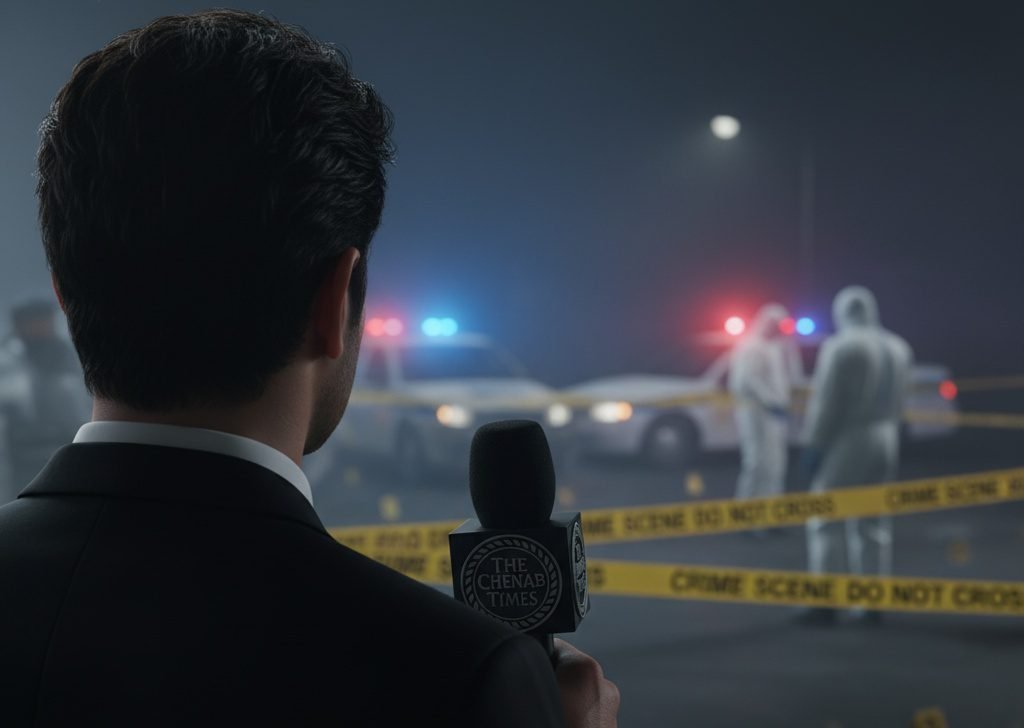
Authorities in Suffolk County, New York, continue to meticulously build their case against Rex Heuermann, a man arrested and charged in connection with a series of brutal murders that have haunted the region for over a decade. The investigation into the Gilgo Beach killings, a case that gained national notoriety with the discovery of multiple dismembered bodies, has now entered a critical phase as prosecutors prepare to present evidence against Heuermann, focusing on his alleged involvement in the deaths of at least three women.
According to details received by The Chenab Times, the complex investigation is piecing together a timeline that stretches back to 2007, with law enforcement agencies meticulously examining evidence gathered from crime scenes, Heuermann’s properties, and digital records. The Gilgo Beach murders remain one of the Long Island’s most chilling mysteries, with the discovery of human remains beginning in late 2010 and continuing intermittently thereafter, exposing a dark undercurrent of violence that had gone undetected for years.
Rex Heuermann, an architect residing in Massapequa Park, was arrested in July 2023, more than thirteen years after the first victim, Melissa Barthelemy, disappeared in July 2007. Heuermann has been formally charged with multiple counts of murder in connection with the deaths of Melissa Barthelemy, Megan Waterman, and Amber Lynn Costello. These three women, along with Maureen Brainard-Barnes, are often referred to as the “Gilgo Four” – the first victims whose remains were discovered along Ocean Parkway in Oak Beach, near Gilgo Beach, in December 2010. Their bodies were found wrapped in burlap, a grim discovery that laid bare the scale of the serial killings.
Prosecutors have asserted that Heuermann is responsible for more than the four deaths that form the initial focus of the charges. During legal proceedings, the Suffolk County District Attorney’s office has presented evidence and made statements suggesting Heuermann’s potential involvement in the death of Maureen Brainard-Barnes, whose disappearance in 2007 predated the other victims. The investigation has also explored links between Heuermann and other unidentified remains found in the vicinity, suggesting the possibility of a higher victim count. The complexity of the case is amplified by the sheer number of victims discovered and the passage of time, which often degrades crucial forensic evidence.
The grim discovery timeline began on December 11, 2010, when a New York State Police trooper, investigating a report of a partially clothed woman seeking help on the parkway, stumbled upon the remains of Melissa Barthelemy. A subsequent search of the area over the following days revealed the bodies of Megan Waterman, Amber Lynn Costello, and an unidentified woman, later identified as Jessica Taylor. The remains of Jessica Taylor had previously been found in 2003, and parts of her body were discovered again in 2011 near Gilgo Beach.
Heuermann’s arrest followed years of painstaking police work, leveraging advances in DNA technology and digital forensics. Investigators reportedly focused on cell phone data that allegedly placed Heuermann near the locations of the victims around the times of their disappearances. A comprehensive search of Heuermann’s Massapequa Park home, as well as properties in South Carolina, yielded a significant amount of evidence, including firearms, computers, and other items that investigators believe may be relevant to the case. Authorities have suggested that Heuermann led a double life, operating as a seemingly ordinary architect while allegedly engaging in predatory behavior.
The victims themselves represent a tragic tapestry of lives cut short. Melissa Barthelemy, 24, was a sex worker who disappeared on July 12, 2007, after making a phone call from her cell phone. Megan Waterman, 22, also a sex worker from Maine, vanished in June 2007. Amber Lynn Costello, 27, another sex worker, disappeared in September 2010. Maureen Brainard-Barnes, 25, a hotel housekeeper from New York, was the earliest victim, disappearing in August 2007 while in Manhattan before traveling to Montauk. Her case was initially investigated separately before being linked to the broader Gilgo Beach discoveries.
The investigation into the Gilgo Beach murders has been fraught with challenges, including jurisdictional disputes, internal reviews of the police department’s handling of the case, and the sheer difficulty of connecting a suspect to crimes committed over several years. The New York State Police, the Suffolk County Police Department, and the Federal Bureau of Investigation have all been involved in the extensive and ongoing inquiry. The focus on Heuermann has brought a degree of closure to some families who have been waiting for answers for over a decade, though the full extent of his alleged crimes remains a subject of intense investigation.
As the legal process unfolds, Heuermann faces grave charges that could result in significant prison sentences if he is convicted. The prosecution’s strategy will likely involve presenting a compelling narrative supported by forensic evidence, witness testimonies, and the digital footprint allegedly linking Heuermann to the victims. The defense, conversely, will aim to create reasonable doubt, challenging the evidence presented and the prosecution’s theories. The trial, when it eventually commences, is expected to draw considerable public attention, given the sensational nature of the case and the long period of uncertainty it has imposed on the Long Island community and the families of those lost.
The Suffolk County District Attorney’s office has stated that the investigation is still active and that authorities are committed to uncovering the truth behind all the deaths discovered along Ocean Parkway. The search for additional evidence and the potential identification of further victims continue to be priorities. The Gilgo Beach murders have cast a long shadow over the region, serving as a stark reminder of the persistent threats that vulnerable populations can face and the enduring quest for justice in the face of profound tragedy.


Global Affairs Desk at The Chenab Times covers international developments, global diplomacy, and foreign policy issues through fact-based reporting, explainers, and analytical pieces. The desk focuses on major geopolitical events, diplomatic engagements, and international trends, with an emphasis on verified information, multiple perspectives, and contextual understanding of global affairs.