


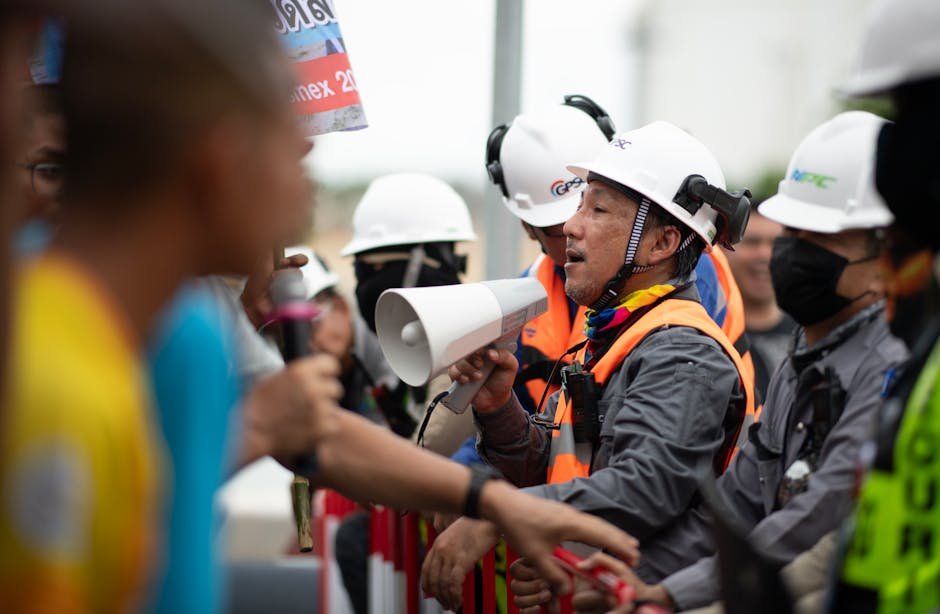
A protest by factory workers demanding wage revisions brought significant parts of Noida and major Delhi-bound routes to a standstill on Monday, triggering extensive traffic congestion and leaving thousands of commuters stranded for hours. The disruption affected key arteries including NH-24, Sector 62, and Sector 63, leading to a near-complete paralysis of movement across the Noida-Delhi corridor.
Information was available with The Chenab Times that the industrial protest, initially localized, rapidly escalated and spread across the region’s road network. By afternoon, the situation had evolved from isolated blockades to a pervasive shutdown of transportation infrastructure, severely impacting critical entry points into the national capital.
The scale of the transportation breakdown was starkly visible, with vehicles bumper-to-bumper across multiple kilometers. Many commuters were forced to abandon their vehicles and wait under the scorching sun as traffic remained completely immobilized. Police attempted to alleviate the congestion by allowing vehicles to move against the normal flow of traffic, guiding drivers to turn back as forward progress was impossible.
Authorities indicated that the disruption originated from protests in Noida’s Phase-2 and Sector 60 areas, where factory workers had gathered to press for long-pending wage revisions and the enforcement of minimum wage standards. As the number of protesters swelled, the demonstration expanded onto adjacent roads, creating a domino effect that crippled the wider transport network. While the protest commenced peacefully, later stages saw instances of aggression, with reports of stone-pelting, vandalism, and arson, including a vehicle being set ablaze and damage to public property.
Efforts to clear the roads were further complicated by these aggressive actions, prolonging the blockade. The Gautam Buddh Nagar Police Commissionerate responded by intensifying security measures in industrial zones and deploying senior officers to manage the situation and restore normalcy. The impact of the protest extended beyond Noida, with a separate demonstration by women employees causing a blockade on the Delhi-Agra National Highway between Faridabad and Palwal, thereby increasing pressure on alternative routes and exacerbating congestion throughout the National Capital Region.
Workers involved in the protest stated that their demands for salary increases and adherence to minimum wage regulations had been consistently overlooked despite repeated attempts at dialogue, leading to the escalation of their actions. For the commuters caught in the gridlock, however, the underlying cause provided little immediate solace. The day was characterized by a profound slowing of movement across the NCR, where each attempt to navigate through the congestion led only to further delays and impassable routes.
The ordeal for many began around midday. This correspondent, attempting to travel from Greater Noida towards NH-24 via Crossing Republic, encountered initial signs of obstruction even before reaching the highway, with vehicles already turning back. Drivers reported that the road ahead was completely blocked. An attempt to utilize a parallel service lane quickly proved futile, as the jam extended to Sector 62, demonstrating that the blockage was not confined to a single point but had already infiltrated interconnected routes.
By approximately 1:30 pm, a police official confirmed the road closure due to the factory worker protest but could offer no timeline for its resolution. The standstill intensified, locking up cars, trucks, and two-wheelers. Diversion attempts proved equally problematic. A significant detour via Gaur City, Crossing Republic again, and then towards Parthala bridge leading to Kailash Hospital also met with similar blockades, including the Sector 63 road, indicating the protest’s expansion across multiple industrial pockets and the simultaneous sealing of parallel corridors.
A further effort to enter Delhi through Sector 15, approximately eight to ten kilometers from Sector-63, was also met with a road closure. The DND Flyway, already experiencing heavy congestion since morning due to the spillover effects of the protest, offered no viable passage. After more than four hours of navigating a labyrinth of blocked routes and ineffective diversions, with no clear indication of when normal movement would resume, this correspondent was advised to return. Traffic began to ease gradually only around 6 pm, providing limited relief to those who had been stranded throughout the day.
The situation underscored the vulnerability of the region’s transportation infrastructure to localized industrial disputes, demonstrating how swiftly a protest can escalate to overwhelm urban systems and bring regional movement to a near-total halt, creating significant hardship for thousands of citizens.


The Chenab Times News Desk