


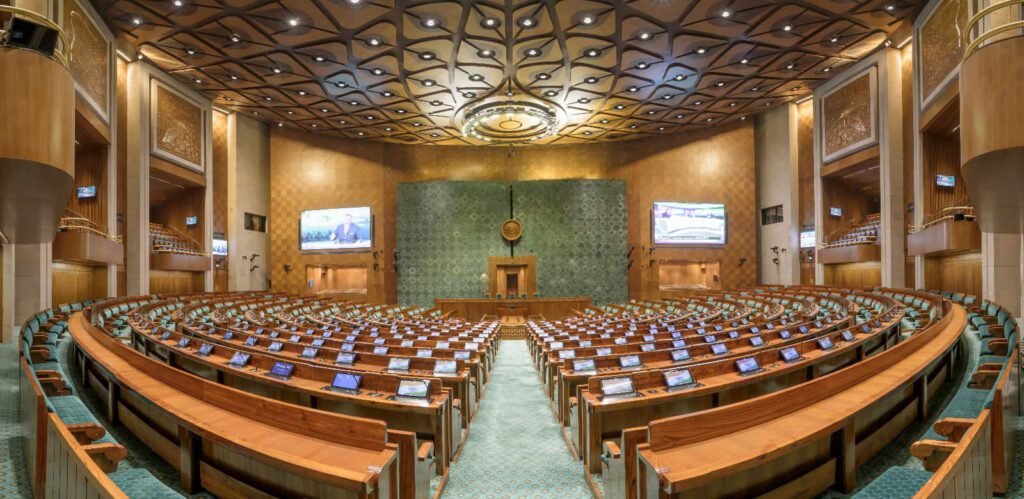
New Delhi: Senior Congress leader Shashi Tharoor has strongly criticised the proposed delimitation exercise, likening it to “political demonetisation” and warning of a potential “tyranny of demographic majority.” Speaking in the Lok Sabha on Friday, Tharoor cautioned that the process, if rushed, could upset India’s federal balance and marginalise smaller states, particularly those that have actively pursued population control measures.
The remarks by the Thiruvananthapuram MP came during a debate on bills related to women’s reservation and the constitution of a Delimitation Commission. Tharoor expressed concern that linking women’s representation to the delimitation process was akin to “holding the aspirations of Indian women hostage.” He argued that the women’s reservation bill could be implemented immediately without being contingent on the complex and contentious exercise of redrawing constituencies.
Tharoor drew a parallel between the government’s approach to delimitation and the hurried implementation of demonetisation, suggesting that both actions, due to their haste, could lead to significant negative consequences for the country. “You have proposed delimitation with such haste, the same haste that you showed on demonetisation,” Tharoor stated. “Unfortunately, we all know what damage that did to the country. Delimitation, sir, will turn out to be political demonetisation. Don’t do it…”
The Congress leader elaborated on his concerns, highlighting three key considerations regarding delimitation. Firstly, he pointed to the imbalance between smaller and larger states, and between states that have diligently implemented population control and invested in inclusive human development, and those that have not. Secondly, he raised the issue of states contributing significantly to the economy versus those that are net recipients of central funds. Thirdly, Tharoor warned that delimitation could reward higher population growth rather than governance outcomes, thereby distorting representation between states and weakening the federal structure.
He questioned the message such an approach would send, asking, “We must ask if this is the message we wish to send: that governance excellence leads to political irrelevance.” Tharoor further added that the exercise could marginalise states that provide resources for the nation’s sustenance and possess distinct cultural identities, potentially making their citizens feel like “bystanders in their own country.”
The delimitation exercise in Jammu and Kashmir, for instance, has seen its Assembly seats increase from 87 to 90, with new reservations for Scheduled Castes and Scheduled Tribes. While the new distribution assigned 43 seats to the Kashmir Valley and 47 to the Jammu region, shifting weight towards Jammu, the process has been met with opposition from various political parties. The delimitation in Jammu and Kashmir followed the 2019 reorganisation of the state into a Union Territory, with the Delimitation Commission using the 2011 Census as a base and considering factors like geography and terrain.
Tharoor urged that the delimitation process be subjected to detailed discussion rather than being rushed through, emphasizing that it has the potential to “tear the fabric of federalism” in the country. He advocated for the immediate implementation of the women’s reservation bill, stating that it was “ready for harvesting” and could be enacted based on the existing parliamentary strength without the need for a future restructuring of constituencies.
The debate highlighted the significant political sensitivities surrounding delimitation, particularly the potential impact on the balance of power between northern and southern states. While the opposition has broadly supported women’s reservation, concerns persist regarding its linkage to the delimitation process, which is expected to redraw parliamentary constituencies based on updated population data.
In response to Tharoor’s criticisms, Union Home Minister Amit Shah had previously assured that southern states would not be negatively impacted by the delimitation process. However, Tharoor’s remarks underscore a broader apprehension that the exercise, if not handled with care and thorough deliberation, could lead to unintended consequences that affect the foundational principles of India’s democratic and federal structure.
The constitutional challenge to the increase in Assembly seats in Jammu and Kashmir and the overall delimitation exercise was dismissed by the Supreme Court. The court upheld the delimitation provisions of the Reorganisation Act, stating that Article 170 of the Constitution, which governs the composition of State Legislatures, does not apply to Union Territories.
Tharoor’s critique adds another layer to the ongoing discourse surrounding electoral reforms in India, emphasizing the need for careful consideration of demographic shifts, regional disparities, and the potential for political power to be concentrated in fewer hands as a result of boundary redrawing. The linking of women’s reservation with delimitation remains a focal point of contention, with many arguing for its immediate passage to empower women in politics without further delay.


The Chenab Times News Desk