


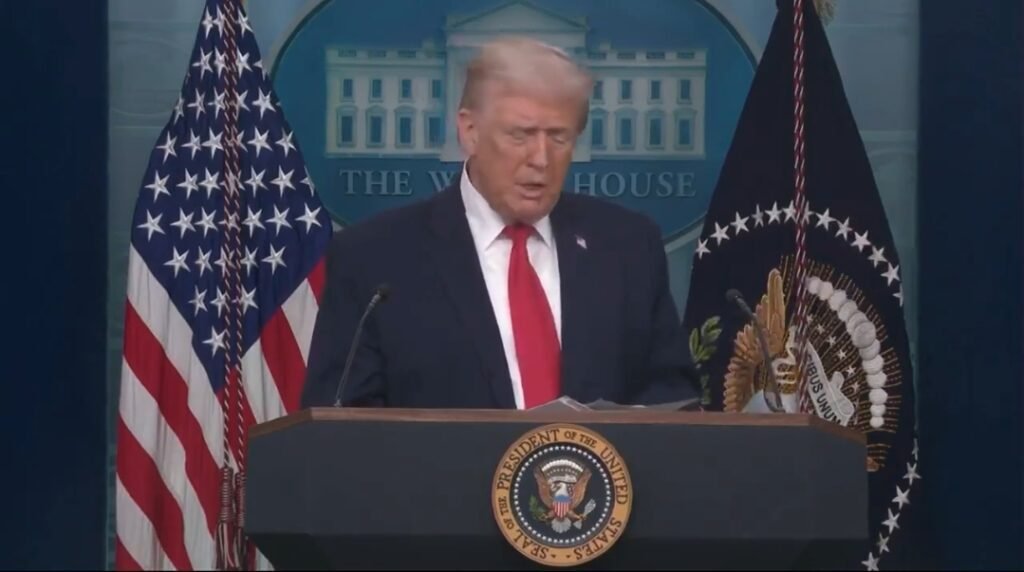
Former President Donald Trump’s stated goal of eliminating Iran’s atomic stockpile is being revisited in the context of policy decisions made during his administration, particularly the 2018 withdrawal from the Joint Comprehensive Plan of Action (JCPOA).
The Chenab Times has learned that the decision to abandon the Obama-era nuclear deal, which aimed to curb Iran’s nuclear program in exchange for sanctions relief, has been cited as a significant factor in Iran’s subsequent acceleration of its uranium enrichment activities. This development continues to shape ongoing international discussions and diplomatic efforts concerning Iran’s nuclear capabilities.
In May 2018, President Trump announced the United States’ withdrawal from the JCPOA, a multilateral agreement negotiated in 2015 among Iran and the P5+1 (the five permanent members of the United Nations Security Council—China, France, Russia, the United Kingdom, and the United States—plus Germany). Trump characterized the deal as “terrible” and “one-sided,” asserting that it did not sufficiently address Iran’s ballistic missile program or its regional influence, and that it would not prevent Iran from eventually developing nuclear weapons.
The withdrawal was met with widespread criticism from European allies and international organizations that had supported the accord, including the International Atomic Energy Agency (IAEA), which reported Iran’s compliance with the deal’s terms at the time of the US withdrawal. Following the US exit, Iran began to gradually increase its uranium enrichment levels and expand its stockpile of enriched uranium, deviating from the restrictions imposed by the JCPOA. This response has been interpreted by many analysts as a direct consequence of the US sanctions being reimposed and the collapse of the economic benefits Iran was supposed to receive under the agreement.
The JCPOA had stipulated that Iran limit its uranium enrichment purity to 3.67% and reduce its stockpile of enriched uranium. Before the agreement, Iran’s enrichment activities were much more advanced, with purity levels reaching up to 20% and a larger, albeit civilian-purposed, stockpile. The deal also included a substantial reduction in the number of centrifuges Iran operated.
Following the US withdrawal and the reimposition of stringent economic sanctions, Iran announced its intention to cease implementing certain provisions of the JCPOA. Over time, Iran’s enrichment levels have risen, with the country reporting enrichment activities at higher purities, including significant quantities of uranium enriched to 60%, a level close to that needed for weapons-grade uranium. The IAEA has consistently reported on these developments through its regular inspections and reports, highlighting the increased technical capacity Iran has developed.
The stated aim of eliminating Iran’s atomic stockpile, as articulated by Trump, implies a desire to dismantle Iran’s entire nuclear infrastructure capable of producing fissile material for weapons. However, the path to achieving such a goal is fraught with geopolitical complexities. The sanctions imposed by the Trump administration aimed to exert maximum economic pressure on Iran, with the objective of forcing the regime to negotiate a new, more stringent deal. This strategy, however, has not yet led to Iran returning to the negotiating table on terms that would satisfy the original demands for a comprehensive agreement addressing all concerns.
Diplomatic efforts to revive the JCPOA have been ongoing, involving indirect talks between the US and Iran, mediated by other countries such as Qatar, Oman, and the European Union. These discussions have sought to find a pathway back to the original agreement or to negotiate an interim understanding that would provide some predictability regarding Iran’s nuclear program. However, progress has been slow, with significant disagreements remaining on the scope of sanctions relief and the specific nuclear commitments required from Iran.
The legacy of the 2018 decision continues to cast a long shadow over international security discussions. The concern among international powers is that Iran’s growing nuclear knowledge and material could potentially be diverted for military purposes, a scenario that the original JCPOA was designed to prevent. The current situation presents a delicate balance, where the threat of further escalation in Iran’s nuclear activities is juxtaposed with the desire to avoid a wider regional conflict.
The debate surrounding the effectiveness of the “maximum pressure” campaign initiated by the Trump administration versus the approach of diplomatic engagement and multilateral agreements remains a central theme in US foreign policy discourse regarding Iran. While proponents of the former argue that economic hardship is the only language Tehran understands, critics point to the counterproductive outcome of Iran advancing its nuclear program significantly since the JCPOA’s unraveling. The international community continues to monitor the situation closely, with concerns about proliferation and regional stability at the forefront of diplomatic agendas.
The IAEA has played a crucial role in monitoring Iran’s nuclear activities, providing technical assessments and verifying compliance with its safeguards agreements. However, the agency’s ability to provide assurances about the peaceful nature of Iran’s nuclear program has been hampered by challenges, including limitations on access and data verification, particularly since Iran began restricting some of the IAEA’s inspection activities in response to political developments.
Looking forward, any successful resolution to the Iran nuclear issue will likely require a sustained commitment to diplomacy, a clear understanding of both Iran’s security concerns and the international community’s non-proliferation objectives, and a willingness to engage on a broad range of issues that contribute to regional stability.


Global Affairs Desk at The Chenab Times covers international developments, global diplomacy, and foreign policy issues through fact-based reporting, explainers, and analytical pieces. The desk focuses on major geopolitical events, diplomatic engagements, and international trends, with an emphasis on verified information, multiple perspectives, and contextual understanding of global affairs.