


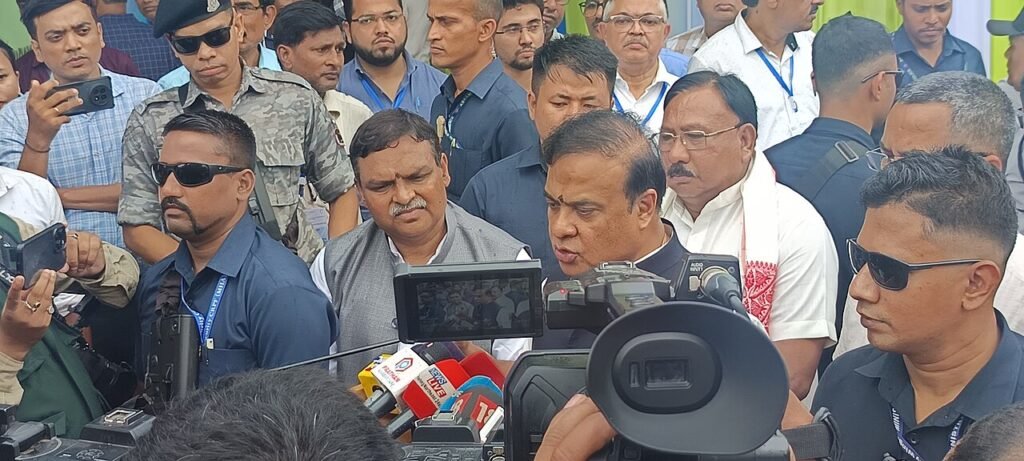
Assam Chief Minister Himanta Biswa Sarma has stated that the ongoing West Bengal assembly elections hold significance for every Indian, asserting that infiltrators from Bangladesh are not only altering the demographic landscape of West Bengal but also extending their presence into neighbouring states.
The Chenab Times has learned that Sarma, addressing a press conference in Kolkata, projected a significant victory for the Bharatiya Janata Party (BJP) in both Assam and West Bengal. He anticipates the BJP securing over 100 seats in Assam out of 126 and winning 110 of the 152 seats contested in the initial phases in West Bengal. He further suggested that the BJP’s performance in West Bengal could exceed 200 seats, noting the absence of a climate of fear indicated by the approximately 93 percent voter turnout in the first phase.
Sarma characterized the West Bengal election as more than a routine state poll, describing it as a contest with “civilisational implications” for the entire nation, particularly the eastern and northeastern regions. He emphasized that the impact of infiltration extends beyond West Bengal and Assam, affecting states such as Jharkhand and Bihar.
Highlighting the geographical vulnerabilities, Sarma pointed out that West Bengal shares 54 percent of India’s total border with Bangladesh, a figure substantially higher than that of Tripura (21 percent), Meghalaya (11 percent), Mizoram (8 percent), and Assam (6 percent). He stressed that an open border in any of these states would have repercussions across the entire region, with infiltrators using West Bengal as a transit point to reach other parts of India.
The Assam Chief Minister accused the Trinamool Congress (TMC) government in West Bengal of deliberately obstructing the fencing of the international border. He contrasted this with Assam’s achievement of 100 percent border fencing and ongoing work in Tripura, stating that West Bengal is the sole state where such work is not progressing. Sarma alleged that the TMC’s lack of cooperation stems from vote bank politics and vested economic interests related to syndicates involved in smuggling activities.
Sarma expressed concern over the substantial increase in registered voters in West Bengal’s border districts, including Uttar Dinajpur, Malda, Murshidabad, South and North 24 Parganas, Jalpaiguri, Cooch Behar, and Nadia. He remarked that these districts now bear a resemblance to extensions of Bangladesh, indicating a rapid demographic shift.
The Chief Minister warned that unchecked infiltration could lead to both West Bengal and Assam losing their Hindu majority status within the next two decades, citing the current Muslim population in Assam nearing 40 percent. If the BJP forms the government in West Bengal, Sarma stated his intention to request Union Home Minister Amit Shah to establish a joint task force comprising the chief ministers of West Bengal, Assam, Tripura, Meghalaya, and Mizoram to address infiltration collaboratively.
He advocated for extending the Legal Immigrant Expulsion Act of 1948, which empowers district collectors to expel infiltrators within 48 hours, to all five border states. Sarma noted that the Supreme Court has already upheld the validity of this act for Assam.
Comparing economic indicators, Sarma asserted that Odisha has surpassed West Bengal in key economic aspects, and Assam’s economy, growing at 12 percent annually compared to West Bengal’s nine percent, is projected to exceed West Bengal’s per capita income within two years. He expressed the BJP’s agenda of rapid industrialization coupled with demographic protection for West Bengal, aiming for the state to compete with economic powerhouses like Gujarat and Maharashtra.


The Chenab Times News Desk