


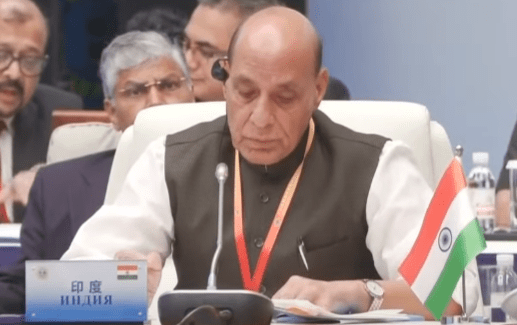
NEW DELHI: Defence Minister Rajnath Singh on Tuesday issued a strong warning against state-sponsored cross-border terrorism, asserting that “terror epicentres” are no longer immune to “justifiable punishment.” Speaking at a Shanghai Cooperation Organisation (SCO) conclave in Bishkek, Singh’s remarks were widely interpreted as a direct message to Pakistan regarding its alleged role in fostering cross-border militancy.
According to details received by The Chenab Times, Singh addressed the SCO defense ministers, emphasizing the need for the influential grouping to remain vigilant against state-sponsored cross-border terrorism and to reject any notion of double standards in combating this menace. He articulated that the true measure of power lies not in its use against the vulnerable, but in its application to protect those unable to defend themselves.
The Defence Minister advocated for a global consensus that prioritizes “co-existence, co-habitation and compassion over chaos, competition and conflict.” He urged the SCO member states to take appropriate action against entities that “abet, shelter and provide safe havens” to militants, underscoring that such state-sponsored activities fundamentally undermine the sovereignty of nations.
Singh stressed the importance of a unified front against terrorism, separatism, and extremism. He stated that effectively tackling these threats without exception could transform regional security from a persistent challenge into a foundation for peace and prosperity. The Defence Minister described terrorism as the “most serious threat” to the evolving world order, noting that counter-terrorism cooperation has been a core principle of the SCO since its inception.
Recalling the solemn remembrance of the victims of the Pahalgam militant attack on April 22, Singh highlighted the profound shock this incident caused globally. He then referenced ‘Operation Sindoor,’ stating, “During Operation Sindoor, we demonstrated our firm resolve that terrorism epicentres are no longer immune to justifiable punishment.” This operation, he implied, served as a clear demonstration of India’s determination to respond decisively to militant havens.
Singh referred to a declaration adopted at the previous year’s SCO summit in Tianjin, which solidified a collective stance against terrorism. He noted that this declaration reflected a zero-tolerance approach towards terrorism and its perpetrators, a stance endorsed by the forum. However, he cautioned that the “real test of our collective credibility remains in consistency.”
He reiterated that terrorism is devoid of nationality or religious affiliation, and no grievance, perceived or real, can justify acts of terrorism or the resulting human cost. The Defence Minister acknowledged the crucial role of the SCO’s Regional Anti-Terrorist Structure (RATS) and pointed to a joint statement issued during India’s chairmanship concerning ‘Countering Radicalisation leading to Terrorism, Separatism and Extremism.’
Singh highlighted the SCO’s pivotal role in navigating current global uncertainties, posing the question of whether a new world order or a more orderly world is needed. He advocated for an order where every individual is treated with dignity and respect, and where differences are resolved peacefully, preventing disasters. He identified the real crisis as a tendency to question the established rule-based world order, rather than a lack of order itself.
He emphasized that the responsibility rests with the SCO to ensure both regional and global peace and stability. Singh called for adherence to dialogue and diplomacy over relentless force, advocating for an era of peace and prosperity, not violence and war. Quoting Mahatma Gandhi, he warned that “an eye for an eye makes everyone blind” and stressed the importance of considering the impact of actions on the lives of the poor and needy.
The Defence Minister concluded by reiterating India’s belief in the SCO’s capacity to contribute significantly to peace and stability, citing the ancient Indian philosophy of ‘Vasudhaiva Kutumbakam’ (the world is one family) as embodying this spirit of togetherness that transcends all differences. He affirmed India’s commitment to constructive engagement within the SCO, promoting greater cooperation, mutual trust, equality, and understanding among member states to make the organization a beacon of hope and peace.
Discussions during the meeting also covered strategies to counter the challenges of terrorism and radicalization among member countries. The SCO members recognized the symbolic importance of 2026, the organization’s 25th anniversary, and its increasing relevance amidst global unpredictability. The SCO, which includes India, China, Russia, Pakistan, Kazakhstan, Kyrgyzstan, Tajikistan, Uzbekistan, Iran, and Belarus, is a significant transregional economic and security bloc founded in 2001.


The Chenab Times News Desk