


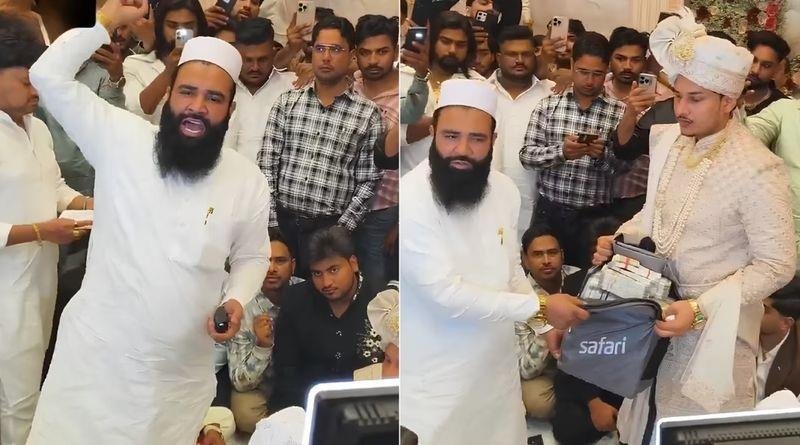
A recent incident at a wedding in Ghaziabad has ignited widespread condemnation on social media after a video emerged showing the public declaration of substantial dowry gifts, including a BMW car and cash exceeding one crore rupees.
The Chenab Times has learned that the footage, which has rapidly circulated online, captures a man openly detailing the expensive presents allegedly given by the bride’s family to the groom’s. The display has prompted strong reactions from internet users, who are calling for stricter enforcement of anti-dowry legislation in India.
Dowry has been legally prohibited in India since the enactment of the Dowry Prohibition Act of 1961. Despite the law, instances of dowry demands and exchanges continue to surface, often drawing public ire and renewed calls for societal change.
The viral clip was reportedly shared on the social media platform X, formerly Twitter, by an account identified as ‘yuva_aas’. The accompanying caption highlighted the scale of the alleged dowry, stating, “1 BMW, 1 crore, 1 lakh, 11 thousand in cash—the girl’s family gave to the boy as dowry. The community’s ruin starts right from here; there must be some limit to taking or giving dowry.” The authenticity of the video could not be independently verified by The Tribune, as noted in their original report.
The public spectacle has resonated with many who view it as a symptom of deeper societal issues related to wealth display and the perpetuation of harmful traditions. Netizens have voiced their dismay, questioning the rationale behind such ostentatious exchanges and advocating for alternative uses of such vast sums of money.
One prominent user questioned the practice, writing, “I don’t understand why families give Rs 1 cr to the groom for marrying their daughter. Why not use that same money to help her start a business or if she’s not interested in running a business, they could buy her property worth cr. Why hand it over to the groom?” This sentiment reflects a growing call for empowering women with financial independence rather than channeling wealth through marital alliances.
Another perspective shared online drew parallels to the selective adherence to religious and cultural practices, with one user commenting, “In the Subcontinent WE follow the Islam that pleasures Us! They’ll do Haldi, They’ll do Mehndi, They’ll take Dahej, They’ll play songs, there will be barat and eventually they deny when someone asks them to say Jai Shri Ram! Why can’t you? Well, you are doing all those things!” This observation touches upon the hypocrisy perceived in the selective adoption of traditions.
However, some users offered a nuanced viewpoint, suggesting that the issue lies not with the act of giving gifts, but with the public nature of the display and the societal pressure associated with it. One individual stated, “I view this issue differently. It is not about giving, giving publicly is a problem. How can you invalidate gifts given to own daughter or son-in-law. Such gift must be private affairs. If wealthy Muslim wants to give something to their own daughter? by your rule none can give.” This perspective highlights the distinction between private generosity and public ostentation that may fuel dowry demands.
The outrage over the incident underscores the enduring debate surrounding dowry in India, a practice that continues to persist despite legal prohibitions and widespread social criticism. The public display in Ghaziabad serves as a stark reminder of the challenges in eradicating such deeply entrenched customs and the ongoing need for both legal enforcement and societal attitudinal change.
In response to the lavish gifts, one user sarcastically remarked, “Might as well give him a set of bangles and a saree,” illustrating the absurdity and demeaning nature that many perceive in the public announcement of dowry. Such exchanges are seen by critics not only as illegal but also as reinforcing patriarchal norms that devalue women and their contributions.
The Dowry Prohibition Act, 1961, defines dowry as any property or valuable security given or agreed to be given by one party to a marriage to the other party at or before or after the marriage. The act explicitly prohibits the demand, payment, or acceptance of dowry. Penalties for contravention include imprisonment and fines.
The incident in Ghaziabad has once again brought the issue of dowry to the forefront of national discussion, highlighting the gap between legal statutes and societal realities. It serves as a catalyst for continued dialogue on gender equality, financial empowerment, and the need to dismantle traditions that perpetuate inequality and exploitation.


The Chenab Times News Desk