


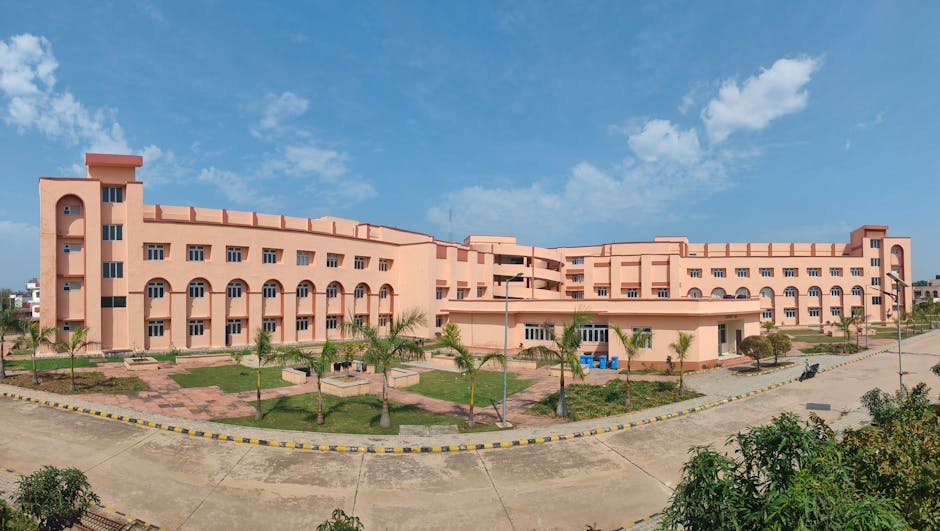
NATIONAL CAPITAL REGION, May 14: The National Institute of Technology (NIT) Rourkela, located in Odisha, has announced the launch of four new academic programmes designed to equip students with specialized skills in rapidly evolving fields such as artificial intelligence and semiconductor technology. These initiatives are set to commence with the 2026-27 academic session.
Information was available with The Chenab Times that the institute will now offer two new Bachelor of Technology (B.Tech) programmes: Mathematics and Computing, and Engineering Physics. Complementing these undergraduate courses, NIT Rourkela will also introduce two Master of Technology (M.Tech) degrees: Semiconductor Devices and Technology, and Machine Learning and Signal Analysis.
According to NIT Rourkela officials, the introduction of these programmes aligns with the objectives set forth by the National Education Policy (NEP) 2020. The new curricula aim to foster interdisciplinary learning, encourage advanced research, and provide industry-relevant skills to students.
Professor Ashok Kumar Turuk, Dean (Academic) at NIT Rourkela, highlighted the significance of subjects like physics and mathematics in driving technological advancements and industrial transformations. He stated that the programs are a crucial step towards cultivating a future-ready workforce capable of contributing to India’s growing deep-tech and knowledge-based economy, in line with the NEP 2020 vision of multidisciplinary education, flexibility, and research-driven innovation.
The B.Tech programme in Mathematics and Computing, to be offered by the Department of Mathematics, will delve into areas including machine learning, artificial intelligence, cryptography, statistical modelling, and advanced computing techniques. The inaugural batch is planned to accommodate 25 students, selected through the Joint Entrance Examination (JEE) Main.
Professor Manas Ranjan Tripathy, Head of the Department of Mathematics, explained that the programme intends to prepare graduates for diverse career paths in AI and machine learning (ML), software development, fintech, cybersecurity, and data analytics, as well as research. He emphasized that contemporary mathematics extends beyond traditional calculations, serving as the fundamental basis for numerous cutting-edge fields.
The Department of Physics and Astronomy is set to introduce the B.Tech in Engineering Physics and the M.Tech in Semiconductor Devices and Technology. The Engineering Physics course will cover a broad spectrum of topics, including quantum technologies, semiconductor devices, photonics, nanotechnology, materials science, cryogenics, optoelectronics, spintronics, astronomy, and high-energy physics. The first batch for this program will also consist of 25 students admitted through JEE Main.
The M.Tech in Semiconductor Devices and Technology will provide specialized training in semiconductor device fabrication, IC manufacturing, wafer technology, packaging, and simulation methods. This postgraduate program will admit 15 students through the Graduate Aptitude Test in Engineering (GATE).
Professor Jyoti Prakash Kar, Head of the Department of Physics and Astronomy, noted that these programs are formulated in synergy with national initiatives such as the India Semiconductor Mission, National Quantum Mission, and National Space Mission, aiming to bolster research and develop a skilled workforce in critical technology sectors.
Furthermore, the Department of Electronics and Communication Engineering has launched an M.Tech programme in Machine Learning and Signal Analysis, which will admit 12 students via GATE. This course will focus on advanced topics such as deep learning, speech and image processing, autonomous systems, wireless communication, and biomedical signal analysis, the institute reported.


The Chenab Times News Desk