


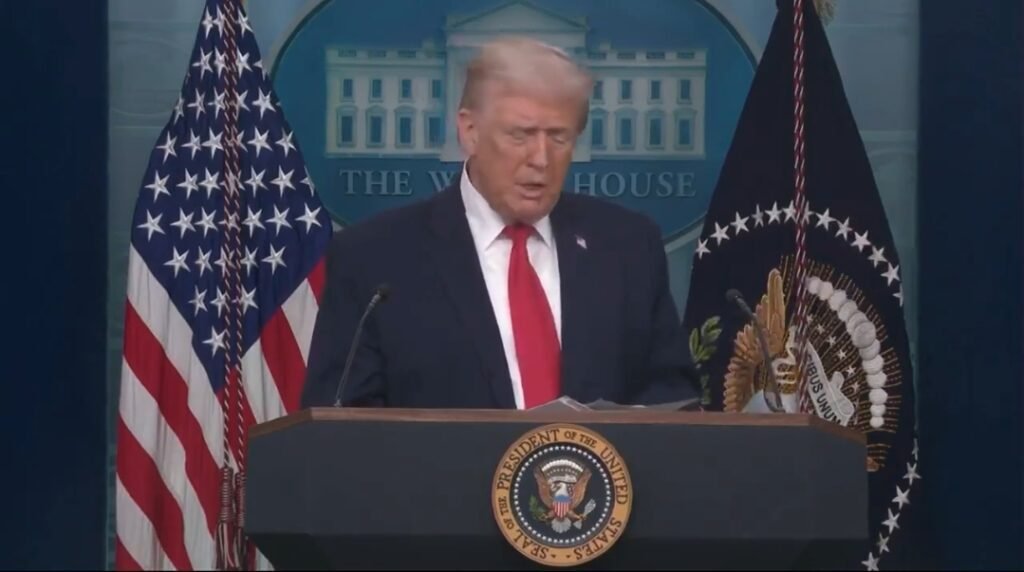
U.S. President Donald Trump arrived in Beijing for a high-stakes summit with Chinese President Xi Jinping, addressing critical issues including trade, the war in Iran, and arms sales to Taiwan. The meeting, the first face-to-face encounter between the two leaders since October and Trump’s first visit to China since 2017, occurs against a backdrop of heightened geopolitical tensions and a fragile U.S.-China relationship.
According to details received by The Chenab Times, the summit is a crucial event for stabilizing the U.S.-China trading relationship, which has seen significant tariff impositions and subsequent negotiations. The leaders also face the complex geopolitical challenge presented by the ongoing war in the Middle East, which has disrupted global energy markets and added strain to international diplomacy. President Xi Jinping conveyed stern words regarding the issue of Taiwan, warning of potential conflicts if not handled properly, while President Trump expressed optimism about the potential for cooperation, acknowledging China’s growing status.
The U.S. president’s arrival in Beijing was marked by a formal welcome ceremony at the Great Hall of the People, featuring a military honor guard and band, with hundreds of Chinese youths waving American and Chinese flags. Following the ceremony, Trump and Xi engaged in a bilateral meeting. During their initial remarks, both leaders offered positive sentiments regarding the U.S.-China relationship, with President Trump referring to Xi as a “great leader” and a “friend,” and expressing confidence that the relationship would improve. This sentiment of strong personal chemistry between the leaders was noted during their previous interactions.
The summit’s agenda prominently featured trade, a long-standing point of contention between the two economic powers. During his previous presidential campaign, Trump had strongly criticized China’s trade practices, labeling the imbalance as “one-sided and unfair.” However, during his 2017 visit, Trump opted to praise Xi and avoid direct criticism of China’s trade policies, instead attributing the deficit to past U.S. administrations’ “incompetence.” While specific details of new trade agreements were described as relatively small in scale, both sides were keen to maintain a trade truce that had been struck the previous October. This truce involved the suspension of certain U.S. tariffs on Chinese goods and reciprocal measures from China. Despite these efforts, Chinese exports to the U.S. had continued to show a decline in early 2026, prompting China to diversify its trade relationships.
On the geopolitical front, the war in the Middle East and its impact on global energy markets, particularly the closure of the Strait of Hormuz, loomed large over the discussions. The U.S. president had indicated that while the conflict was a significant concern, he did not expect it to dominate the summit. However, Iran’s foreign minister had visited Beijing shortly before the summit, signaling the issue’s importance. President Trump pressed for the full implementation of United Nations Security Council sanctions on North Korea, and President Xi outlined additional measures his government was taking to curb financial dealings with Pyongyang. Secretary of State Rex Tillerson described a lack of disagreement on the North Korea issue, though he cautioned that achieving complete denuclearization would be a long process.
The issue of Taiwan emerged as a significant point of discussion, with President Xi Jinping issuing strong warnings about potential “clashes and even conflicts” if the matter was not “handled properly.” This stance highlights the persistent sensitivity surrounding Taiwan in U.S.-China relations.
Beyond the formal discussions, the itinerary included visits to Beijing’s historic Temple of Heaven and a state banquet, underscoring the ceremonial aspects of the high-level diplomatic engagement. While reporters sought to question the leaders on specific outcomes, particularly regarding Taiwan, both presidents largely avoided direct responses, allowing for a controlled narrative of the summit.
The economic discussions also involved meetings with business leaders from both nations, aiming to strengthen partnerships and identify new avenues for cooperation. President Trump reiterated his administration’s commitment to improving the U.S.-China trade relationship, emphasizing the need for fairness and reciprocity. He noted that trade imbalances, along with issues such as market access, forced technology transfer, and intellectual property theft, had cost the United States billions of dollars annually. Achieving a level economic playing field, he stated, would lead to greater prosperity for both countries.
The summit underscored a shifting dynamic in U.S.-China relations, with some analysts observing that the U.S. appeared to be acknowledging China’s growing global status. The term ‘G2,’ referring to a superpower duo, had been revived by President Trump in previous interactions, suggesting an acknowledgment of the intertwined influence of the two nations. Despite the complexities and underlying tensions, both leaders expressed a desire for a stable bilateral relationship, recognizing its importance for global stability.
The visit also saw engagements with prominent American business executives, including those from major technology and automotive sectors, with discussions focusing on potential investments and trade opportunities within China. These engagements aimed to foster a positive business climate and reinforce the economic ties between the two nations, even as broader geopolitical and trade disputes continued to shape the relationship. The meetings provided a platform for dialogue on issues ranging from market access and intellectual property rights to technological collaboration and the long-term vision for economic partnership.


Global Affairs Desk at The Chenab Times covers international developments, global diplomacy, and foreign policy issues through fact-based reporting, explainers, and analytical pieces. The desk focuses on major geopolitical events, diplomatic engagements, and international trends, with an emphasis on verified information, multiple perspectives, and contextual understanding of global affairs.