


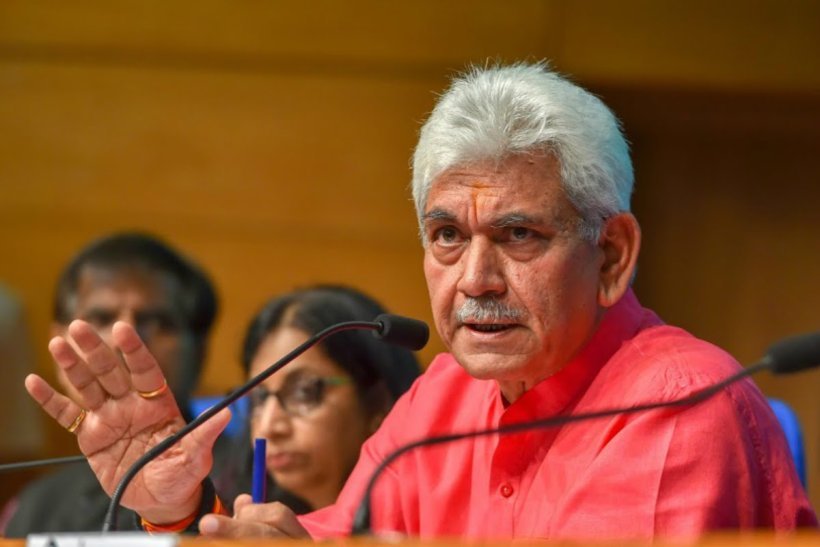
SRINAGAR: Lieutenant Governor Manoj Sinha asserted on Thursday that Jammu and Kashmir has historically embodied the spirit of “Sarva Dharma Sambhav” (universal religious harmony) and continues to serve as a premier example of coexistence and communal amity.
Information was available with The Chenab Times that Lieutenant Governor Sinha was addressing the ‘Rishivar’ Inter-Faith Conference held at the SKICC in Srinagar. He highlighted that the fundamental principles of harmony and mutual respect have been integral to Indian civilisation since ancient times.
The Lieutenant Governor referenced the Rigveda, India’s oldest scripture, citing Sanskrit terms like “Justam” and “Devebhut” to symbolise harmony and the divine essence present within all individuals. He explained that the Rigveda teaches that the divine harmonised the unique virtues and light of every member of society without discrimination.
“If one wants to witness the clearest glimpse of this philosophy, it can be seen in Jammu and Kashmir, which for centuries has remained home to almost all major religions,” Sinha stated, emphasizing the region’s historical role as a confluence of faiths.
He contrasted India’s ancient civilisational thought with many nations that began discussing coexistence much later, noting that “Sarva Dharma Sambhav” has been a cornerstone of India’s ethos for millennia. He underscored that coexistence was not merely a concept in India but a lived reality thousands of years ago, with Indian traditions consistently honouring diverse beliefs and schools of thought.
Referencing Sanatan Dharma as one of the world’s oldest faith traditions, dating back over 8,000 years, Sinha noted its survival through historical struggles due to its emphasis on coexistence, respect for all beliefs, and acceptance of diversity. He pointed out that scholars globally acknowledge the philosophy of “Sarva Dharma Sambhav” as originating from Sanatan Dharma’s principles.
The Lieutenant Governor quoted the Atharva Veda, suggesting that ancient sages envisioned a society where people of different faiths, beliefs, and consciousness could live together as a single harmonious family. He also cited the Yajurveda, composed between 1400 and 2000 BCE, which advocated for viewing every individual with friendship and mutual respect.
Drawing from the Bhagavad Gita, Sinha recalled Lord Krishna’s declaration that individuals approach the divine through various paths, and the divine fulfills each according to their faith and devotion. He also mentioned the teachings of Buddhism and Jainism, asserting that respecting other religions enhances the dignity of one’s own faith.
Highlighting Kashmir’s historical legacy, the Lieutenant Governor referred to historians and Kalhana’s Rajatarangini, which suggest Srinagar was founded by Emperor Ashoka, a proponent of communal harmony and religious tolerance. Ashoka’s edicts, he noted, warned that glorifying one’s own religion while denigrating another harms one’s own faith most profoundly.
Sinha stated that India had shown the world the path of peace through its ideas and actions long before many modern civilisations emerged. He acknowledged that various faiths, including Christianity, Islam, and Sufism, later influenced Indian philosophy, while Sanatan Dharma’s message of coexistence continued to inspire societies globally.
The Lieutenant Governor quoted the Rigveda: “Truth is one, but scholars interpret it in different ways,” and asserted that Jammu and Kashmir stands as a living testament to this inclusive philosophy. He mentioned that even before the advent of Islam and Sufism in Kashmir, philosopher Vasugupta propagated Shiv Sutras and spiritual teachings centered on universal consciousness.
Referring to Kalhana’s Rajatarangini, Sinha noted the text’s assertion that there is not even a small piece of land in Jammu and Kashmir devoid of pilgrimage and sacredness. He also quoted the mystic poet Lal Ded, who advocated against divisions between Hindus and Muslims, urging people to recognise their true selves and shared humanity.
He stated that Sheikh Noor-ud-din Noorani (Nund Rishi) significantly bolstered social harmony and unity among different traditions in Kashmir. “Different faiths have found their finest confluence in Jammu and Kashmir. Such a beautiful blend of traditions is rarely seen elsewhere in the world,” he remarked.
Sinha referred to the Rishi-Sufi tradition and quoted Nund Rishi’s message of transforming conflict into tools for cultivation and peace. Quoting the Rigveda again, he emphasized that societal progress is achieved when people share common goals, collective harmony, and unity of thought.
“Humanity can progress only when all sections of society move together for collective welfare,” Sinha said, adding that “Sarva Dharma Sambhav” is India’s most precious gift to humanity and must be continuously nurtured to strengthen unity and prosperity. He concluded that meaningful social transformation begins with individual conduct and that inter-faith dialogues play a crucial role in strengthening societal harmony.
The Lieutenant Governor also spoke about the migration of Kashmiri Pandits, stating that ordinary Kashmiris were not responsible for the events that transpired in the Valley. He highlighted Jammu and Kashmir’s participation in nationwide celebrations marking 150 years of “Vande Mataram,” noting that the Union Territory secured the top position among all States and Union Territories in a national program organized by the Union Ministry of Culture, despite representing only about one percent of India’s population.
He further mentioned that several districts in Jammu and Kashmir, including Kulgam and Baramulla, were among the country’s top-performing districts during this campaign. Sinha also addressed the perception of Kashmir, asserting that Kashmiris possess a deeper understanding and awareness of India than often perceived and that many outside the region fail to grasp the ground realities.
In relation to an anti-drug campaign launched on April 11, the Lieutenant Governor reported unprecedented public response and cooperation, expressing confidence that the menace could be significantly curbed within 100 days with sustained collective efforts.


The Chenab Times News Desk