


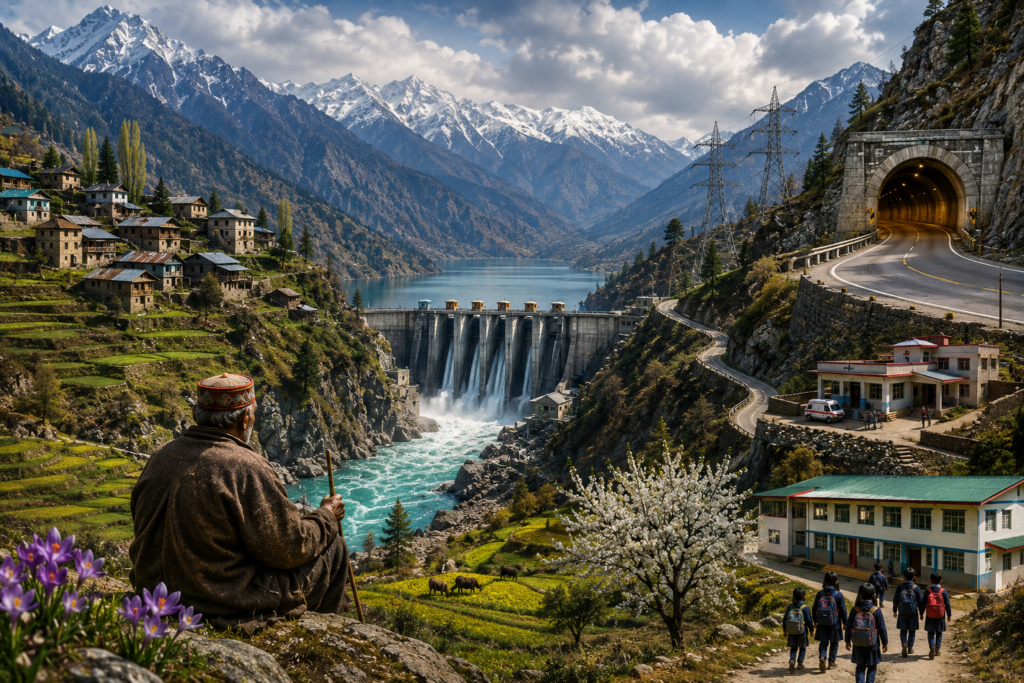
For decades, the political and developmental discourse of Jammu and Kashmir has been viewed through a rigid, two-dimensional lens: the political centre of the Kashmir Valley and the expanding urban and industrial corridors of the Jammu plains. This geographic simplification continues to dominate administrative priorities, public debate, and budgetary allocations. Yet it overlooks a third reality—one that exists in the rugged mountains and remote highlands of the Union Territory.
This reality belongs to the Chenab Valley (Doda, Kishtwar, and Ramban), the Pir Panjal region (Rajouri and Poonch), and the remote hill areas of Reasi, Udhampur, and Kathua. These regions contribute significantly to Jammu and Kashmir’s natural wealth and strategic importance, yet they continue to suffer from deep intra-regional disparities. Developmental planning remains heavily concentrated around Srinagar and the more accessible plains of Jammu, creating an extractive relationship in which resources from the highlands fuel growth elsewhere while mountain communities remain isolated, underdeveloped, and underrepresented.
This is the geography of silence—where regions appear on maps but remain absent from policy priorities.
For years, social activists, civil society groups, and local organisations have argued that the Chenab Valley, Pir Panjal, and other hill regions of Jammu have been systematically neglected in matters of development and governance. Yet their demands have largely remained unanswered. Many local political leaders, rather than collectively advocating for the structural concerns of their regions, have often remained preoccupied with ministerial positions, political alliances, and short-term electoral considerations while the developmental gap continues to widen.
The Paradox of Plenty: Resource Extraction and Local Deprivation
Perhaps the greatest irony of these peripheral highlands lies in their role as major contributors to the region’s economy while receiving comparatively limited benefits in return.
The Chenab River basin serves as the hydropower backbone of Jammu and Kashmir, hosting major projects such as Baglihar, Dul Hasti, and Salal, alongside upcoming ventures including Kwar and Pakal Dul. While the electricity generated from these projects powers homes and industries across northern India, local communities often continue to face inadequate infrastructure, environmental pressures, unstable power supply, and limited access to skilled employment opportunities associated with these projects.
During winter months, power outages remain a recurring challenge in many parts of the Chenab Valley despite the region’s immense contribution to energy production. The contrast between resource generation and local development raises important questions about equity, revenue-sharing mechanisms, and long-term regional planning.
A similar pattern is visible in agriculture and allied sectors. High-value products such as Basholi Pashmina, Kishtwar saffron, Bhaderwahi Rajmash, lavender, and other niche crops possess considerable commercial potential. However, the absence of adequate marketing infrastructure, cold-storage facilities, value-addition units, and strong institutional support continues to limit their economic impact on local communities.
Although products such as Kishtwar saffron and Bhaderwahi Rajmash have received Geographical Indication (GI) recognition, farmers still face challenges relating to quality control, branding, market access, and price realization. Lavender cultivation has shown promise in parts of the region, but sustained growth requires greater investment in processing facilities, supply chains, and farmer support systems.
Other areas including Bani, Billawar, Dudu-Basantgarh, Gool-Gulabgarh, Bhalesa, Marwah, Dachhan, Padder, and Warwan possess significant potential in horticulture, high-value agriculture, animal husbandry, and eco-tourism. However, realizing this potential requires focused policy interventions rather than periodic announcements and symbolic promises.
The tourism sector presents a similar story. Destinations such as Bani Valley, Billawar, Jai Valley, Padri, Guldanda, Dudu-Basantgarh, Gool-Gulabgarh, and Warwan possess exceptional natural beauty and strong potential for eco-tourism, trekking, winter sports, and cultural tourism. Yet these areas receive only a fraction of the investment, promotion, and hospitality infrastructure directed toward established destinations such as Gulmarg or the religious tourism circuit of Katra.
The Human Cost: Healthcare, Education, and Infrastructure Deficits
The consequences of this imbalance are most visible in healthcare.
While basic healthcare infrastructure exists on paper, many peripheral districts continue to face severe shortages of specialist doctors, diagnostic facilities, and emergency care services. Vacancy rates for specialists in district hospitals and community health centres remain a persistent challenge. As a result, a large number of critical patients must be referred to tertiary-care institutions in Jammu or Srinagar.
This referral-dependent healthcare model places enormous pressure on patients and families, particularly in emergency situations where travel across mountainous terrain can prove life-threatening. The problem is further compounded by staff shortages, infrastructure deficits, and difficult geographical conditions.
The education sector reflects similar disparities. While premier institutions are concentrated in the Jammu plains, large parts of the Chenab Valley and Pir Panjal remain absent from India’s premier higher-education landscape. Satellite campuses in Bhaderwah, Kishtwar, and Kathua, as well as institutions such as Baba Ghulam Shah Badshah University in Rajouri, continue to face challenges related to funding, infrastructure, research facilities, and industry linkages.
Consequently, many young people are compelled to migrate in search of better educational and employment opportunities. This continuous outflow of talent deprives these regions of the skilled human capital necessary for long-term development.
Infrastructure challenges further reinforce this cycle of underdevelopment. Roads connecting Doda, Kishtwar, Ramban, and other mountainous districts remain vulnerable to landslides, shooting stones, and weather-related disruptions. A single spell of heavy rainfall can sever connectivity, disrupt supply chains, and affect economic activity across large areas.
The Mughal Road, which provides an important alternative connection between Rajouri-Poonch and South Kashmir, continues to remain inaccessible during significant portions of winter due to heavy snowfall near Peer Ki Gali. The absence of all-weather connectivity limits economic integration and hampers emergency access for remote communities.
The Way Forward: Structural and Legislative Interventions
Addressing these disparities requires more than routine developmental spending. It demands a structural rethinking of governance and regional planning.
One possible approach would be the establishment of empowered regional development institutions with greater authority over local planning, budget allocation, and resource management. Strengthening local governance structures would help ensure that policies reflect the specific needs of mountain communities rather than being designed exclusively from distant administrative centres.
The benefits generated from large hydropower projects should also translate into measurable local development. Mechanisms for greater local participation, community development funds, and targeted investments in host districts could help address longstanding concerns regarding resource distribution.
Tourism development should prioritize community-based models that enable local residents to retain a larger share of economic benefits. Investments in homestays, sustainable tourism infrastructure, waste management systems, and improved connectivity can generate employment while preserving ecological balance.
Healthcare reforms must focus on specialist recruitment, incentives for service in difficult terrains, improved diagnostics, telemedicine networks, and the upgradation of strategically located hospitals into fully equipped trauma and emergency-care centres.
Similarly, educational institutions in these regions should be strengthened through specialized programmes aligned with local economic needs, including hydropower engineering, geology, forestry, horticulture, mountain agriculture, environmental management, and sustainable tourism.
Infrastructure development must also prioritize all-weather connectivity. The proposed Peer Ki Gali tunnel and other strategic projects have the potential to transform regional mobility, reduce isolation, and improve economic integration. Simultaneously, greater investment in resilient mountain engineering, slope stabilization, and climate-adaptive infrastructure is essential.
The persistent underdevelopment of the Chenab Valley, Pir Panjal, and the peripheral hill regions of Jammu demonstrates the limitations of a governance framework that continues to view Jammu and Kashmir through a binary lens.
Development cannot be measured solely by balancing investments between Srinagar and Jammu city. Genuine regional equity requires recognizing the unique challenges and aspirations of mountain communities that have remained at the margins of policy discourse for decades.
Whether in healthcare, education, connectivity, digital infrastructure, tourism, or economic opportunity, these regions continue to lag behind despite their immense contributions to the Union Territory’s economy and resource base.
As T. S. Eliot wrote in The Waste Land: “These fragments I have shored against my ruins.”
The fragments of the Chenab Valley, Pir Panjal, and Jammu’s peripheral highlands continue to stand against the accumulated weight of neglect. Lasting equity in Jammu and Kashmir will not emerge merely from balancing geography; it will emerge from recognizing these regions as distinct centres of growth deserving equal dignity, investment, and developmental priority.
The geography of silence must end. The highlands are not waiting for a saviour; they are waiting to be seen.
The author is an independent researcher and a postgraduate in History who has qualified UGC-NET and JKSET.


Majid Zareem is an independent researcher with a master’s degree in history.