


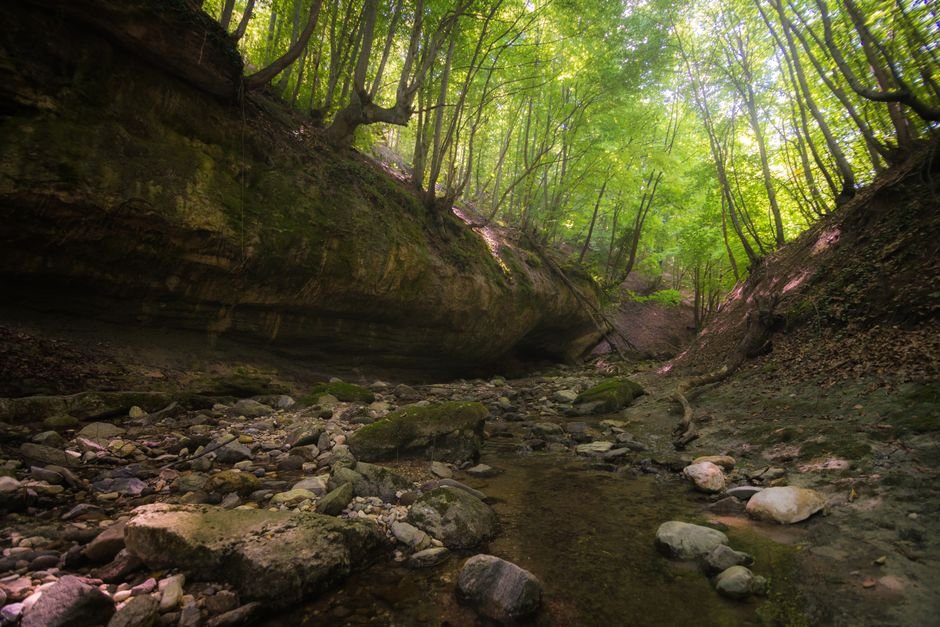
Jammu and Kashmir’s Guryul Ravine, home to the Earth’s most complete record of the 252-million-year-old Great Dying extinction event, is at risk of being lost due to ongoing neglect and industrial encroachment, despite recently being granted National Geo-Heritage status.
Information was available with The Chenab Times indicating that geological formations within the Guryul Ravine, located near Srinagar, preserve a crucial 2.68-meter-thick section detailing the most significant extinction in the history of life, an event that wiped out 90 percent of marine species and 70 percent of terrestrial species.
This geological boundary, known as the Permian-Triassic boundary, has eleven sections globally, including sites in China, Alaska, Iran, Siberia, and Wales. However, scientists widely regard Kashmir’s Guryul section as the most legible and complete archive, offering an unparalleled window into Earth’s past. The significance of this site extends beyond regional or national importance; it is considered a global heritage belonging to all of humanity, documenting a catastrophe that fundamentally shaped life on the planet.
The Chinese team, which secured the official global designation for its Meishan section in 2004, has reportedly acknowledged Guryul’s superior quality as a record. Despite the scientific consensus on its importance, work on the Guryul site effectively ceased after 1989 due to the prevailing situation in Kashmir. This cessation created a research vacuum that was filled by China’s sustained and meticulous investigation of its own boundary section.
While the Meishan site benefited from continuous scientific publication, the Guryul section remained untouched and undefended. By 2012, the ravine began to suffer significant damage from quarrying operations, with a substantial portion of the section reportedly being extracted for use as aggregate. Even historical markers, such as a Chinar tree used by geologist Middlemiss as a survey benchmark in 1910, were lost.
Similar neglect has affected other significant paleontological and archaeological sites in Kashmir. At Galandar, near Pulwama, a complete elephant skull discovered in a Karewa deposit lay exposed and unexamined for seven years, during which surrounding land faced encroachment, leading to the destruction of nearby potential evidence of early human habitation, possibly a 500,000-year-old human skeleton. Evidence of pre-Homo sapiens human presence in Kashmir, considered among the oldest in Asia, was also nearly lost to a railway embankment project.
The recent National Geo-Heritage status granted to Guryul and its associated sections is a positive step. However, experts caution that such designations are insufficient without robust protection measures. Industrial allocations have already encroached upon the demarcated zones, and the access routes to the site are reportedly deteriorating, further compromising its integrity.
The geological inheritance of Kashmir, including the Guryul Ravine, is a result of deep geological processes spanning millions of years. This accidental geography imposes a profound responsibility to protect these invaluable records, not only for India but for the global community that has a rightful claim to the scientific knowledge these rocks contain. The critical question now is whether timely action will be taken to preserve this irreplaceable heritage before it is irrevocably damaged.


The Chenab Times News Desk