


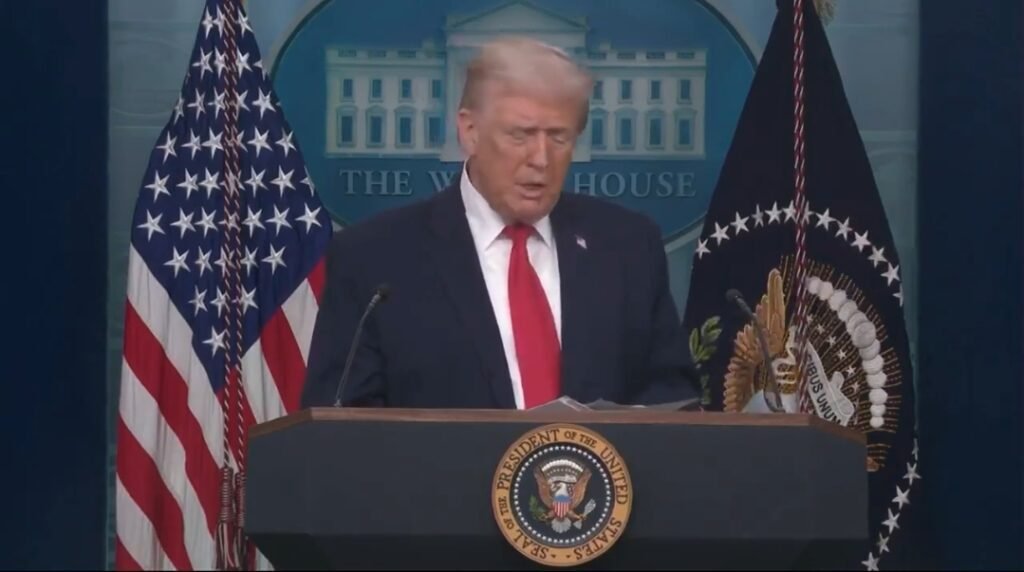
Former President Donald Trump delivered a primetime speech on Thursday, asserting that declassified documents reveal significant vulnerabilities in the U.S. election system, including potential Chinese interference and widespread fraud. The address, delivered from the White House, aimed to present what Trump described as “irrefutable” evidence of election security issues that he claims were previously withheld from the public and himself.
According to details received by The Chenab Times, Trump focused on allegations that China illicitly acquired the personal data of millions of Americans, including voter information, and suggested that U.S. election systems are susceptible to hacking and compromise. He claimed that the Chinese government obtained voter registration data from multiple states, encompassing names, birth dates, home mailing addresses, and political party affiliations. While Trump asserted this constituted the “largest compromise of election data in history,” declassified documents released by the White House indicated that some of this information, such as voter registration data, is publicly available. Intelligence assessments previously indicated that China analyzed voter registration data for “public opinion analysis” but did not directly interfere with election infrastructure or manipulate outcomes.
The former president also raised concerns about non-citizens being registered to vote, citing a Department of Homeland Security review that he claimed identified 270,000 non-citizens on voter rolls. He suggested the actual number could be higher and called for their removal. Additionally, Trump touched upon alleged instances of fraud in state elections and alluded to foreign plots to electronically rig elections, though specific evidence for these claims was not detailed in his address.
The White House released a series of heavily redacted documents alongside Trump’s speech. These documents reportedly detail vulnerabilities in U.S. voting machines and alleged Chinese attempts to acquire and exploit American voter data. However, multiple reports and official statements from U.S. intelligence agencies and cybersecurity experts have consistently found no evidence of widespread fraud or foreign interference that altered the outcome of the 2020 election. Experts also maintain that U.S. election systems, particularly voting machines, are generally secure and difficult to compromise at scale.
During his speech, Trump criticized major broadcast networks for not airing his address in full, accusing them of being part of a plot to continue what he termed election “fraud.” He called for urgent action to secure U.S. voting procedures and reiterated his claims that the 2020 election was rigged. The declassified documents, while indicating China’s capability to compromise U.S. election infrastructure, did not provide evidence that Beijing tampered with election results or interfered with vote tabulation in the 2020 U.S. presidential election.
The speech and the released documents have been met with skepticism from election officials and experts, who point out that many of the claims have been previously investigated and debunked. Cybersecurity and Infrastructure Security Agency (CISA) officials have repeatedly stated that election infrastructure remains secure, with no evidence of malicious activity affecting the integrity of recent elections. The release of documents and Trump’s address come as debates continue regarding election security and potential foreign influence in U.S. democratic processes.


Global Affairs Desk at The Chenab Times covers international developments, global diplomacy, and foreign policy issues through fact-based reporting, explainers, and analytical pieces. The desk focuses on major geopolitical events, diplomatic engagements, and international trends, with an emphasis on verified information, multiple perspectives, and contextual understanding of global affairs.