


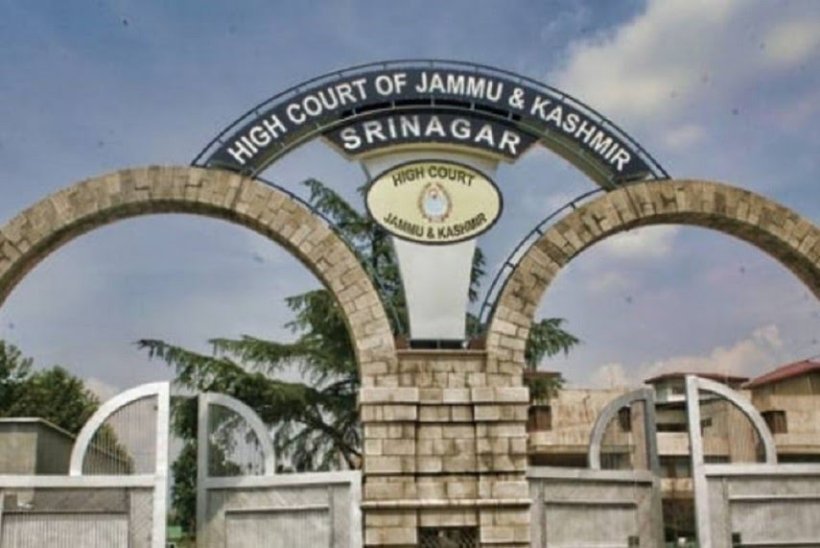
SRINAGAR: The High Court of Jammu & Ladakh has affirmed that pension is a constitutional right, dismissing a plea by the Union Territory administration to withhold full pension and post-retirement benefits for a retired polytechnic principal. The court ruled that retiral dues cannot be suspended based on mere suspicion when no formal departmental inquiry or judicial proceedings are underway.
Information was available with The Chenab Times that a Division Bench, comprising Acting Chief Justice Sanjeev Kumar and Justice Mohd Yousuf Wani, dismissed a writ petition filed by the Union Territory and its Skill Development Department. This decision upheld a previous order from the Central Administrative Tribunal (CAT), Srinagar Bench, directing the release of all retiral dues to Firdous Ahmad Itoo, the former Principal of Government Polytechnic College, Pulwama.
The case originated when the government challenged the CAT’s order dated March 30, 2026. The Tribunal had instructed authorities to process and release Mr. Itoo’s pension and other post-retirement benefits within six weeks, with a stipulation that any delay would incur interest at six per cent per annum. Mr. Itoo had retired from his position on April 30, 2024, upon reaching the age of superannuation.
Despite his retirement, the government issued an order on September 4, 2024, granting him only a provisional pension and withholding his gratuity and other retirement dues. Mr. Itoo subsequently approached the Central Administrative Tribunal, seeking the cancellation of the government order that denied him his full retiral benefits. He also requested the release of the withheld amounts along with interest and compensation.
Before the Tribunal, Mr. Itoo contended that no judicial or departmental proceedings were pending against him, rendering the withholding of his pension and gratuity legally unjustified. He emphasized that pension constitutes a property right, protected under Article 300-A of the Constitution of India.
The administration defended its action by informing the Tribunal that information from the Crime Branch indicated Mr. Itoo was a suspect in FIR No. 11/2018, registered by the Economic Offences Wing, Crime Branch, Kashmir. An inquiry into alleged embezzlement at the Islamic University of Science and Technology (IUST) was reportedly contemplated against him.
However, the Tribunal found no pending judicial trial or departmental inquiry against the retired officer. It concluded that the government lacked the authority to deny him his pension and gratuity based solely on suspicion. Consequently, the Tribunal ordered the release of all retiral benefits.
The High Court, in its judgment on July 15, 2026, found no grounds to overturn the Tribunal’s decision. The Bench cited established legal precedents, including a Division Bench decision in Ghulam Mohi-ud-din Lone v. State of J&K (2020) and a Supreme Court judgment in Union of India v. K.V. Jankiraman (1991), which clarify that retiral benefits can only be withheld under specific statutory conditions.
The High Court reiterated that pension and gratuity are protected constitutional rights, as stated in the Ghulam Mohi-ud-din Lone judgment. The court quoted, “The hard earned benefit in the shape of pension and gratuity that accrues to an employee is in the nature of ‘property’. The right to property may not be a fundamental right any more but it continues to be a Constitutional right and cannot be taken away without due process of law, as is provided under Article 300A of the Constitution of India.” The court further stressed that these rights cannot be abrogated by executive instructions but only through statutory provisions.
The Bench noted that the government’s case relied solely on the assertion that Mr. Itoo had surfaced as a suspect and that an inquiry was contemplated. The court deemed this legally insufficient. “Indisputably, there are no judicial proceedings or departmental inquiry pending against the respondent No. 1 and, therefore, he cannot be deprived of his hard earned post retiral benefits, including full pension and gratuity,” the Bench ruled.
The court observed that the statutory framework permits the withholding of pension only when departmental or judicial proceedings have been formally instituted before retirement. A pending investigation or the contemplation of an inquiry does not meet this legal threshold. Finding no errors in the Tribunal’s order, the High Court dismissed the government’s writ petition in its entirety.
This ruling reinforces the principle that governments cannot withhold pension and retirement benefits based on mere allegations or ongoing investigations unless the statutory requirements under the Civil Service Regulations are met. The judgment is expected to have broader implications for retired government employees facing similar situations where their benefits are withheld without formal proceedings.


The Chenab Times News Desk