


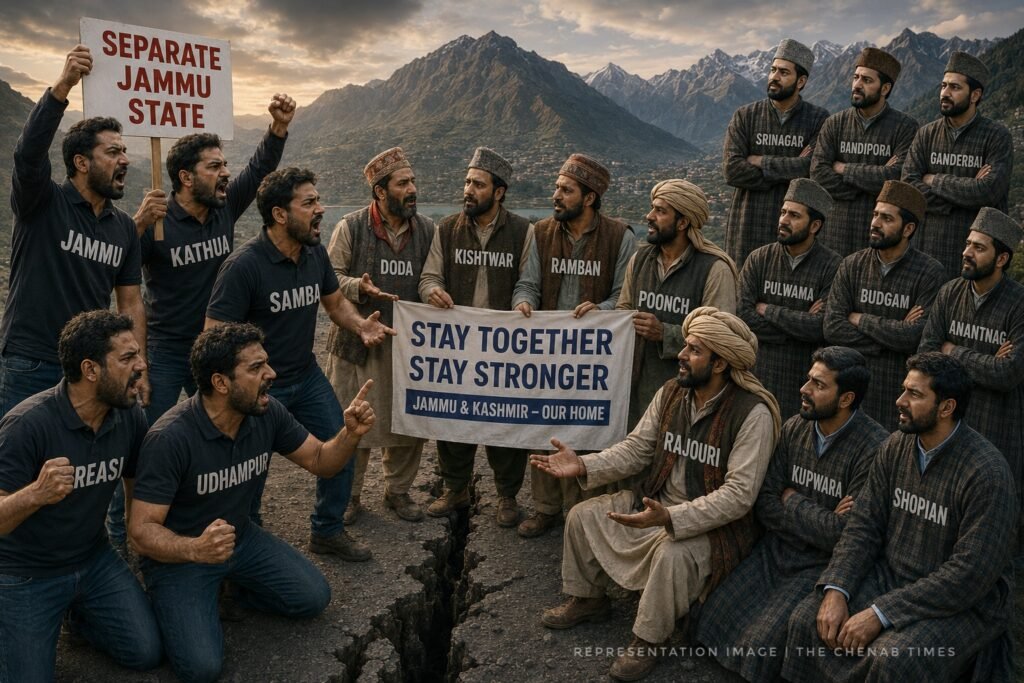
In his 1955 essay Thoughts on Linguistic States, Dr. B.R. Ambedkar offered a sharp, timeless warning about redrawing maps on emotional whim. To him, carving out a new state was never about soothing local pride or scoring political points—it was a high-stakes balancing act between keeping a government running smoothly and ensuring minorities did not get squeezed out. “If a new State is created such that a majority can use its newly found power to tyrannize a distinct minority within its borders,” Ambedkar wrote, “the very purpose of democratic decentralization is defeated.”
That warning lands squarely in the middle of today’s renewed chatter about splitting Jammu away from Kashmir to form its own state.
When the twelfth-century chronicler Kalhaṇa wrote his epic history Rajatarangini, he described Kashmir as a peaceful, mountain-ringed valley where “the sun shines mildly.” He spent little time worrying about the rugged foothills to the south—the region that would later become Jammu. The only place which he fond pleasing in Jammu was Bhaderwah which he called Bhadarvakash i.e. a pleasant place to visit. For nearly two centuries, the administrative union between Jammu and Kashmir has felt like a tense, forced marriage born out of the 1846 Dogra monarchy: two completely different regions sharing a roof, constantly bickering over who gets the bigger bedroom and who pays the electricity bill.
Ever since the political restructuring of 2019 altered the region’s map, the old idea of giving Jammu its own statehood has resurfaced. Supporters pitch it as a long-overdue “amicable divorce” that would finally free Jammu from Srinagar’s shadow. But if you look past the catchy slogans, the idea hits a wall of administrative headaches, deep internal divides, and a fundamental misunderstanding of what actually fixes people’s day-to-day problems.
The Reality Check: Legal, Financial, and Logistical Hurdles
Proponents often talk about a separate Jammu state as if it is as simple as swapping out stationery, painting a new sign on a government building, and naming a capital. In reality, it is a legal and logistical nightmare.
Legally, carving out a new state means Parliament must use Article 3 of the Constitution. While New Delhi proved in 2019 that it can reorganize the region overnight, doing it a second time to create a standalone Jammu state creates a strange political paradox. Mainstream leaders across the spectrum are already demanding the restoration of unified J&K statehood. Splitting the region again would derail those promises and kick off fresh legal battles.
Administratively, a new state means building an entirely new government machine from the ground up: a dedicated secretariat, a separate police command, and brand-new state commissions. Paradoxically, the government abolished the century-old Darbar Move—where the entire administration packed up and moved between Srinagar and Jammu twice a year—specifically to cut costs. Splitting the state would permanently double those exact administrative costs by creating two sets of everything.
Economically, the popular argument that Jammu “supports” Kashmir—or vice versa—doesn’t hold up under hard scrutiny. Jammu certainly has key advantages, including better year-round road connections and a safer environment for factories. But Jammu’s economy relies heavily on being the primary gateway to the Valley’s massive consumer market. Stand alone, and that advantage shrinks. Plus, in a region where most good jobs are in the public sector, splitting the state reshuffles employment quotas in unpredictable ways, altering reservation access for Scheduled Castes and Scheduled Tribes across new provincial borders.
Political Tug-of-War: The Debate and Its Motives
The debate over a separate Jammu state splits neatly along geographic and political lines. The demand originally came from civil society groups like the Jammu Mukti Morcha in the 1990s, who argued that Jammu’s Hindu-majority population was routinely side-lined by Srinagar-based politicians. Recently, local political figures have brought the idea back into the spotlight.
The debate has drawn sharp national attention. In a recent interview with The Tribune India, Chief Minister Omar Abdullah fired back at politicians pushing for the split, specifically calling out local BJP leaders like Sham Lal Sharma. Abdullah pointed out that the same political forces who supported turning Ladakh into a separate Union Territory in 2019 are now struggling to manage the fallout there. “Ladakh is slipping out of their hands, and now they want to ruin Jammu too,” Abdullah remarked, questioning whether the demand was rooted in anything other than religious polarization when other political promises fell through.
On the other side, parties like the National Conference and Congress argue that breaking up J&K destroys its shared historical identity. Meanwhile, the central BJP leadership finds itself in a delicate spot. While its core voter base in the Jammu plains likes the idea of a state of their own, the party’s national narrative has been built around the complete integration of a unified Jammu and Kashmir. Pushing for another split would look like admitting that the post-2019 integration model is still struggling to satisfy local aspirations.
Jammu’s Internal Divide: Plains Versus the Hills
The biggest flaw in the “Separate Jammu” argument is the assumption that Jammu is one homogeneous region. It isn’t. Jammu is deeply divided by geography, culture, and economic development. The real gap isn’t between Jammu and Srinagar—it is between the prosperous southern plains (Jammu, Samba, Kathua) and the neglected hill districts (the Chenab Valley and Pir Panjal regions).
The southern plains enjoy good highways, industrial areas, and major institutions like IIT, IIM, and AIIMS. In contrast, the hill districts—Doda, Kishtwar, Ramban, Poonch, and Rajouri—deal with rough terrain, crumbling roads, and limited healthcare. The Chenab Valley generates massive amounts of hydroelectric power for the entire region, yet the villages sitting right next to those massive dams face constant blackouts and lack basic drinking water.
This geography maps directly onto demographic lines. The plains are mostly Hindu and Dogri-speaking, while the hill regions are predominantly Muslim and speak Pahari, Gojri, or Kashmiri.
Because of this, local leaders in the Chenab Valley and Pir Panjal openly reject the idea of a unified Jammu state centred around the plains. They have made it clear that if Jammu breaks away from Kashmir, they will demand their own autonomous hill councils or separate administrative setups. They have little interest in trading political domination by Srinagar for political domination by the Jammu plains. This anxiety echoes Dr. Ambedkar’s warning about creating a new state only to give a local majority total control over a vulnerable minority, potentially cutting off the hill districts’ historical and political ties to the Valley.
History’s Lesson: Better Governance Over New Borders
Demanding new map boundaries is an old political trick to distract people from everyday problems. While politicians argue over borders, young people in Jammu are dealing with far more immediate struggles: high youth unemployment, local businesses losing ground to outside conglomerates, and scandal-riddled recruitment drives that leave educated youth in limbo. The famous Urdu poet Sahir Ludhianvi captured this frustration best: “Tu idhar udhar ki na baat kar, yeh bata ki karwan kyun luta?” (Stop talking around the issue; tell me why the caravan was looted in the first place!)
India’s history of carving out new states offers a necessary reality check. When Jharkhand, Uttarakhand, and Chhattisgarh were created in 2000, followed by Telangana in 2014, people were promised that local control would automatically bring rapid development. Yet, moving a capital city doesn’t magically make a government work better. Jharkhand and Chhattisgarh remain rich in natural resources but continue to struggle with systemic poverty. Uttarakhand created a booming economy in its plains, while its remote mountain villages continue to empty out due to a lack of basic services.
Splitting a state often just swaps an old political elite for a new one. If Jammu becomes its own state, power will simply concentrate in the Jammu plains—leaving places like Kishtwar and Poonch just as side-lined as before.
With a strong political base in the Jammu plains, opposition leaders have real leverage to advocate for Jammu without pushing a risky, divisive statehood proposal. Instead of getting bogged down in border debates, leadership can push New Delhi for concrete reforms: empowering independent Hill Development Councils for the Chenab Valley and Pir Panjal, securing legal protections for local land and job quotas, and building genuine industrial and tourism infrastructure across Jammu’s border districts.
Redrawing a map makes for an easy campaign slogan, but fixing governance takes real work. Jammu’s frustration over years of political neglect is completely valid—but creating a brand-new state boundary isn’t the fix. Real progress isn’t about changing the lines on a map; it’s about making sure a student in Kishtwar gets the same quality education and opportunity as a student in Jammu.


Majid Zareem is an independent researcher with a master’s degree in history.