


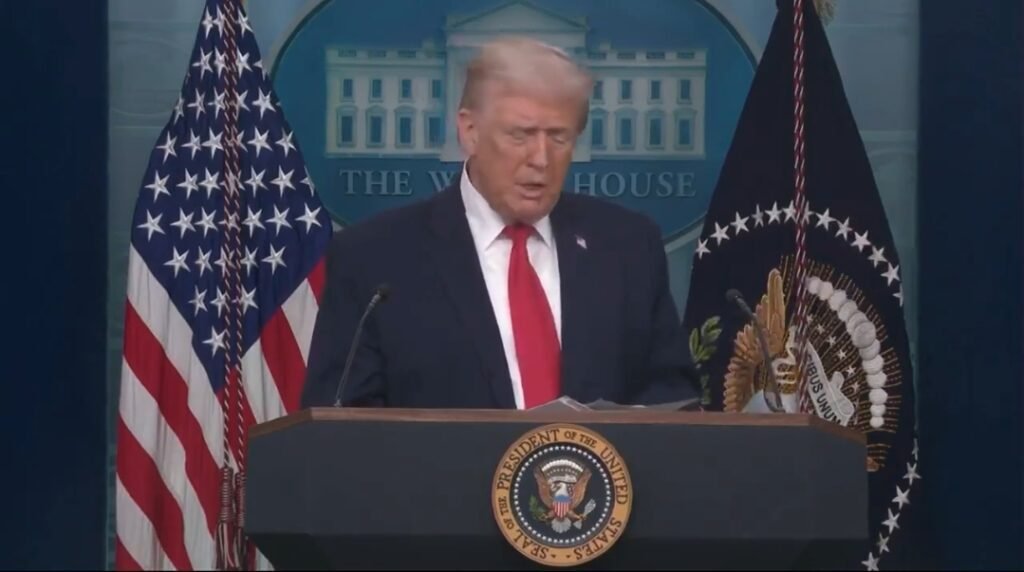
Former President Donald Trump has ordered the installation of temporary warning signs and exhibits outside the Smithsonian’s National Museum of American History. These signs are intended to inform visitors about a recent White House report that criticizes the museum’s portrayal of American history, labeling it as influenced by “ideological capture” and “extreme political activism.” The directive aims to steer visitors toward information that aligns with the Trump administration’s perspective on American history.
The executive order, signed by Trump, mandates that signs be placed on sidewalks and walkways leading to the museum, which are maintained by the National Park Service. These signs will reference findings from a White House Domestic Policy Council report titled “Saving America’s Story: How Ideological Capture at the Smithsonian Institution’s National Museum of American History Erases Our Heritage.” The report, released earlier in July, claims that the museum has shifted its mission from historical education and scholarship toward activism, promoting narratives that portray American values negatively and are rooted in ideologies such as Marxism.
The White House report, which is extensive, suggests that the museum focuses disproportionately on aspects like slavery, racism, and inequality, while allegedly failing to adequately celebrate the nation’s founding principles and achievements. Recommendations from the report include posting warning signs that state exhibits were created by individuals who “don’t want you to love your country.” Additionally, the order calls for increased recognition of the signers of the Declaration of Independence during the upcoming 250th anniversary of the United States and revision of exhibits deemed ideologically biased by the administration.
The Smithsonian Institution, the world’s largest museum, education, and research complex, comprises 21 museums and the National Zoo. Eleven of these museums are situated along the National Mall in Washington, D.C. The institution receives a significant portion of its annual budget from federal appropriations, making it subject to governmental directives. This executive action represents a continuation of efforts by the former president and his team to influence the presentation of history in federally supported cultural institutions.
Previous actions by the Trump administration targeted perceived liberal biases in cultural and educational organizations. In March 2025, an executive order was issued aimed at “Restoring Truth and Sanity to American History.” This order put Vice President JD Vance in charge of overseeing efforts to “remove improper ideology” from various areas of the Smithsonian, including its museums, research centers, and the National Zoo. The administration also expressed a desire to ensure that gender-related exhibits, such as those in the National Museum of Women’s History, focused on women and did not “recognize men as women in any respect.”
The directive also includes instructions for the Secretary of the Interior to reinstate monuments, memorials, and statues that may have been removed or altered. The order aims to ensure that the 250th anniversary of America’s founding is celebrated in a manner that honors its founders and core principles, as interpreted by the administration. The signage intended for the Smithsonian’s National Museum of American History will not only warn visitors of the report’s findings but also direct them to websites and resources that the Trump administration endorses as providing “accurate information” regarding American history.
The report, authored by the Domestic Policy Council, critically assesses the National Museum of American History’s interpretive ideology, stating it cannot be trusted to tell America’s story honestly. It asserts that current leadership views American history as a tool for advancing social justice and transforming society, rather than as a shared inheritance to be celebrated. The administration’s stance is that this ideological shift has moved the museum’s mission away from straightforward historical education and scholarship towards extreme political activism.
The White House has accused the Smithsonian and its museum leadership of promoting “divisive narratives” and “improper ideology.” This move by the former president is part of a broader effort to reshape the narrative of American history presented in federally funded institutions, reflecting a broader political and cultural debate over historical interpretation and national identity.

Global Affairs Desk at The Chenab Times covers international developments, global diplomacy, and foreign policy issues through fact-based reporting, explainers, and analytical pieces. The desk focuses on major geopolitical events, diplomatic engagements, and international trends, with an emphasis on verified information, multiple perspectives, and contextual understanding of global affairs.