


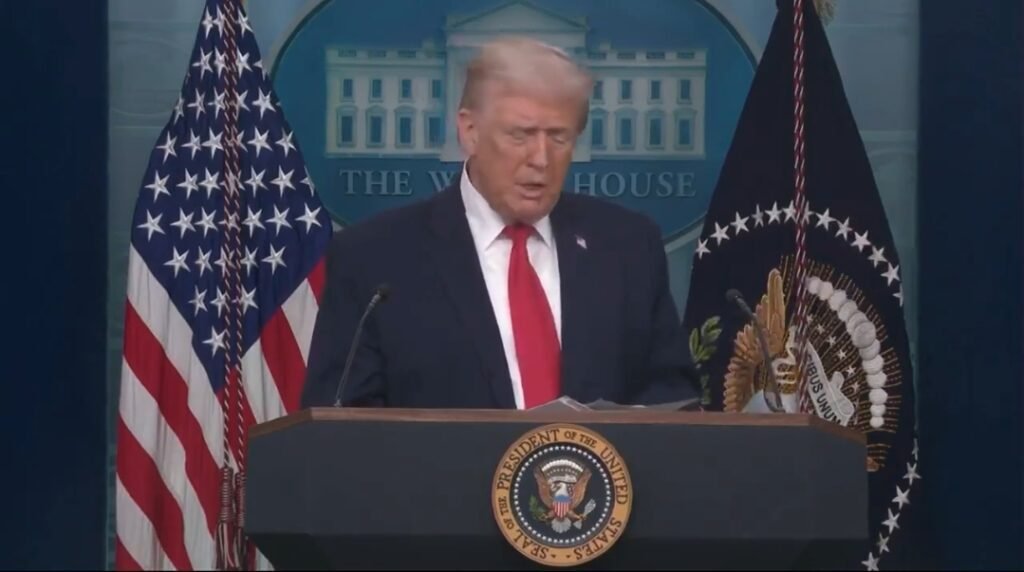
President Donald Trump has publicly attributed recent cyberattacks targeting Minnesota’s water systems to the state’s perceived incompetence, specifically criticizing its Democratic governor. This stance diverges from assessments by U.S. officials and intelligence agencies, which were investigating the potential involvement of Iran in the sophisticated breaches. The president’s remarks came during a Cabinet meeting at Camp David on Friday, where he dismissed the possibility of Iranian involvement, stating, “I don’t think so. I think, I blame it on Minnesota because they’re grossly incompetent.”
According to details received by The Chenab Times, the cyberattacks, which occurred on a Sunday and Monday, affected more than 30 water systems across Minnesota. State officials, including those from Minnesota IT Services (MNIT), were working to identify the perpetrators. The attacks targeted the operating technology of these systems, including programmable logic controllers (PLCs), which are used for remote monitoring and control of critical equipment. The Cybersecurity and Infrastructure Security Agency (CISA) had previously issued an alert highlighting the increasing threat to PLCs, noting that attackers were modifying passwords to lock out operators from U.S. water systems.
Governor Tim Walz responded sharply to President Trump’s accusations, asserting that the president was aware of the true culprits and that other states had also been targeted. Walz characterized the attacks as indicative of modern warfare and criticized the current administration’s approach to national security, particularly its alleged weakening of CISA through budget cuts. He stated, “DOGE took an axe to CISA and left the U.S. exposed to cyber attacks. Thankfully, our experts in Minnesota were able to identify the vulnerability quickly and work with local communities to stop it.”
Federal authorities, including the FBI and CISA, were actively investigating the incidents. Initial assessments from U.S. officials and intelligence agencies, as reported by various news outlets, suggested a potential link to Iranian hackers. These assessments were based on patterns of cyber activity and prior warnings about Iran’s focus on critical infrastructure, including water systems. However, sources cautioned that these were preliminary findings and could change as more technical evidence was gathered. There was also speculation that attackers might attempt to impersonate Iranian actors to exacerbate existing geopolitical tensions between the United States and Iran.
The scope of the cyber threats extended beyond Minnesota, with the FBI reporting incidents in at least seven states. While Minnesota experienced widespread disruptions affecting over 30 water systems, other affected states’ specific locations have not been publicly disclosed by the FBI. The nature of the attacks involved compromising the operational technology that controls water and wastewater facilities, leading in some instances to loss of monitoring and control functionalities, pressure drops, and even flooding.
Despite the seriousness of the cyber threats, state and local officials in Minnesota emphasized that the attacks did not compromise the safety or quality of the water supply. In affected communities, such as Braham, residents were asked to conserve water for a few hours as systems were brought back online. Plymouth, a larger city, reported that its water infrastructure communications were restored by Tuesday afternoon with no impact on water levels or quality.
The incidents have highlighted broader vulnerabilities within the U.S. water infrastructure. A report by the EPA’s Office of Inspector General in early 2025 indicated that a significant number of drinking water systems across the nation face cybersecurity risks, with many lacking basic security precautions, outdated software, and weak access controls. CISA and the EPA have collaborated to provide resources and guidance to water utilities to enhance their cybersecurity posture, including advisories on securing programmable logic controllers and improving general cyber resilience.
The Cybersecurity and Infrastructure Security Agency (CISA) had issued a warning about a substantial rise in hackers targeting technology used in water and wastewater systems. This warning came shortly after the Minnesota attacks. CISA officials noted that cyber threat actors were increasingly targeting PLCs, sometimes changing passwords to lock out operators and disconnect devices from networks. The agency urged water utilities to take immediate steps to secure their systems, including removing publicly exposed devices from the internet and updating passwords.
The attacks targeting water systems are part of a larger trend of escalating cyber threats against critical infrastructure. Threat researchers have noted that groups linked to Iran have a history of targeting such systems, driven by geopolitical motivations and the potential for causing widespread panic. The relative lack of resources and outdated technology in many local water facilities make them attractive targets for both state-sponsored actors and opportunistic hackers.
President Trump’s comments also touched upon federal cybersecurity efforts, with Governor Walz referencing alleged budget cuts to CISA under the Trump administration that he claimed weakened the nation’s defenses. This exchange underscores the ongoing political debate surrounding cybersecurity policy and resource allocation, even as federal agencies work to investigate and mitigate sophisticated cyber threats emanating from both state and non-state actors. The FBI and CISA continue to investigate the incidents, gathering technical evidence to definitively attribute the attacks and identify the responsible parties.


Global Affairs Desk at The Chenab Times covers international developments, global diplomacy, and foreign policy issues through fact-based reporting, explainers, and analytical pieces. The desk focuses on major geopolitical events, diplomatic engagements, and international trends, with an emphasis on verified information, multiple perspectives, and contextual understanding of global affairs.