


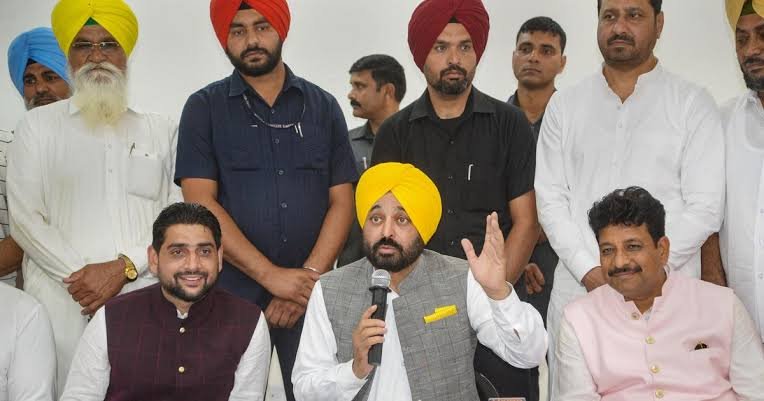
The recent Punjab government’s decision to distribute school bags bearing Chief Minister Bhagwant Mann’s photograph to students of Classes XI and XII has reignited a contentious debate in the state. This move, occurring as the state approaches Assembly elections, highlights a persistent trend of utilizing educational institutions as platforms for publicizing the achievements and image of ruling political parties.
Information was available with The Chenab Times that this is not an isolated incident. In May, the Aam Aadmi Party (AAP) government faced similar scrutiny for distributing pamphlets detailing its four-year report card during Mega Parent-Teacher Meetings. Furthermore, the painting of government schools in the party’s distinctive yellow and blue colours drew criticism from opposition parties and teachers’ organisations, who argued that such actions blurred the lines between educational welfare schemes and overt political branding.
However, the practice of political appropriation in Punjab’s schools predates the current administration. The previous Congress government also drew criticism when an examination paper for Class V incorporated an advertisement highlighting an increase in social security pensions. Students were reportedly required to answer questions based on this advertisement, a move that effectively integrated political messaging into academic assessment.
Earlier still, during the tenure of the Shiromani Akali Dal (SAD)-Bharatiya Janata Party (BJP) coalition government, the Mai Bhago Vidya Scheme, launched in 2011-12 to provide bicycles to girl students in Classes XI and XII, also became a subject of controversy. While the scheme aimed to honour the legacy of the Sikh warrior Mai Bhago, media reports indicated that the bicycles distributed bore photographs of the then Chief Minister Parkash Singh Badal. The scheme was later extended to students in Classes IX and X, with substantial funds allocated.
The consistent recurrence of these practices in Punjab raises pertinent questions about why educational initiatives and students have become a preferred channel for government outreach and political communication. Experts suggest that the strategic importance of this demographic group is linked to the state’s electoral landscape. Punjab had approximately 2.14 crore registered voters in the 2022 Assembly elections, including a significant number of first-time voters. Currently, nearly 1,16,220 students are enrolled in Classes XI and XII across the state’s 1,927 senior secondary schools.
Ronki Ram, Professor Emeritus at the Institute of Development and Communication (IDC) in Chandigarh and a former professor at Panjab University, commented on the efficacy of such methods. He explained that while carrying a photograph of the Chief Minister on government schemes serves as an important means of public communication, schools are inherently different from public spaces. “When a student carries a school bag or a book cover bearing the photograph of a political leader, the government’s message enters the home along with the child. The parents and other family members also see it, making it a useful medium for parties to convey their messages,” he stated.
Dr GC Kaul, former head of the Postgraduate Department of Punjabi at DAV College, Jalandhar, identified two key reasons for the focus on students in Classes XI and XII. He pointed out that many of these students are nearing voting age. Additionally, a substantial number of students come from economically weaker sections with limited access to resources, potentially making them more receptive to the benefits and messages conveyed through government schemes.
Vikramdev Singh, state president of the Democratic Teachers Front, expressed concern over the timing of political exposure for young students. He argued that students in Classes XI and XII are still developing their understanding of political and public issues and may not possess the critical capacity to evaluate all political messages presented to them. “Political parties want to catch them young because they are easier to influence,” Singh said.
Despite these practices, the integration of political branding into education-centric welfare schemes has not consistently translated into direct electoral gains. Historical data suggests that such initiatives do not guarantee electoral success. The SAD-BJP government, which introduced the Mai Bhago Vidya Scheme, did not secure power in the 2017 elections. Similarly, the electoral performances of other parties indicate that branding campaigns alone are insufficient to sway voters. While these efforts can indeed facilitate government outreach and publicize their work, voting decisions are ultimately influenced by a complex interplay of factors, including the government’s overall performance, pressing local issues, and the prevailing broader political environment, according to experts.


The Chenab Times News Desk