


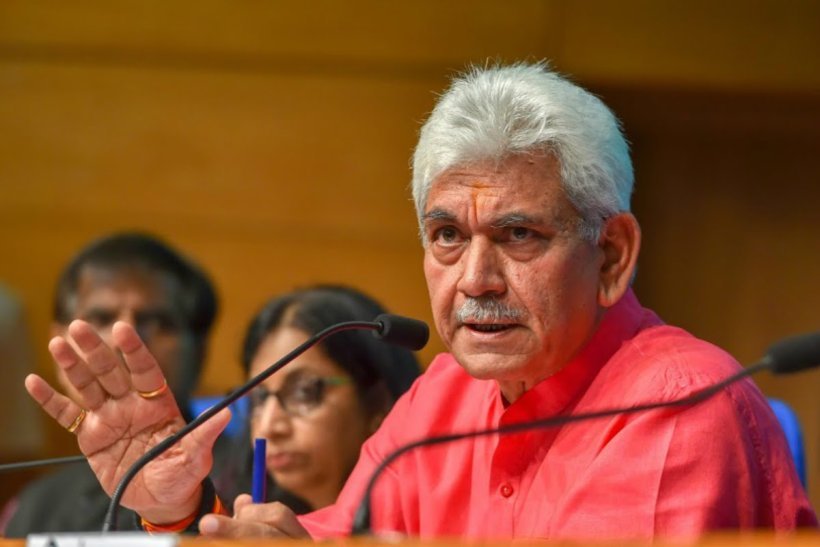
Srinagar, August 3: Lieutenant Governor Manoj Sinha has urged for the integration of nature-based solutions into development planning to bolster climate resilience across the Himalayan region, emphasizing their crucial role in mitigating the impacts of climate change.
According to details received by The Chenab Times, Sinha made these remarks while attending a conference at the Islamic University of Science & Technology (IUST) focused on strengthening climate resilience and livelihoods in the Himalayas through nature-based approaches. During the event, he also inaugurated new academic blocks at IUST’s Larmoo Campus, including facilities for Civil and Mechanical Engineering and the Law School.
The Lieutenant Governor highlighted the accelerating pace of climate change in the Himalayas, noting a significant increase in natural disasters affecting the region. He pointed out that in Jammu and Kashmir alone, flash floods and cloudbursts have led to widespread damage to public infrastructure, including roads, water supply schemes, and power feeders.
Sinha articulated that development and conservation are not mutually exclusive, asserting that natural systems themselves function as vital infrastructure. He cited watershed construction as an example of an effective flood-control system that also purifies water and supports irrigation. Similarly, he described wetlands as essential reservoirs that manage excess monsoon water and sustain surrounding areas during drier periods. He further explained that dense forested mountain slopes act as natural barriers, protecting villages from potential landslides.
“Therefore, I believe that when we destroy these natural systems, we are playing with the future. But when we conserve and restore these natural systems, we are investing in a bright future,” Sinha stated, underscoring the long-term benefits of environmental stewardship.
He called upon scientists and domain experts to elevate nature-based solutions from the periphery of development strategies to a central position. The Lieutenant Governor presented six key recommendations to policymakers, scientists, and engineers aimed at embedding these principles into regional development frameworks.
The recommendations include leveraging modern technologies such as remote sensing, geospatial mapping, and artificial intelligence to monitor environmental changes like glacier retreat, spring flow, soil health, and forest cover. This data, he stressed, should inform all development projects within the region. He also advocated for the incorporation of nature-based solutions into project budgeting, appraisal, and monitoring processes.
Furthermore, Sinha emphasized the importance of engaging farmers, shepherds, orchard owners, and tribal communities as equal stakeholders, recognizing the invaluable traditional knowledge they possess regarding local ecosystems. He proposed that annual budget reviews should assess the growth or decline of forests and ecosystems, ensuring accountability for environmental assets. The establishment of platforms for sustained collaboration among scientists, policymakers, and local communities was also recommended. He further suggested a shift from purely engineered solutions like concrete embankments towards restoring floodplains and wetlands, integrating built structures with natural systems for enhanced effectiveness.
The Lieutenant Governor also urged universities to develop nature-based solutions as a multidisciplinary subject, integrating fields such as ecology, hydrology, engineering, economics, disaster management, and traditional knowledge. He stressed the need for future professionals to grasp the interconnectedness of ecosystems, economies, technologies, and societies.
Recalling the ‘Green Jammu Kashmir Drive’ launched in 2020, which contributed to increasing forest cover to approximately 55 percent, Sinha reiterated the significance of sustainable living. He articulated a vision for a Himalayan region characterized by healthier watersheds, thriving wetlands, and naturally flowing rivers that support biodiversity and cultural heritage.
“By placing nature at the centre of development, integrating modern technology with traditional wisdom, and involving communities as equal partners, the Himalayan region can build resilience against climate change. We must remember that Himalayas are not merely a geographical entity but a living heritage that demands foresight, patience, and responsibility,” Sinha concluded.
During the event, the Lieutenant Governor also released a special edition of IUST’s magazine ‘Times Echo’ focusing on a 100-Day Anti-Drug campaign and a policy brief on the ‘Nasha Mukt Jammu Kashmir Abhiyan,’ prepared by various experts from Jammu and Kashmir. Certificates were also distributed to trainees under the Pradhan Mantri Kaushal Vikas Yojana (PMKVY).
Notable attendees at the conference included Justice Sanjeev Kumar, Chief Justice (Acting) of the High Court of Jammu Kashmir and Ladakh; Prof. Shakil A. Romshoo, Vice Chancellor of IUST; Prof. Shamim Ahmad Shah, Registrar of IUST; Prof. Javed Hussain Mir, Convener of the Conference, along with eminent scientists, experts, senior officials, faculty, and students.


The Chenab Times News Desk